


Prediction: Eli Lilly Will Be Worth $2 Trillion by 2031
Key Points
Expanding the GLP-1 market with new launches and label expansions will help Eli Lilly overcome increased competition.
The company should also develop new products in other areas while leveraging AI to reduce costs.
Eli Lilly is trading at reasonable levels relative to its growth potential.
- 10 stocks we like better than Eli Lilly ›
Eli Lilly (NYSE: LLY) made history last year when it became the first healthcare stock to hit a $1 trillion market cap. It hasn't performed that well since, due to a combination of factors, including questions about its valuation. However, the company is riding a powerful tailwind that could allow it to become a $2 trillion corporation in five years, nearly doubling from its current levels. Here is why the stock is a buy.
Image source: The Motley Fool.
Missed Nvidia in 2009? This Rare Signal Is Flashing Again. In 2009, a "Double Down" signal flashed for a little-known chipmaker called Nvidia. For the first time in years, that same "Total Conviction" signal is flashing for a company 1/100th the size of Nvidia. Continue »
The GLP-1 opportunity
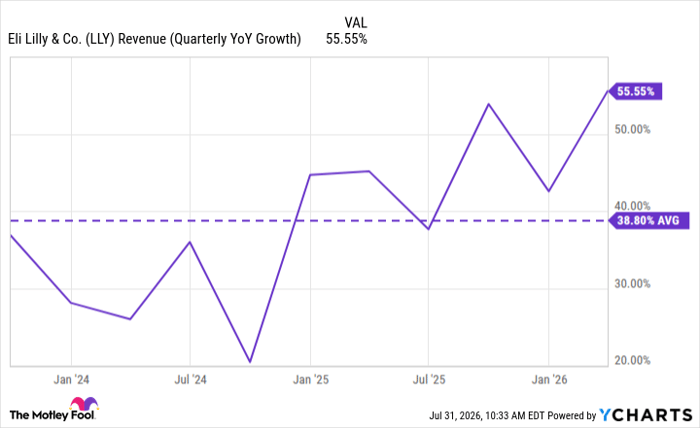
Over the past three years, Eli Lilly's revenue growth has been more comparable to that of a smaller tech corporation than to that of a major pharmaceutical giant.
LLY Revenue (Quarterly YoY Growth) data by YCharts
The company's top-line growth rates will probably decline over the next few years. Eli Lilly will face more competition in the GLP-1 market, where it generates the lion's share of its revenue. New launches will give patients more options and put pressure on the company's pricing power. So, we shouldn't expect Eli Lilly's year-over-year revenue growth to average nearly 40% over the next five years, but it should remain much higher than the average for pharmaceutical giants.
For context, revenue growth in the high teens for drugmakers of this size is already considered very strong, and Eli Lilly is likely to remain above that level. The company's tirzepatide, marketed as Mounjaro for diabetes and Zepbound for weight loss, is currently the leader in these fast-growing markets. Some analysts estimate it could hit $62 billion in annual sales by 2030, which would become the highest peak ever seen in the industry. If that sounds too optimistic, remember that tirzepatide is already the world's best-selling compound, although it has been on the market for just about four years.
It generated well over $30 billion in sales last year. It should also add important label expansions over the medium term, some of which could meaningfully move the needle. Perhaps the most promising is in metabolic dysfunction-associated steatotic liver disease, a condition that affects millions of patients and where there is a high unmet need. A label expansion here could add billions in peak annual revenue for tirzepatide. Several other new indications would be important too.
Further, Eli Lilly's portfolio also includes Foundayo, an oral GLP-1 it launched earlier this year. While it is, so far, only approved for weight loss (where it is performing well and attracting mostly new patients), it could also earn approval for many new indications, including in diabetes, obstructive sleep apnea, hypertension, and more. Then we can look at Eli Lilly's pipeline. The company boasts several promising candidates.
The most talked-about may be retatrutide, a phase 3 asset that posted weight-loss efficacy numbers that rival those typically seen in bariatric procedures. Eli Lilly will expand the GLP-1 market thanks to newer, differentiated products. Rapidly growing growing sales volume will help offset lower realized prices and allow the pharmaceutical leader's revenue growth to maintain a strong pace through the end of the decade.
Eli Lilly will make progress elsewhere
While Eli Lilly's GLP-1 portfolio will be its main driver of revenue and earnings growth, it should also launch new medicines in other areas. It has already started doing so. Recent important approvals include Kisunla for Alzheimer's disease and Omvoh for ulcerative colitis, both of which could eventually generate over $1 billion in annual sales. Eli Lilly has been on an acquisition spree and has expanded its pipeline. It now boasts promising candidates across many therapeutic areas.
By 2030, expect a large portfolio of brand-new drugs. None of them should make a massive impact on its financial results individually. Together, they could move the needle. Besides new products, Eli Lilly should also achieve productivity gains from its investments in artificial intelligence, which may allow it to reduce expenses, including those associated with discovering and developing new medicines. Even very modest gains of, say, 1% across Eli Lilly's pipeline could meaningfully impact earnings and margins.
The price is (still) right
Eli Lilly is currently trading at 34x forward earnings. That seems too high relative to the average of 18.8x for healthcare stocks, but for a company that has posted significantly higher revenue and earnings growth than similarly sized peers -- and is likely to continue doing so for the foreseeable future -- it's fair for investors to pay a steep premium. Eli Lilly will justify its valuation as it continues to post excellent financial results and makes breakthroughs in its core area of expertise and elsewhere, leading to above-average returns through 2031. The stock is currently worth $1.1 trillion. It needs a compound annual growth rate of 12.7% over the next five years to reach $2 trillion. That's within Eli Lilly's reach.
Should you buy stock in Eli Lilly right now?
Before you buy stock in Eli Lilly, consider this:
The Motley Fool Stock Advisor analyst team just identified what they believe are the 10 best stocks for investors to buy now… and Eli Lilly wasn’t one of them. The 10 stocks that made the cut could produce monster returns in the coming years.
Consider when Netflix made this list on December 17, 2004... if you invested $1,000 at the time of our recommendation, you’d have $386,727!* Or when Nvidia made this list on April 15, 2005... if you invested $1,000 at the time of our recommendation, you’d have $1,232,139!*
Now, it’s worth noting Stock Advisor’s total average return is 906% — a market-crushing outperformance compared to 208% for the S&P 500. Don't miss the latest top 10 list, available with Stock Advisor, and join an investing community built by individual investors for individual investors.
See the 10 stocks »
*Stock Advisor returns as of August 1, 2026.
Prosper Junior Bakiny has positions in Eli Lilly. The Motley Fool has positions in and recommends Eli Lilly. The Motley Fool has a disclosure policy.
Recommended Articles


