


25 Billion Reasons Why Tesla Fell 15% After Earnings
Key Points
Tesla produced record second-quarter revenue, but its free cash flow finished in the negative.
The $25 billion Tesla plans to spend this year is almost three times more than it spent last year.
Tesla's stock is by far the most expensive of the "Magnificent Seven" stocks.
- These 10 stocks could mint the next wave of millionaires ›
It's been a rough year so far for Tesla (NASDAQ: TSLA), and it got worse after it reported its second-quarter earnings on July 22. Although the company had record Q2 vehicle deliveries, produced record revenue, and achieved $100 billion in revenue over the past 12 months, its stock tanked after reporting earnings.
On the surface, there were a handful of encouraging things about Tesla's earnings, but the reason for its slump comes down to the $25 billion in capital expenditures (capex) the company is planning for this year. This follows a trend Wall Street has seen recently with many big tech and AI-related stocks.
Missed Nvidia in 2009? This Rare Signal Is Flashing Again. In 2009, a "Double Down" signal flashed for a little-known chipmaker called Nvidia. For the first time in years, that same "Total Conviction" signal is flashing for a company 1/100th the size of Nvidia. Continue »
Does Tesla have a spending issue?
A company's capex is what it spends on things such as machinery, buildings, and other infrastructure. It's a necessary expense to support growth, but sometimes, a company can take its spending too far. The $25 billion in capex that Tesla estimates for this year is much smaller than other "Magnificent Seven" companies', but it's almost triple the $8.5 billion it spent last year.
Image source: Tesla.
In Q2, Tesla's capex was $5.8 billion, up around 142% from the $2.4 billion it spent in Q2 2025. Although the increased capex isn't a surprise (it's been the theme across all big tech companies), it's obvious that investors feel as though spending is outpacing return potential, mainly because of how it's hurting free cash flow.
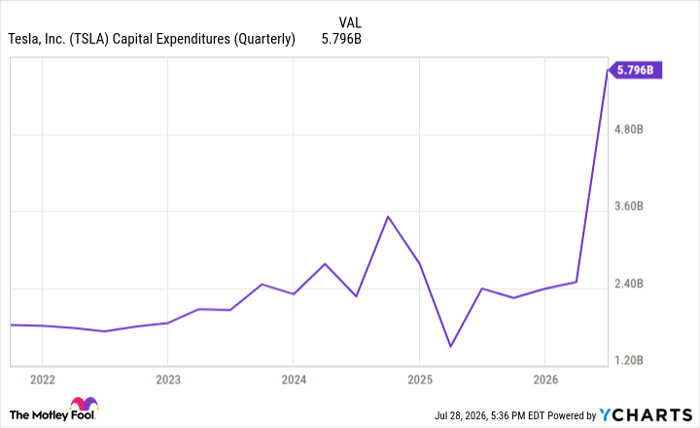
TSLA Capital Expenditures (Quarterly) data by YCharts.
The spending isn't bad in and of itself, but the alarming part for many investors was the fact that Tesla's free cash flow was negative $1.1 billion and its cash and investments decreased by $1.2 billion. You could chalk up the increased spending to being a means to an end, but there needs to be a much clearer "end" in this case.
Is Tesla's stock a buy right now?
Although Tesla is a car company at its core, its selling point isn't its electric vehicles. It's the promise of its robotaxi network and humanoid robots. Unfortunately, though, there hasn't been enough progress to justify how expensive Tesla's stock currently is.
At the time of writing, Tesla is trading at 171.1 times its projected earnings for the next 12 months, much more than any other "Magnificent Seven" stock. The next closest is Apple, trading at 38.8 times its projected earnings.
Right now, it's hard to justify investing in Tesla given how much is riding on its long-term ambitions without substantial progress toward them. That doesn't make it a bad company -- just a not-so-good stock to invest in right now.
Don’t miss this second chance at a potentially lucrative opportunity
Ever feel like you missed the boat in buying the most successful stocks? Then you’ll want to hear this.
On rare occasions, our expert team of analysts issues a “Double Down” stock recommendation for companies that they think are about to pop. If you’re worried you’ve already missed your chance to invest, now is the best time to buy before it’s too late. And the numbers speak for themselves:
- Nvidia: if you invested $1,000 when we doubled down in 2009, you’d have $511,613!*
- Apple: if you invested $1,000 when we doubled down in 2008, you’d have $64,817!*
- Netflix: if you invested $1,000 when we doubled down in 2004, you’d have $390,394!*
Right now, we’re issuing “Double Down” alerts for three incredible companies, available when you join Stock Advisor, and there may not be another chance like this anytime soon.
See the 3 stocks »
*Stock Advisor returns as of July 30, 2026.
Stefon Walters has positions in Apple. The Motley Fool has positions in and recommends Apple and Tesla. The Motley Fool has a disclosure policy.
Recommended Articles


