


Inflation and Retirement -- Why 2026 Fears May Be Overblown for Investors
Key Points
Inflation is certainly a factor in retirement planning, but it may not play as large a role as you imagine.
Due in part to inflation, Americans believe they need $1.2 million to retire comfortably.
Some 70% of respondents in one survey believe it's important not to spend their nest egg down.
- 10 stocks we like better than iShares Trust - iShares Core High Dividend ETF ›
High inflation has affected everyone in the U.S., from young parents shopping for school supplies to retirees living on a fixed income. It's also left retirees particularly worried about whether rising prices will rapidly erode their income and savings.
However, David Blanchett, head of retirement research at Prudential Financial, argues that the long-term impact of inflation on retirement portfolios may be less severe than many imagine. In a LinkedIn post, Blanchett wrote: "Don't get me wrong here, I'm not trying to say that inflation isn't important, but I think there is a bit of a disconnect between consumer/retiree perceptions of inflation and the actual risk when it comes to retirement."
Where to invest $1,000 right now? Our analyst team just revealed what they believe are the 10 best stocks to buy right now, when you join Stock Advisor. See the stocks »
Here's more on his thinking and what it may mean for retirees.
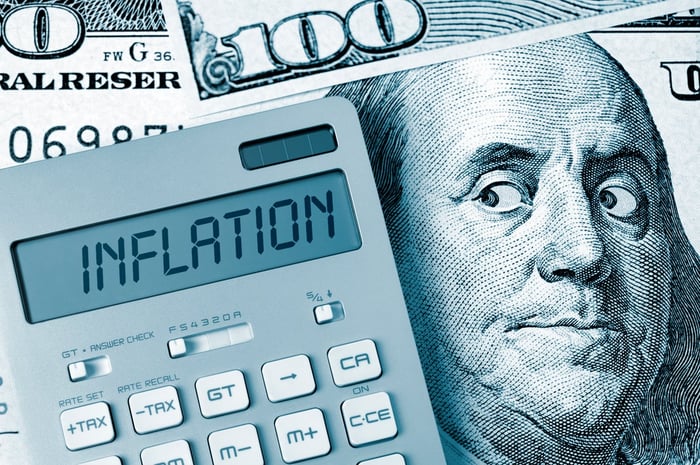
Image source: Getty Images.
The common assumption
Most retirement planning tools, including those used by financial advisors, assume your spending in retirement will grow each year in lockstep with inflation. After analyzing real retirement spending data, Blanchett found the opposite to be true. Usually, spending declines over time in retirement -- even among affluent retirees who could easily afford to spend more.
While 33% of Americans have more credit card debt than retirement savings, a recent poll from Schroders found that those currently participating in a workplace retirement plan believe they need $1.2 million to retire comfortably. The assumption that retirement spending grows at the same pace as inflation may well factor into that belief.
Spending "smile" vs. spending "smirk"
In earlier work, Blanchett introduced the idea of a retirement spending "smile." Higher spending in the early years gives way to a dip in the middle as spending slows, then rises again as health and long-term costs mount.
Blanchett now finds that for the median retiree, the pattern looks more like a "smirk." Spending is relatively strong early on, but then trends downward, often without a large spike late in life. While healthcare costs do rise for some, many retirees find that higher medical expenses are roughly offset by lower spending on travel, hobbies, and other discretionary categories.
Could this make inflation less scary?
According to Blanchett, a retiree who understands that they're likely to spend less later in life can safely spend more early in retirement. Still, the idea of spending is terrifying for many retirees, no matter how much they have put away. All the "what ifs" can lead to being far more conservative than necessary, and possibly missing out on valuable life experiences, like travel.
Only 28% of older adults are comfortable with the idea of spending their retirement savings, according to Corebridge Financial research. In fact, 70% say it's very important that their nest egg does not shrink -- and part of that concern is likely due to fears about inflation.
There are steps you can take to lessen the fear of inflation in retirement. For example:
- Invest now in a dividend-paying index fund, like iShares Core High Dividend ETF (NYSEMKT: HDV). The regular income stream could help offset inflation's impact on your budget.
- Create a cash fund with the sole purpose of allowing yourself to skip retirement account withdrawals during periods of high inflation. The goal is to build a buffer that you can easily access when needed. For example, consider a money market account, certificate of deposit, or high-interest savings account.
If you find yourself worrying excessively about inflation, Blanchett's research indicates that your fears may be overblown.
Should you buy stock in iShares Trust - iShares Core High Dividend ETF right now?
Before you buy stock in iShares Trust - iShares Core High Dividend ETF, consider this:
The Motley Fool Stock Advisor analyst team just identified what they believe are the 10 best stocks for investors to buy now… and iShares Trust - iShares Core High Dividend ETF wasn’t one of them. The 10 stocks that made the cut could produce monster returns in the coming years.
Consider when Netflix made this list on December 17, 2004... if you invested $1,000 at the time of our recommendation, you’d have $369,577!* Or when Nvidia made this list on April 15, 2005... if you invested $1,000 at the time of our recommendation, you’d have $1,301,557!*
Now, it’s worth noting Stock Advisor’s total average return is 908% — a market-crushing outperformance compared to 208% for the S&P 500. Don't miss the latest top 10 list, available with Stock Advisor, and join an investing community built by individual investors for individual investors.
See the 10 stocks »
*Stock Advisor returns as of July 23, 2026.
Dana George has no position in any of the stocks mentioned. The Motley Fool has no position in any of the stocks mentioned. The Motley Fool has a disclosure policy.
Recommended Articles


