


A Strange Pairing Between Stellantis and Carvana Is a Match Made in Heaven
Key Points
Carvana entering the new-car business is about much more than new-car sales.
Carvana's move will open new and lucrative revenue streams for its traditional business.
Stellantis' massive $70 billion global turnaround could make it the perfect partner with a long list of upcoming launches and brand investment.
- 10 stocks we like better than Carvana ›
Carvana (NYSE: CVNA) turned many investors' heads when it began scooping up brick-and-mortar dealerships recently. The strategic move seemed to go against the entire company's vision of online used-car sales (we'll get into that in a second). A smaller detail many overlooked was that Carvana opted to buy Stellantis (NYSE: STLA) dealerships primarily, a strange decision given the automaker's long list of recent struggles and receding market share. That said, this strange pairing might just be a match made in heaven for Carvana, and here's why.
What's going on?
At first glance, Carvana scooping up physical dealerships goes against its historic strategy, but in reality, it's attempting to disrupt the age-old dealership model as we know it. As it attempts this strategic pivot, there's also reason to believe the synergy created could reward investors.
Where to invest $1,000 right now? Our analyst team just revealed what they believe are the 10 best stocks to buy right now, when you join Stock Advisor. See the stocks »
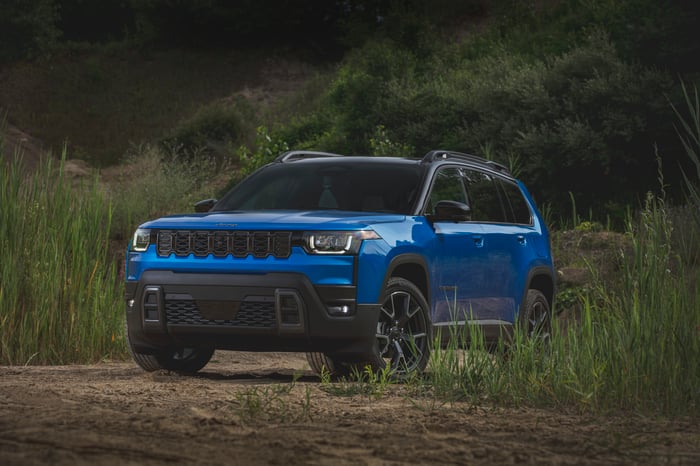
Jeep will play a big role in reversing market share losses. Image source: Stellantis.
Carvana's physical dealerships still won't sell you a vehicle in person; instead, they're for test drives, showing car capabilities, and helping consumers buy from a larger selection online. What this strategy also does is give Carvana control of the entire trade-in lifecycle. One of the more challenging aspects for Carvana was bringing in valuable used-vehicle inventory. Controlling dealerships that allow consumers to bring trade-in vehicles when purchasing new ones gives Carvana a bloodline of used-vehicle inventory to boost its historical business.
Another aspect of this strategy is that Carvana's acquired dealerships still plan to use the service bay as usual, potentially unlocking additional service revenue from its consumer base that may want to continue doing business with Carvana. What some investors aren't aware of is that while new and used vehicles drive dealerships' top-line revenue, the most profitable aspects, by a large margin, are service and parts, and finance and insurance. Carvana is unlocking the bread-and-butter of dealerships that its traditional online-only business lacked: high-margin maintenance and repair.
The initial results are incredibly intriguing, with its Arizona store booming in sales and becoming a top-selling dealership. More specifically, according to reports from The Wall Street Journal, Carvana's recently purchased Arizona dealership went from averaging 30 to 50 monthly sales to selling more than 700 new vehicles in May, according to Stellantis figures given to CNBC.
Here's why it's a great match
While Stellantis would surely benefit from increased sales across many dealerships, the match is primarily important to Carvana. That's because, at least initially, Carvana has chosen to make Stellantis dealerships its primary purchase. The question is why. The old saying "Buy low, sell high" is a fitting one for this scenario. Stellantis has experienced executive turnover, including the appointment of a new CEO, and it recently unveiled a massive $70 billion global turnaround plan with a strong focus on North America.
Stellantis has faced seemingly endless questions over the past few years about its product decisions, shrinking product lineups, receding market share, delayed launches, and uncertainty about the future of some of its many brands. That story is likely to change over the next five years as 11 new vehicles are headed to the U.S. market as Stellantis is committing 70% of its future investment into four primary brands. Two of them -- Ram and Jeep -- are focused on turning around Stellantis' North America market.
Furthermore, a growing concern has been rising new-car prices. Some analysts have called this an affordability crisis. This gives Stellantis, and by extension Carvana, the opportunity to quickly boost sales from the growing consumer demand for more affordable vehicles. In fact, at least nine upcoming models are targeting launch prices starting under $40,000, and two are targeting under $30,000. Stellantis' reduced focus on less-profitable, typically pricier electric vehicles (EVs) could also help Carvana's early efforts in the new-car business.
What it all means for Stellantis and Carvana
At the same time, Stellantis' struggles have given Carvana an opportunity to purchase dealerships at lower prices than in the past. It also strategically pivots to a company putting up tens of billions to revive market share, product lineups, and brand identity. You could argue that Stellantis, because of its massive investment and potential turnaround, could be the best dealership partner over the next five years as Carvana fine-tunes its new strategy to disrupt the industry.
It's certainly a strange pairing, considering Carvana's history of used-car and online-only sales, but it might just be a match made in heaven over the next five years, especially if early results continue. As far as these two companies go, this is a much bigger deal for Carvana. Not only is it perhaps timing the brands of physical dealerships perfectly, considering Stellantis' upcoming massive investment in product and branding, Carvana opening the doors to new-car sales will give it entirely new revenue and profit streams, including servicing that is higher margin, that its historical business has lacked. If Carvana executes its strategy and disrupts the new-car dealership model, its earnings and stock price could soar over the next five years.
Should you buy stock in Carvana right now?
Before you buy stock in Carvana, consider this:
The Motley Fool Stock Advisor analyst team just identified what they believe are the 10 best stocks for investors to buy now… and Carvana wasn’t one of them. The 10 stocks that made the cut could produce monster returns in the coming years.
Consider when Netflix made this list on December 17, 2004... if you invested $1,000 at the time of our recommendation, you’d have $370,332!* Or when Nvidia made this list on April 15, 2005... if you invested $1,000 at the time of our recommendation, you’d have $1,272,280!*
Now, it’s worth noting Stock Advisor’s total average return is 904% — a market-crushing outperformance compared to 208% for the S&P 500. Don't miss the latest top 10 list, available with Stock Advisor, and join an investing community built by individual investors for individual investors.
See the 10 stocks »
*Stock Advisor returns as of July 22, 2026.
Daniel Miller has no position in any of the stocks mentioned. The Motley Fool recommends Stellantis. The Motley Fool has a disclosure policy.
Recommended Articles


