


TSMC Just Increased Its Investment in America by $100 Billion. Here's What That Means for the AI Semiconductor Stock Trade.
Key Points
The company plans to spend an additional $100 billion at its Arizona facilities.
Revenue is currently growing 34% year over year, with record capital expenditures planned for 2026.
Shares of the stock are at an interesting point in the middle of the AI infrastructure boom and could be risky to buy right now.
- 10 stocks we like better than Taiwan Semiconductor Manufacturing ›
The resurgence of manufacturing in the United States is beginning to center on an unlikely location: Arizona. Phoenix is going to receive a massive $265 billion investment in manufacturing facilities from Taiwan Semiconductor Manufacturing (NYSE: TSM), which recently announced a $100 billion spending increase over its original plan.
As the leader in advanced semiconductor technologies, TSMC, as the company is known, is becoming the poster child not only for the artificial intelligence (AI) trade but also for the United States' reshoring initiative. Here's what this latest announcement means for AI stocks, and whether TSMC is a buy right now.
Where to invest $1,000 right now? Our analyst team just revealed what they believe are the 10 best stocks to buy right now, when you join Stock Advisor. See the stocks »
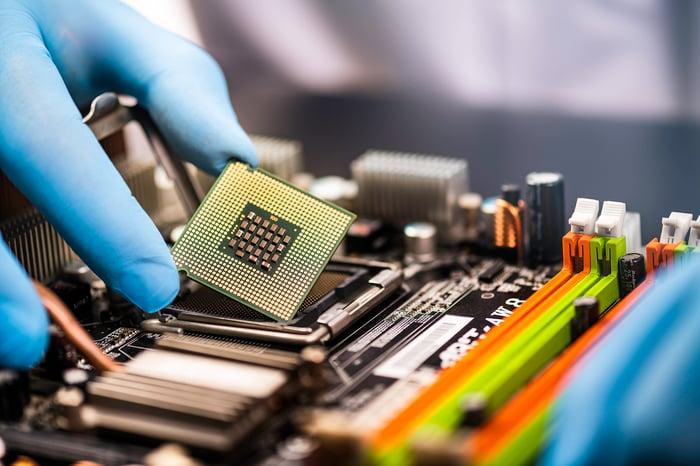
Image source: Getty Images.
Betting big on America
In conjunction with the United States government and its major customers, including Apple and TSMC, TSMC made a major bet to diversify its manufacturing away from Taiwan, which is facing potential threats from China.
There were fears that relocating facilities to a new area could undermine TSMC's expertise in advanced chipmaking, but reports have claimed that the Arizona facilities are producing yields similar to those in Taiwan. That's great news for TSMC and the reshoring theme in the United States. The company is producing 4-nanometer chips in Arizona, which are close to its most advanced technologies available today. This new $100 billion increase will be for even more advanced semiconductor manufacturing processes.
Last quarter, TSMC's revenue grew 34% year over year to $40 billion, driven by insatiable demand for chips from AI companies. As more of these facilities in Arizona and Taiwan come online, they will help supply this chip demand.
Managing the AI boom
TSMC's capital expenditures were a record $48.5 billion over the past 12 months. Customers want it to increase capital spending further so AI chips can get out the door, and management has answered their call with plans to spend $60 billion or more in 2026 on new facilities. At the same time, it still generated record free cash flow of $40 billion over the past 12 months, driven by the high prices it achieved through advanced AI chipmaking.
This capital spending should flow through both directions of the semiconductor supply chain, to TSMC customers such as Nvidia and to equipment suppliers for manufacturing, such as ASML.
Over the next few years, investors may worry that this increase in capacity will eventually lead to oversupply. But for the time being, it looks as if the revenue growth party for AI semiconductor stocks will continue.
Is TSMC stock a buy?
Despite this record financial performance, TSMC stock is down 15% from recent highs. It generated an operating margin of 60% last quarter and should see more impressive revenue growth in the quarters ahead.
Right now, TSMC stock trades at a price-to-earnings ratio (P/E) of 29. To determine whether this figure is expensive, investors need to analyze their expectations for future semiconductor demand from AI infrastructure companies.
Further 34% revenue growth and sky-high profit margins could help TSMC's P/E ratio get cheaper quickly. On the other hand, if spending on AI computer chips peaks, the company may be spending massive amounts on new facilities into a demand cliff, leading not only to a decrease in revenue but also to a collapse in profit margins.
Historically, the semiconductor industry has been cyclical, yet driven by long-term secular growth. Any downcycle would probably lead to a fall in TSMC's share price, as it has many times in its history. Or AI could be a new paradigm for the computer chip market, eliminating its cyclicality.
Unless you believe the latter, investors today would be smart to avoid buying TSMC stock. It's already trading at a high earnings ratio after years of rapid revenue growth and profit margin expansion.
Should you buy stock in Taiwan Semiconductor Manufacturing right now?
Before you buy stock in Taiwan Semiconductor Manufacturing, consider this:
The Motley Fool Stock Advisor analyst team just identified what they believe are the 10 best stocks for investors to buy now… and Taiwan Semiconductor Manufacturing wasn’t one of them. The 10 stocks that made the cut could produce monster returns in the coming years.
Consider when Netflix made this list on December 17, 2004... if you invested $1,000 at the time of our recommendation, you’d have $370,332!* Or when Nvidia made this list on April 15, 2005... if you invested $1,000 at the time of our recommendation, you’d have $1,272,280!*
Now, it’s worth noting Stock Advisor’s total average return is 904% — a market-crushing outperformance compared to 208% for the S&P 500. Don't miss the latest top 10 list, available with Stock Advisor, and join an investing community built by individual investors for individual investors.
See the 10 stocks »
*Stock Advisor returns as of July 22, 2026.
Brett Schafer has no position in any of the stocks mentioned. The Motley Fool has positions in and recommends ASML, Apple, Nvidia, and Taiwan Semiconductor Manufacturing. The Motley Fool has a disclosure policy.
Recommended Articles


