


1 eVTOL Stock to Buy, and 1 to Avoid
Key Points
Joby Aviation leads the eVTOL race with stronger execution.
Archer still faces significant execution and commercialization risks.
Buy Joby stock today and watch Archer from the sidelines.
- 10 stocks we like better than Joby Aviation ›
The electric vertical takeoff and landing (eVTOL) industry is no longer just a collection of futuristic concepts. Several companies now have aircraft in advanced testing, regulators are actively working toward certification, and commercial launches are beginning to take shape.
Of course, that doesn't mean every eVTOL stock deserves a place in your portfolio. But if I had to choose one today, I'd buy Joby Aviation (NYSE: JOBY) and avoid Archer Aviation (NYSE: ACHR).
Where to invest $1,000 right now? Our analyst team just revealed what they believe are the 10 best stocks to buy right now, when you join Stock Advisor. See the stocks »
Buy: Joby Aviation
Joby has consistently stayed ahead of nearly every competitor in the industry. To date, the company has completed more than 50,000 miles of test flights, making it one of the most tested eVTOL developers in the world. It's also steadily progressing through the Federal Aviation Administration's (FAA) certification process, which remains the biggest hurdle before commercial service can begin.
Earlier this year, Joby began flying its first FAA-conforming production aircraft. This is a big deal because it's built to the same standards regulators expect for commercial certification. Joby isn't just building aircraft at this point. It's actively building an operating business.
The company currently has partnerships with Delta Air Lines to launch airport shuttle services in New York and Los Angeles and with Virgin Atlantic to bring similar services to the United Kingdom. It also acquired Uber Elevate several years ago, giving it an established software platform and customer relationships that should help commercial operations.
International expansion is underway, too. Joby has completed demonstration flights in Japan and the United Arab Emirates and expects Dubai to become one of its first commercial markets.
A healthy balance sheet
At the end of Q1, 2026, Joby reported approximately $1.1 billion in cash, cash equivalents, and investments. That gives management a lot of flexibility as it works toward commercialization without immediately returning to capital markets.
Yes, it's true that Joby is still losing money. Revenue remains minimal, and profitability is likely several years away. But among publicly traded eVTOL companies, Joby appears to have the strongest combination of technology, certification progress, strategic partnerships, and financial resources.
Avoid: Archer Aviation
Archer has made meaningful progress over the past year, but there are still some pretty serious execution risks. Indeed, the company has generated excitement through high-profile partnerships with United Airlines, Stellantis, and the U.S. military. Its Midnight aircraft continues to advance through flight testing, too.
Those are legitimate strengths, but the problem is that much of Archer's valuation already assumes successful execution. And like Joby, Archer has yet to generate meaningful commercial revenue. Its business still depends on obtaining FAA certification, scaling manufacturing, building charging infrastructure, training pilots, and convincing customers to adopt an entirely new transportation model. That's a long list of things that all have to go right.
Financially, Archer remains well funded, reporting roughly $1.7 billion in cash and cash equivalents. But scaling an aerospace manufacturing business isn't cheap. Production delays, certification setbacks, or slower-than-expected customer adoption could force additional fundraising and dilute existing shareholders.
There's also another concern. Unlike Joby, which intends to operate much of its own air taxi network, Archer relies more heavily on partners to commercialize its aircraft. That model could ultimately work, but it also gives Archer less direct control over customer relationships and long-term operating economics.
The better long-term investment
The eVTOL market has enormous potential. Morgan Stanley has estimated the industry could eventually exceed $1 trillion as urban air mobility expands into passenger transportation, cargo delivery, defense, and emergency services.
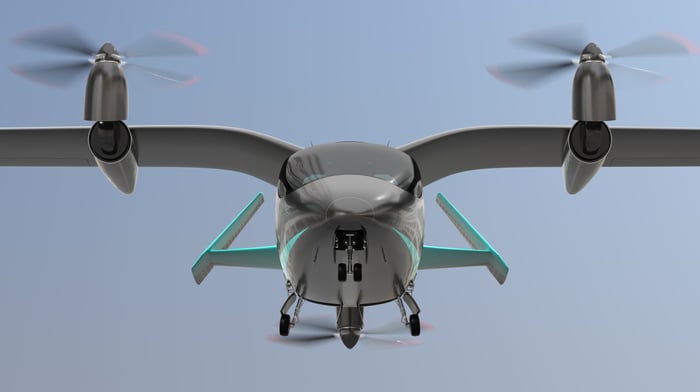
Image source: Getty Images.
But don't confuse a promising industry with guaranteed winners. Joby appears to have established an early lead where it matters most: certification progress, operational testing, international expansion, and commercial partnerships. It also has one of the strongest balance sheets in the sector, reducing the likelihood of near-term shareholder dilution.
Archer could certainly become a successful company over time. If management executes flawlessly, today's valuation may eventually prove justified. But investing isn't about identifying companies that can succeed. It's about identifying companies with the highest probability of success. Today, Joby checks more of those boxes.
If you're looking for exposure to the growing eVTOL market, I'd buy Joby Aviation and leave Archer Aviation on the watch list until it proves it can turn promising technology into a sustainable business.
Should you buy stock in Joby Aviation right now?
Before you buy stock in Joby Aviation, consider this:
The Motley Fool Stock Advisor analyst team just identified what they believe are the 10 best stocks for investors to buy now… and Joby Aviation wasn’t one of them. The 10 stocks that made the cut could produce monster returns in the coming years.
Consider when Netflix made this list on December 17, 2004... if you invested $1,000 at the time of our recommendation, you’d have $364,562!* Or when Nvidia made this list on April 15, 2005... if you invested $1,000 at the time of our recommendation, you’d have $1,247,668!*
Now, it’s worth noting Stock Advisor’s total average return is 894% — a market-crushing outperformance compared to 207% for the S&P 500. Don't miss the latest top 10 list, available with Stock Advisor, and join an investing community built by individual investors for individual investors.
See the 10 stocks »
*Stock Advisor returns as of July 21, 2026.
Jeff Siegel has no position in any of the stocks mentioned. The Motley Fool recommends Delta Air Lines and Stellantis. The Motley Fool has a disclosure policy.
Recommended Articles


