


Lemonade Is Keeping More of Its Own Insurance Risk. Is That a Sign of Confidence or a Red Flag?
Key Points
Lemonade has been leveraging artificial intelligence as it takes on legacy insurance companies.
The stock has experienced significant volatility since its 2020 initial public offering.
Lemonade's underwriting models have improved in recent years, and its recent move signals growing confidence in its underwriting capabilities.
- 10 stocks we like better than Lemonade ›
Long before artificial intelligence (AI) went mainstream with tools like OpenAI's ChatGPT, Lemonade (NYSE: LMND) harnessed AI to rethink insurance. From simplifying the process of purchasing coverage to streamlining claims processing, Lemonade made waves across the insurance industry when it went public in 2020.
It's been a bumpy ride for Lemonade investors, who saw the stock surge to $188 per share following its public debut, only to fall to around $10 per share in late 2023. Lately, the company has found its footing, seeing progress in its underwriting models, and has decided to trust them and transfer less risk to its reinsurer.
Where to invest $1,000 right now? Our analyst team just revealed what they believe are the 10 best stocks to buy right now, when you join Stock Advisor. See the stocks »
With Lemonade reducing its reinsurance coverage, investors may be wondering whether this signals confidence in its improving models or a warning that extra risk may not be worth the squeeze. Let's dive into the numbers to find out.

Image source: The Motley Fool.
Lemonade's AI-driven insurance business is making strides
Lemonade has spent the past several years upending the insurance industry with its AI-centric business model. The company has taken many traditional insurance practices -- from pricing, claims, and customer service -- and incorporated AI into them to automate processes, lower operating costs, and improve underwriting capabilities.
The insurance industry is notoriously difficult to break into because legacy competitors have major competitive advantages through decades of accumulated risk data, established distribution networks, and recognized brand names. Because competition in the space is fierce, companies must navigate an environment in which they can price risk appropriately to build their customer base while maintaining prudent risk management.
In recent years, Lemonade has made tremendous progress in improving its gross loss ratio, which measures losses and loss adjustments (claims costs) relative to gross earned premiums. In the first quarter, Lemonade's 62% gross loss ratio was a drastic improvement from 83% in Q1 2024 and 73% in the first quarter of last year.
Here's why Lemonade's recent move matters to investors
As Lemonade's AI-driven underwriting improves, the company has reduced its quota-share reinsurance transfer (ceded premiums) from 20% of gross written premiums to 18%. Reinsurance is used by insurance companies to transfer a portion of risk to other insurers, and on July 1, the company renegotiated its reinsurance agreement to retain more risk.
Lemonade accomplished this while strengthening protection against the most severe catastrophe scenarios, suggesting management and its reinsurer are more confident in its underwriting and willing to assume more ordinary insurance risk without increasing exposure to extreme losses.
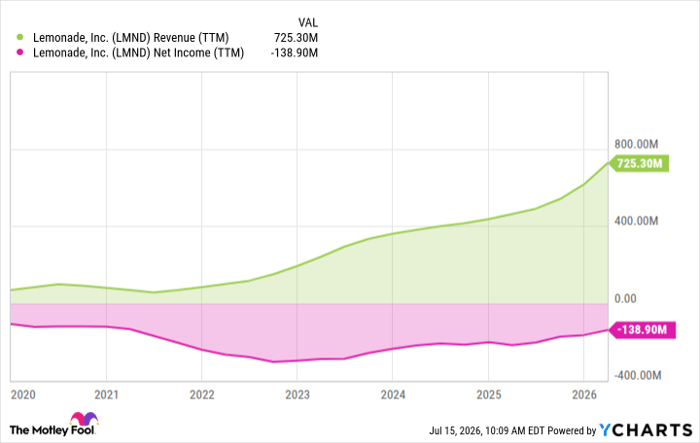
Data by YCharts.
For investors, the move exposes Lemonade to additional risks but also indicates that the company is growing into a more mature insurer, as it trusts its AI-driven underwriting to deliver more consistent results. The company still needs to improve its overall profitability, but with its improving loss ratio and higher retained premiums, Lemonade looks like a promising insurance growth stock with long-term upside potential.
Should you buy stock in Lemonade right now?
Before you buy stock in Lemonade, consider this:
The Motley Fool Stock Advisor analyst team just identified what they believe are the 10 best stocks for investors to buy now… and Lemonade wasn’t one of them. The 10 stocks that made the cut could produce monster returns in the coming years.
Consider when Netflix made this list on December 17, 2004... if you invested $1,000 at the time of our recommendation, you’d have $397,351!* Or when Nvidia made this list on April 15, 2005... if you invested $1,000 at the time of our recommendation, you’d have $1,304,257!*
Now, it’s worth noting Stock Advisor’s total average return is 934% — a market-crushing outperformance compared to 210% for the S&P 500. Don't miss the latest top 10 list, available with Stock Advisor, and join an investing community built by individual investors for individual investors.
See the 10 stocks »
*Stock Advisor returns as of July 16, 2026.
Courtney Carlsen has no position in any of the stocks mentioned. The Motley Fool has positions in and recommends Lemonade. The Motley Fool has a disclosure policy.
Recommended Articles


