


Alex Karp Grouped Palantir With These 3 Unstoppable Stocks as the Only True Artificial Intelligence (AI) Infrastructure Winners
Key Points
Palantir develops a suite of AI software tools used by large corporations and government agencies.
Nvidia is the biggest supplier of GPUs for hyperscale AI data centers.
Micron and SK Hynix are market leaders in high-bandwidth memory and DRAM solutions.
- 10 stocks we like better than Palantir Technologies ›
Palantir Technologies (NASDAQ: PLTR) CEO Alex Karp recently highlighted a small cohort of companies as the true standouts of the artificial intelligence (AI) infrastructure build-out. He placed Palantir alongside Nvidia (NASDAQ: NVDA), Micron Technology (NASDAQ: MU), and SK Hynix (NASDAQ: SKHY) as the only names that truly matter in this new era.
Admittedly, this list feels mismatched upon first glance. Nvidia supplies the GPUs that train and run AI models, while Micron and SK Hynix dominate the memory side of the equation. Palantir sits further downstream, providing the software layer that turns raw data into actionable intelligence.
Where to invest $1,000 right now? Our analyst team just revealed what they believe are the 10 best stocks to buy right now, when you join Stock Advisor. See the stocks »
What could tie these four different businesses together? The answer is a single financial benchmark that reveals how each company is delivering both rapid growth and expanding profitability at the same time.

Image source: Palantir Technologies.
What is the Rule of 40?
The Rule of 40 is a simple yet useful tool for assessing whether a high-growth technology company is building a durable business. It is calculated by adding a company's annual revenue growth rate to its operating profit margin.
As a rule of thumb, a sum above 40 is considered the threshold at which growth and profitability reinforce each other rather than compete. This means companies that clear this hurdle can feasibly reinvest in the business while still generating healthy bottom-line results.
Throughout the AI revolution, Palantir's Rule of 40 score has climbed exponentially. During the first quarter of 2025, the company's Rule of 40 score was 83%. One year later, it soared to 145%.
The improvement comes from two reinforcing trends. First, Palantir's revenue is accelerating as more commercial customers adopt its Artificial Intelligence Platform (AIP). Second, operating margin is expanding because the company can spread its fixed development and sales costs across a larger, growing revenue base. This means that new customers add incremental revenue with relatively little extra cost, improving profitability in tandem with sales growth.
This virtuous cycle is exactly what the Rule of 40 is designed to capture, and Palantir's consistent progress proves the company is executing on both fronts at once.
Why Nvidia, Micron, SK Hynix, and Palantir all generate strong Rule of 40 scores
Despite operating in different parts of the AI stack, these four companies share two traits that drive leading Rule of 40 performance: surging revenue tied directly to insatiable AI demand and meaningful operating leverage that turns accelerating sales into outsize profit.
Nvidia's revenue has exploded because its GPUs are the default engines for AI training and inference in hyperscale data centers. Micron and SK Hynix enjoy parallel tailwinds as AI workloads require ever-larger amounts of specialized high-bandwidth memory (HMB). Without enough memory, even the most capable GPU clusters hit latency issues. Palantir's growth stems from corporations and government agencies needing software to organize siloed data sets used to feed AI systems and to turn model outputs into operational decisions.
Operating leverage compounds the effect. Each business requires significant up-front capital outlays for research, chip fabrication, and software development. But once those investments are in place, new revenue flows through the business with high incremental margins.
Nvidia can sell more GPUs without proportionally increasing its core design expenses. Memory producers invest in improving factory utilization rates to spread fixed costs across higher sales volumes. Meanwhile, Palantir's software model leverages the fact that the cost to acquire a new customer or expand use cases within an existing client is nominal once AIP is integrated.
The result across all four companies is the same: Revenue growth and profit margins rise together, producing a Rule of 40 score that stands out even in a crowded AI landscape.
Which of these four companies should you invest in right now?
Among the four stocks explored in this piece, I think Nvidia offers the most compelling risk-reward profile. The company's forward price-to-earnings (P/E) ratio looks reasonable when measured against its expected growth, considering its position spans the entire AI compute layer -- from chips to networking equipment and the surrounding software ecosystem. This breadth gives Nvidia multiple levers to benefit as AI capex accelerates.
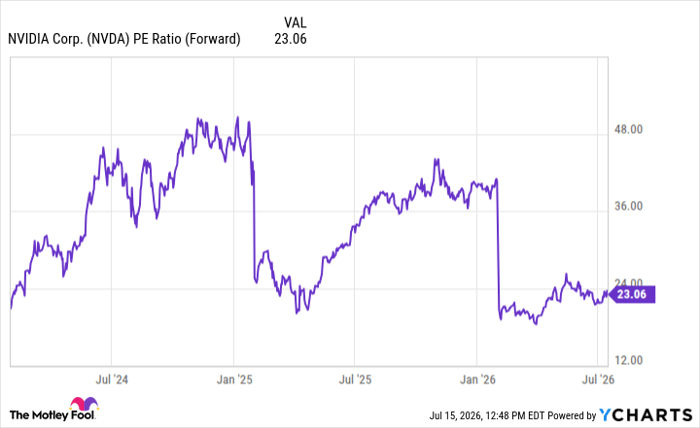
NVDA PE Ratio (Forward) data by YCharts
Palantir trades at a richer valuation that already prices in high expectations for continued commercial acceleration. While its Rule of 40 trajectory is impressive, the stock leaves little margin of safety if growth rates moderate. While Micron and SK Hynix are essential memory suppliers, their role is narrower within the broader AI chip stack. In other words, they do not control the foundational compute architecture in the same way Nvidia does.
Nevertheless, all four companies are well-positioned for the multiyear AI infrastructure build-out. Their shared ability to generate both accelerating revenue growth and expanding profit margins makes them natural complements rather than competing alternatives. A diversified AI-themed portfolio that includes exposure to compute, memory, and platform leaders will capture the full scope of AI infrastructure spending while balancing the unique risks and opportunities each company carries.
Should you buy stock in Palantir Technologies right now?
Before you buy stock in Palantir Technologies, consider this:
The Motley Fool Stock Advisor analyst team just identified what they believe are the 10 best stocks for investors to buy now… and Palantir Technologies wasn’t one of them. The 10 stocks that made the cut could produce monster returns in the coming years.
Consider when Netflix made this list on December 17, 2004... if you invested $1,000 at the time of our recommendation, you’d have $397,351!* Or when Nvidia made this list on April 15, 2005... if you invested $1,000 at the time of our recommendation, you’d have $1,304,257!*
Now, it’s worth noting Stock Advisor’s total average return is 934% — a market-crushing outperformance compared to 210% for the S&P 500. Don't miss the latest top 10 list, available with Stock Advisor, and join an investing community built by individual investors for individual investors.
See the 10 stocks »
*Stock Advisor returns as of July 16, 2026.
Adam Spatacco has positions in Nvidia and Palantir Technologies. The Motley Fool has positions in and recommends Micron Technology, Nvidia, and Palantir Technologies. The Motley Fool has a disclosure policy.
Recommended Articles


