


Micron (MU) Stock Crashes Below $910 as China’s CXMT Plans an $8.5B IPO; Is the DRAM Bull Cycle Cracking?
TradingKey - Micron Technology (NASDAQ: MU) has slumped to a price of $904.28 after dropping 6.96% on July 15, driven by a "perfect storm" of two new threats: Chinese memory maker CXMT revealed an $8.5 billion IPO plan to expand domestic DRAM manufacturing and U.S. government officials hinted that they are planning export restrictions on high-bandwidth memory. The two events combined put a lid on Micron’s two bull case catalysts: pricing power and demand visibility. MU is now approaching its 50-day EMA at around $902, which serves as the first line of support. Below that level, $869 represents the next major floor. KeyBanc on Monday updated its price target to $1,750 from $1,600, citing that the memory environment will remain tight through 2027.
CXMT’s $8.5 Billion IPO; Why a Chinese Memory Competitor Going Public Hurts Micron
ChangXin Memory Technologies (aka CXMT) is the top Chinese DRAM manufacturer. An IPO worth $8.5 billion would rank as one of the biggest semiconductor IPOs in Asia in recent memory and give CXMT the capital to grow production significantly. Although Chinese DRAM manufacturers have historically been a few technology generations behind Micron, Samsung, and SK Hynix, they have been narrowing that gap. CXMT is now making DDR5 chips and is working toward HBM, the high-bandwidth memory type dominated by Micron and SK Hynix. If CXMT’s IPO goes ahead and raises that $8.5 billion, it will significantly speed up that timeline.
Two main issues are raised for Micron. One, any credible expansion in Chinese DRAM supply adds downward pressure on global DRAM prices, which are currently the chief contributor to the company’s gross margin expansion from 38% in FY25 to 72.6% in Q3 FY26.
Micron’s bull thesis is predicated on tight supply conditions remaining the case through 2027, something KeyBanc’s John Vinh reaffirmed during an Asia supply chain trip last week and as a result, bumped up his price target to $1,750 from $1,600. CXMT’s IPO, however, seems to be a clear data point against that supply-tight thesis. Meanwhile, the CXMT announcement came the day before TSMC reports Q2 earnings, which left the semiconductor sector in a risk-off mood that also exacerbated MU’s technical weakness.
The HBM Export Restriction Threat; What the US Government Is Considering
On July 15, reports emerged that the U.S. government is contemplating more restrictive unilateral export restrictions on high-bandwidth memory. Although export controls do cover certain advanced chip equipment and AI chips, they don’t directly cover HBM, or the memory used inside Nvidia’s Blackwell GPUs and AMD’s Instinct accelerators. If new rules were introduced that restricted the countries Micron is able to sell HBM to, that would be huge news.
That’s because HBM represents the company’s highest-margin product and the product is sold out through the end of 2026. Micron also has customer orders booked well into 2027 and 2028 under non-cancelable Strategic Customer Agreements, which means at minimum there would be a contractually bound revenue floor to rely on. However, there remains a big question of the terms of such an SCA in a new regulatory environment.
Of note is the timing of both threats. Micron had a $1 trillion market cap on May 26, 2026, thanks mostly to its HBM business and a huge customer demand from Nvidia, Amazon, Google, and Microsoft. MU has a $2,000 price target from Barclays. Meanwhile, the analyst average price target is now $1,462. The difference between the current $904 and those price targets reflects how quickly the market has repriced two threats on the regulatory front and from Chinese competition that did not exist, in their current forms, six weeks ago.
The bull case remains the same: tight HBM supply, contracted revenue, pricing power. However, both near-term and long-term competitive risks appeared simultaneously and now the market is repricing the possibility that the tight cycle won’t last as long, as cleanly as previously assumed by analysts.
MU Technical Analysis: 50-Day EMA at $902, $869 Below, $951 on Recovery
On the daily, MU at $904.28 has dipped below its former channel and is now testing the $1,000-$1,032 breakout level as resistance from below. Its 50-day EMA at approximately $902 represents the nearest support. A daily close beneath that adds pressure toward $869. Below $869, the next major support lies at $811.97. RSI is roughly at 44, which is neutral and not yet oversold, meaning there remains room on the downside before buyers come in. On the recovery side, a close above $951 would be the first sign that the bears are giving up, followed by the $1,000-$1,032 resistance level.
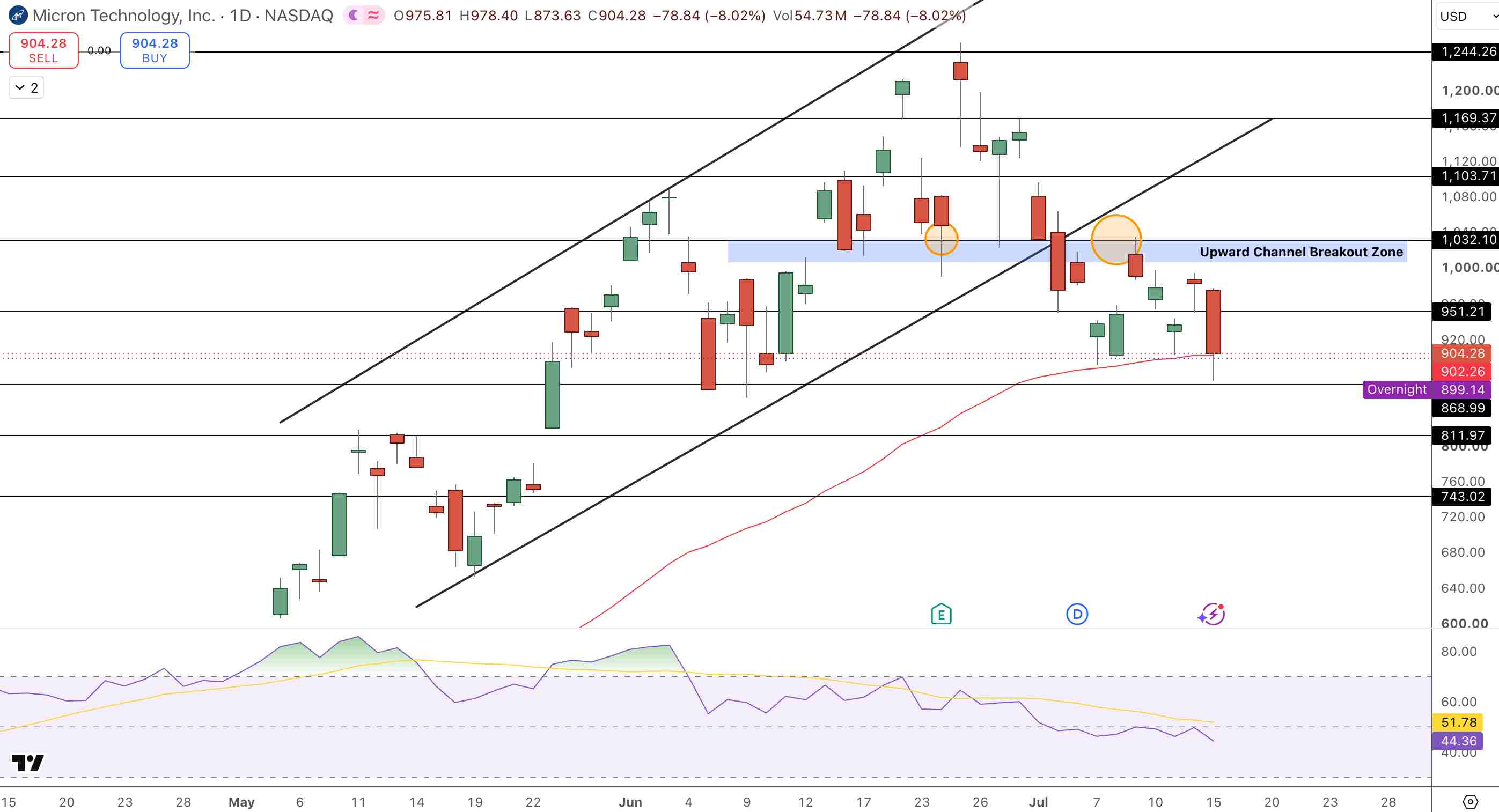
Micron Price Chart - Source: Tradingview
- 50-day EMA: $902 is the nearest support. Close below this adds more pressure.
- Support: $869 is the key level bulls must defend. A close below opens $811.97.
- Recovery target: $951, followed by $1,000-$1,032 resistance.
- CXMT threat: $8.5 Billion IPO will finance DRAM production capacity expansion. This adds downward pressure to Micron’s pricing power.
- HBM restriction: The US government is reviewing additional unilateral export limits on high-bandwidth memory.
- KeyBanc: The firm raised its MU price target to $1,750 from $1,600 on Monday, noting that memory will be tight through 2027.
Why Did Micron Stock Fall 7% on July 15?
Two specific catalysts hit MU on July 15. In July 15, Chinese memory manufacturer CXMT said it would go for $8.5 billion IPO financing in China to scale up DRAM domestically, and would then add a potential supply source that could delay the pricing repair Micron’s bull case requires. In addition, there were reports that the US government may introduce new export controls on high-bandwidth memory products. HBM is Micron’s highest-margin segment. Both threats converged on Micron’s 2026 and 2027 earnings expectations in one session.
What Is CXMT and How Big a Threat Is It to Micron?
ChangXin Memory Technologies (CXMT) is the largest China-based DRAM manufacturer, now in DDR5 production, and developing high-bandwidth memory where both Micron and SK Hynix are leaders. An $8.5 billion IPO would allow CXMT to greatly increase its output. Although Chinese DRAM manufacturers remain technology generations behind Micron, the gap has been closing. The concern is not that CXMT replaces Micron in the near term, but that additional Chinese DRAM supply moderates the pricing recovery that is responsible for Micron’s gross margin expanding from 38% in fiscal 2025 to 72.6% in Q3 FY2026.
Why Is KeyBanc Raising Its Target to $1,750 While the Stock Falls?
KeyBanc analyst John Vinh increased the price target for Micron from $1,600 to $1,750 on the back of an Asian trip where he checked on semiconductor supply and felt that the memory markets remain constrained until at least 2027. The increase is consistent with the thesis that the non-cancelable Strategic Customer Agreements which will cover HBM until 2026 and part of 2027, plus the dearth of new capacity additions in the immediate future by Micron competitors, should be conducive to higher HBM pricing. A 7% single-day decline was a response to market pricing for some of the potential risks stemming from CXMT and reports of export controls, not to any material changes to Micron’s actual operational performance today. KeyBanc’s $1,750 price target vs. the current $904 stock price is the market’s uncertainty premium on those risks.
Bottom Line
Micron shares dropped 7% on July 15 after China’s CXMT indicated a plan to raise $8.5 billion via a DRAM IPO, and US officials suggested new export controls on HBM may be next. Both events hit the same investment thesis: that memory supply will stay tight for prices to hold through at least 2027. The 50-day EMA at $902 is right now a test at Micron’s $904 stock price. A close below that will target $869 and $811.97 below. RSI is not quite oversold at 44 yet, meaning there may be more room to the downside. On the upside KeyBanc boosted its target to $1,750 after checking supply chain in Asia, Barclays targets $2,000, while the average analyst target is $1,462. Bull thesis remains sound according to the data. Just that market is recalibrating the risk premium for the thesis to hold true.
Recommended Articles


