


IBM (IBM) Stock Forecast: Down 25% After Q2 Warning; Is $213 the Floor?
TradingKey - On Wednesday, July 15, the stock hovered at approximately $219.50 following a sharp recovery after plummeting 25.21% on Tuesday, which was the worst day ever for the stock since records began in 1968 and it closed at $217.07. Yesterday, IBM said on a pre-earnings call that second quarter revenue was $17.2 billion, missing the consensus estimate of $17.86 billion by $700 million and adjusted EPS was $2.93, missing the expectation of $3.02.
The company’s CEO, Arvind Krishna, told the market that his clients have started to spend less on IBM’s software and infrastructure and more on their own AI hardware and memory chips. On 4H, IBM is at $219.50, RSI at 19 (very oversold), and support is at $213.28. HSBC analysts cut the rating to “Reduce” with a price target of $191. More detailed second quarter results are expected on July 22.
IBM’s Actual Results and the Reason for the Plunge
Second-quarter 2026 revenue was $17.2 billion up approximately 1% from 2025 Q2, which is much less than the double digit growth estimates analysts expected after a solid Q1. In Q1 2026 IBM revenue was $15.92 billion beating the estimate by $300 million, revenue from software grew 11% to $7.05 billion and EPS of $1.91 beat expectations. Since the first quarter result was excellent the news on Tuesday was more disappointing than an expected miss because investors feared that the growth forecast that had guided their decision-making process to put money in IBM on hybrid cloud and AI software had been unrealistic.
Krishna said that part of the reason was due to the fact that in Q2 his clients started buying more servers, memory chips, and storage because they expected IBM to raise prices and therefore wanted to stock up in anticipation of a price hike which hurt IBM’s software and infrastructure backlog because executives at dozens of large enterprise clients told IBM that they had to pause negotiating the purchase of software and infrastructure as they reviewed their technology budgets. Infrastructure was down 7%, consulting unchanged, and software increased 5%, versus 11% in Q1.
IBM’s Krishna said the company “faltered” and didn’t react fast enough to this shift. Krishna also disclosed that due to Anthropic’s imminent release of the Mythos AI cybersecurity model, some of IBM’s enterprise clients are freezing cybersecurity spend while deciding if the AI tool will change the cybersecurity needs in IT systems. It will be on July 22 with the detailed Q2 results that we will see what IBM’s Q3 and Q4 projections will be.
What This Means for the Broader Software Sector
On Tuesday, the technology sector was jolted when IBM issued an earnings warning, dragging down stocks across the software industry. Microsoft, Salesforce, ServiceNow, and Intuit all slid into negative territory on the news, though they managed to recover some losses later in the day. The unsettling implication raised by the report is that IBM’s Q2 could be indicative of a widespread pattern: if organizations typically push off end-of-quarter software purchases in favor of urgent AI hardware buys, then prospects for many other software companies could dim. As the market leader, IBM is also the biggest company and longest tenured pure play enterprise tech name to have ever given a warning like this.
Meanwhile, in the opposite scenario for the semiconductor industry, shares of Micron rose 5%, while Sandisk was up nearly 6% after Krishna said clients are currently purchasing servers, memory, and storage. Although IBM failed to make the sale, Micron and SK Hynix should have been the clear winners. HSBC downgraded IBM to Reduce from Hold with a price target of $191. Investors will now await Q3 results from other companies, such as Salesforce and Microsoft, to see if the IBM miss is just an isolated execution failure or indicative of a slowdown in software spending.
IBM Technical Setup — RSI 19, $213 Support, $201 Below That
Looking at the 4H timeframe, IBM stock at $219.50 is trading beneath the 50 (at $277), 100 EMA (at $268), and every major Fibonacci level. With the RSI at 19, IBM appears severely oversold, perhaps as the most oversold I can recall in a long time. That doesn’t always mean a rebound is coming, however; oversold readings can often remain oversold for weeks in the event of an actual structural change.
Next up is $213.28 support. If it holds, IBM may get a bit relief and move back towards $233 (which was previously support and is now resistance) after falling below it today. The $233 area is a breakout point where targets open up towards $245 and $255.
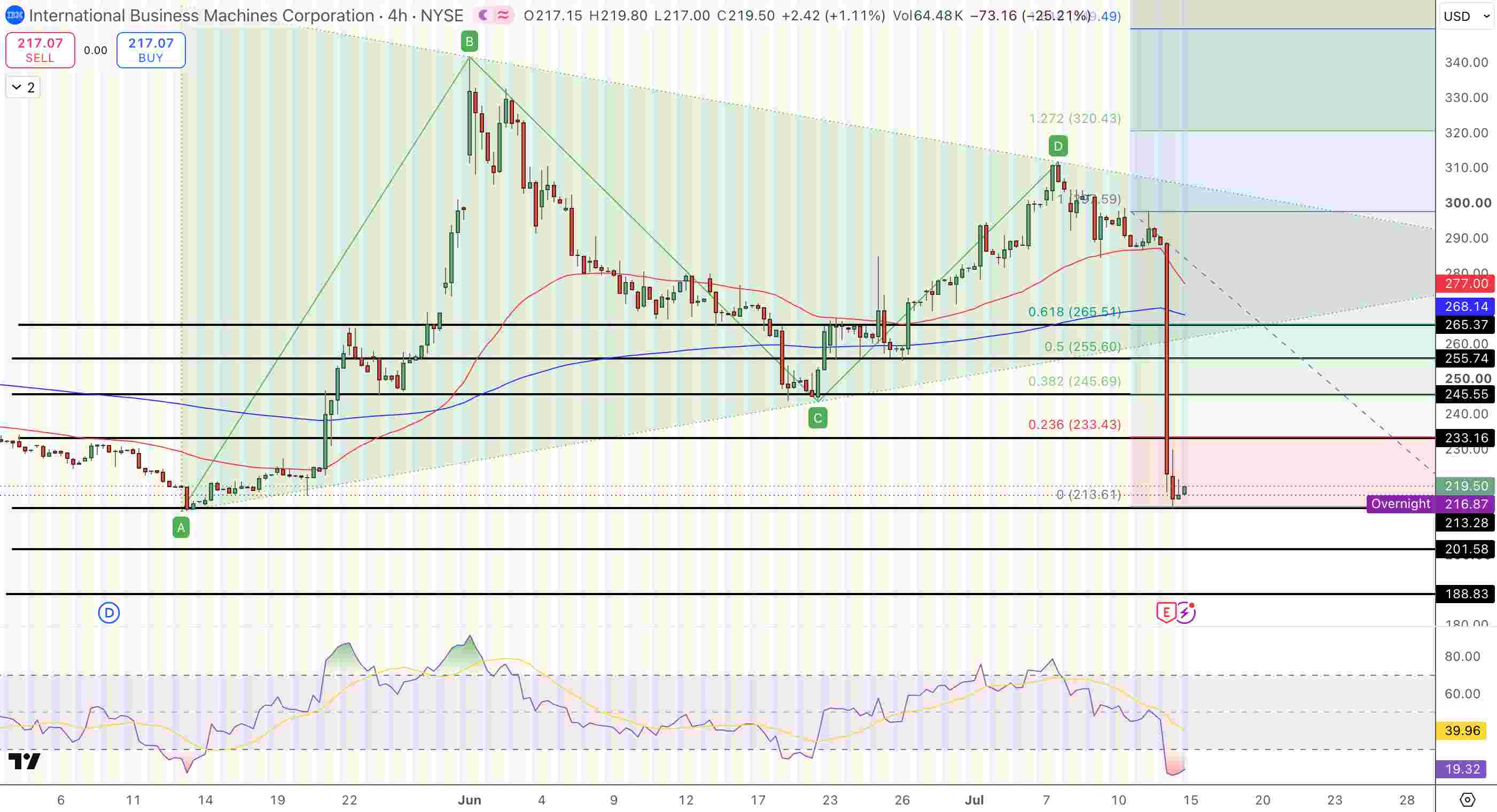
IBM (IBM) Stock Forecast Price Chart - Source: Tradingview
Otherwise, if the stock breaches $213.28, then $201.58 is the first target level. Buying now in IBM is essentially a trade for a potential oversold rebound; I suggest waiting until after the full report on July 22 to consider long term.
- Price: $219.50 today (July 15). Yesterday closed at $217.07, a 25.21% drop.
- Q2 Results: Revenue of $17.2B, missing the $17.86B estimate. EPS of $2.93, missing the $3.02 estimate.
- Why the Sell-Off: Enterprises postponed IBM deals to buy servers, memory, and storage in late Q2.
- Support: $213.28 is essential to avoid a further slide; a break below would set the stage for a $201.58 test.
- Resistance: $233 then $245 and $255; all are former support zones now acting as ceilings.
- Upcoming Event: July 22, 2026: Detailed Q2 earnings and Q3 guidance; HSBC target: $191.
Why Did IBM Stock Fall 25% on July 14?
IBM had given a pre earnings warning of $17.2bn in Q2 2026 revenue, approximately $700m behind the consensus at $17.86bn and an adjusted EPS of $2.93 versus an EPS consensus of $3.02. According to CEO Arvind Krishna, this came from clients moving late-quarter spending to AI hardware (servers, storage, memory chips) instead of IBM’s software and infrastructure and as a result IBM booked a few big deals later than expected. That sent IBM’s share price down 25.21%, its largest one day drop since at least 1968, worse than its previous record from Black Monday in October 1987.
Is $213 a Genuine Support Level for IBM?
$213.28 is the main support identified by the 4H chart after the break of the Fibonacci levels above in the crash on Tuesday. This represents a zone where buying previously emerged and it is the area the price seems to be stabilizing at after its slide down from above $290. But the weakness after crash this large will change the base of sellers.
If the Q3 outlook in IBM’s Q2 full earnings release on July 22 is below consensus, $213 probably wouldn’t be the bottom and the next support would be at $201.58. The RSI of 19 is deep in oversold and the odds are that there will be a short term bounce but it doesn’t mean that $213 will act as a solid floor.
What Should Investors Watch at IBM’s July 22 Full Earnings?
The Q2 full results and conference call on July 22 are more important as they will give more detail than the Q2 preliminary numbers. Investors need to know whether IBM thinks that the software deal delays will correct over Q3 and if the shift towards AI hardware will be a quarter specific phenomenon or a multi quarter head wind as well as the revised Q3 to full year revenue and EPS guidance. Krishna says in his letter “We are now undertaking new initiatives to help offset the impact.” It will be up to the new initiatives Krishna mentions at July 22 to convince the market $217 is a floor and not a beginning of a trend.
Bottom Line
IBM fell 25% on Tuesday July 14, its worst session since 1968. The company posted Q2 revenue of $17.2bn, $700m below expectations as clients switched from buying IBM software to buying hardware. At $219.50 on Wednesday, the RSI is at 19, and the stock is currently below all major moving averages. A support is at $213.28 with support at $201.58 below. If there is a reversal the resistance is at $233. HSBC already downgraded the stock to Reduce and lowered the target to $191.
The question is not about is the stock oversold as it is clear that it is, the question is about whether July 22 full earnings report will reveal any Q3 improvement or will it confirm that the spending shift on software is a bigger phenomenon than one quarter.
Recommended Articles


