


Fed Chair Kevin Warsh Sends a Blunt Warning to Wall Street. What Should Investors Do?
Key Points
Warsh's stance could lead to longer-duration bear markets.
However, it could make index ETF investing even more relatively attractive.
- These 10 stocks could mint the next wave of millionaires ›
When President Donald Trump helped push out Federal Reserve Chairman Jerome Powell, he was looking to replace him with someone who would lower interest rates and help prop up stock prices. However, the person he appointed to replace Powell appears to have a vastly different idea.
Instead of cutting rates as Fed chief at his first meeting, new Fed chairman Kevin Warsh kept rates steady while issuing a terse statement that ended with: "The Committee will deliver price stability." The implication of his message was clear: Not only are rate cuts off the table, but interest rate hikes are also more likely in the future.
Missed Nvidia in 2009? This Rare Signal Is Flashing Again. In 2009, a "Double Down" signal flashed for a little-known chipmaker called Nvidia. For the first time in years, that same "Total Conviction" signal is flashing for a company 1/100th the size of Nvidia. Continue »
This was also confirmed by the Fed Dot Plot, a quarterly graph that tracks where each Fed member predicts future interest rates are headed. The graph showed that the vast majority of members predicted rates to be steady or higher this year, with about half expecting at least one rate increase and a third expecting two or more hikes.
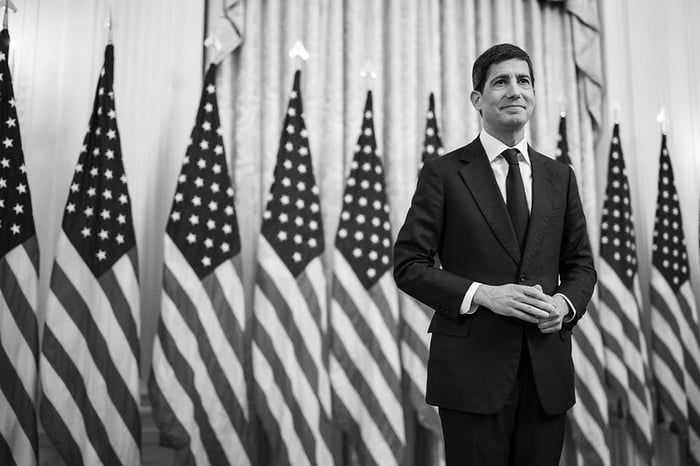
Fed chairman Kevin Warsh. Image source: Official White House Photo by Daniel Torok.
Warsh also indicated that the Fed will be less communicative and take a less active role in the stock market. At the Federal Open Market Committee's (FOMC's) June 17 meeting press conference, he said: "So I think financial markets perform best when they react to incoming data. I think the financial markets work less efficiently when they ask a question: 'How will the Federal Reserve react to that incoming information?'"
Warsh is looking to remake the Fed, and one thing he has made clear is that the Fed is not there to bail out Wall Street or help prop up stock prices. How this will play out will be interesting, and certainly goes in the opposite direction of the man who just appointed him to the position.
What should investors do?
Fed rate cuts have generally been good for stocks, with the market typically generating positive returns over the year following an initial rate cut. This isn't the case every time, and it doesn't always save stocks from falling into a bear market, but it generally helps them bounce back unless it is due to a severe recession, as we saw in 2008 with the housing bubble.
With the "Fed Put" off the table, the typical magnitude and duration of bear markets could change, as they have tended to be shorter in recent times. It isn't necessarily a bad thing to let the market sort things out for itself rather than being propped up by cheap money, but it is a change investors and executives will have to get used to moving forward.
My advice is not to shift strategies in response to these Fed changes. Most investors are best served by dollar-cost averaging into a core index exchange-traded fund (ETF) or two, like the Vanguard S&P 500 ETF (NYSEMKT: VOO) or the Invesco QQQ Trust (NASDAQ: QQQ), over a long period of time. This is what ultimately will help create long-term wealth.
ETFs that track market-cap-weighted indexes benefit from a "survival of the fittest" dynamic, with successful companies naturally becoming larger portions of the index while weaker ones shrink or eventually exit. A less accommodative Fed would only reinforce this, making index ETFs even more attractive investments.
Where to invest $1,000 right now
When our analyst team has a stock tip, it can pay to listen. After all, Stock Advisor’s total average return is 929%* — a market-crushing outperformance compared to 211% for the S&P 500.
They just revealed what they believe are the 10 best stocks for investors to buy right now, available when you join Stock Advisor.
See the stocks »
*Stock Advisor returns as of July 12, 2026.
Geoffrey Seiler has positions in Invesco QQQ Trust and Vanguard S&P 500 ETF. The Motley Fool has positions in and recommends Vanguard S&P 500 ETF. The Motley Fool has a disclosure policy.
Recommended Articles


