


SK Hynix and Samsung Have a $2 Trillion Warning for Micron Stock Investors. Is This a Signal to Sell?
Key Points
SK Hynix and Samsung have pledged $2 trillion to bring additional memory capacity online to address the ongoing shortage and tremendous demand for memory chips.
This doesn't look like a good sign for Micron Technology at first, which has been benefiting from the memory supply shortage.
- 10 stocks we like better than Micron Technology ›
Micron Technology (NASDAQ: MU) stock has been on a tear over the past year. Shares of the memory specialist have jumped nearly 8x in a short time, driven by a rapid increase in demand for memory chips that has overwhelmed supply.
The memory supply shortage has been a massive tailwind for Micron Technology's bottom line. The company's earnings have been growing exponentially due to the incredible rise in memory prices. However, Micron's peers, Samsung and SK Hynix, have ambitious investment plans that could significantly reduce the supply demand gap in the memory industry.
Where to invest $1,000 right now? Our analyst team just revealed what they believe are the 10 best stocks to buy right now, when you join Stock Advisor. See the stocks »
That may not be a good thing for Micron stock. Here's why.

Image source: Micron Technology.
SK Hynix and Samsung are the kingpins of the memory industry
As reported by Reuters, South Korea aims to double its memory chip production capacity over the next five years. Samsung and SK Hynix are going to play a key role in this expansion, as they have pledged an investment of just over $2 trillion.
Given that Samsung and SK Hynix are among the world's largest memory chip suppliers, their massive investments could significantly reduce the demand-supply gap. Specifically, the two Korean giants control 67% of the global dynamic random-access memory (DRAM) capacity, according to Counterpoint Research. Their combined share of the NAND flash storage market stands at 47%.
Micron, for comparison, controls 22% of the DRAM market and 13% of the NAND flash market. So, Samsung and SK Hynix can influence the global memory in a big way. This doesn't bode well for Micron, as its pricing power could take a hit if Korean competitors add substantial new capacity. Even analysts are worried that this capacity expansion could create an oversupply, and that could negatively impact memory prices.
Does this mean it is time to book your profits in Micron stock? Not necessarily.
Micron's impressive growth is here to stay
Adding new memory production capacity takes time. Building a memory fab can take anywhere between three to five years. So, even if SK Hynix and Samsung accelerate their infrastructure build-out, it will take a few years for them to start producing memory chips from their new facilities. Moreover, Samsung and SK Hynix are likely to monitor memory demand to ensure that they don't end up in an oversupply situation, which has hurt both companies in the past.
Additionally, SK Hynix's chairman believes that the additional capacity won't be enough to address the supply shortage. It is easy to see why that's the case. The high-bandwidth memory (HBM) used in AI chips consumes 3x as much wafer capacity as conventional memory chips. With HBM demand anticipated to increase at an annual rate of 42% through 2033, the ongoing shortage in the console, smartphone, and personal computing (PC) markets is likely to persist.
And as the new capacity comes online, it is likely to be absorbed by the markets where there is currently a major shortage. For instance, smartphone sales are anticipated to decline by 13.9% in 2026, according to IDC. The firm anticipates a 1.1% drop next year before growth resumes in 2028. Higher memory prices have been affecting smartphone sales, so any additional capacity could go toward satisfying pent-up demand in this market over the next couple of years.
So, the structural growth of the memory market due to the advent of AI should ideally prevent a downturn. That's why Micron investors shouldn't worry as the favorable conditions driving its growth are likely to persist.
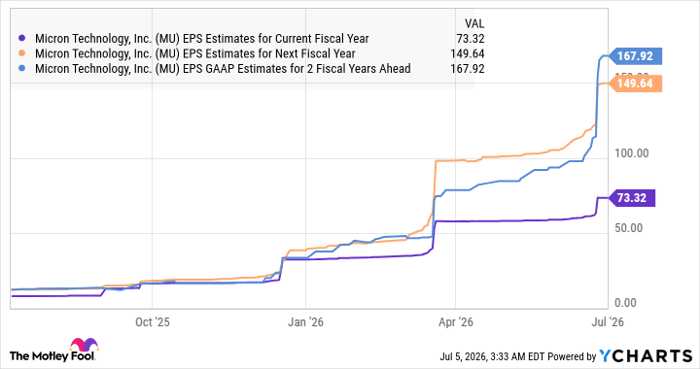
This is probably why analysts are predicting that the company will clock outstanding earnings growth.
Data by YCharts
Moreover, Micron's price-to-earnings ratio of 23 makes it too cheap to ignore, considering its astronomical growth and sunny outlook. The tech-focused Nasdaq-100 index trades at 35 times earnings, which means Micron is a value stock. Assuming Micron trades at even 25 times earnings at the end of fiscal 2028 and its earnings per share reach $167.92, the company's stock price could jump to $4,198.
That's just over 4x its current stock price. So, investors can continue holding this AI stock in their portfolios, or even buy more, as it could keep skyrocketing.
Should you buy stock in Micron Technology right now?
Before you buy stock in Micron Technology, consider this:
The Motley Fool Stock Advisor analyst team just identified what they believe are the 10 best stocks for investors to buy now… and Micron Technology wasn’t one of them. The 10 stocks that made the cut could produce monster returns in the coming years.
Consider when Netflix made this list on December 17, 2004... if you invested $1,000 at the time of our recommendation, you’d have $418,761!* Or when Nvidia made this list on April 15, 2005... if you invested $1,000 at the time of our recommendation, you’d have $1,195,804!*
Now, it’s worth noting Stock Advisor’s total average return is 918% — a market-crushing outperformance compared to 208% for the S&P 500. Don't miss the latest top 10 list, available with Stock Advisor, and join an investing community built by individual investors for individual investors.
See the 10 stocks »
*Stock Advisor returns as of July 6, 2026.
Harsh Chauhan has no position in any of the stocks mentioned. The Motley Fool has positions in and recommends Micron Technology. The Motley Fool has a disclosure policy.
Recommended Articles


