


Advanced Micro Devices vs. Nvidia: What Scale and Trajectories in Their Revenue Tell Investors
Key Points
Nvidia currently reports a significantly higher total revenue base compared to Advanced Micro Devices (AMD).
Nvidia exhibits rapid, uninterrupted quarter-over-quarter increases, while AMD shows more moderate growth with occasional quarter-over-quarter flat periods.
Investors should watch whether the revenue gap between the two companies continues to widen or eventually stabilizes in upcoming quarters.
- 10 stocks we like better than Advanced Micro Devices ›
Advanced Micro Devices: Moderate Revenue Expansion
Advanced Micro Devices (NASDAQ:AMD) primarily earns its revenue by designing and selling microprocessors, graphics processing units, and embedded processors for consumer, commercial, and enterprise computing markets.
It announced an expanded infrastructure partnership with Meta Platforms in February 2026, and it reported an approximately 13% net income margin for the quarter ended March 28, 2026.
Nvidia: Continuous Revenue Scaling
Nvidia (NASDAQ:NVDA) primarily generates its revenue by providing graphics platforms, accelerated compute hardware, and networking solutions for data centers, gaming, and automotive markets.
It introduced the Vera Rubin platform in March 2026, while it recorded an approximately 63% net income margin for the quarter ended Jan. 25, 2026.
Why Revenue Matters for Retail Investors
Revenue represents the total amount of money a company brings in from its core operations, and tracking it helps investors understand the total volume of sales a business generates before any expenses are deducted.
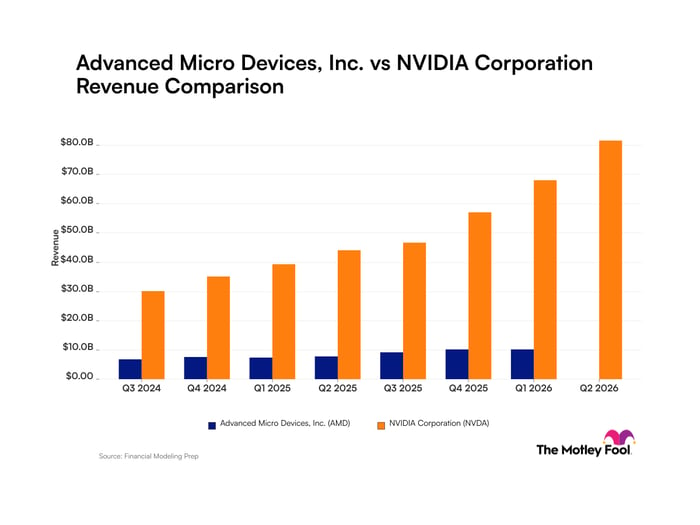
Image source: The Motley Fool.
Quarterly Revenue for AMD and Nvidia
| Quarter (Period End) | Advanced Micro Devices Revenue | Nvidia Revenue |
|---|---|---|
| Q2 2024 | $5.8 billion (period ended June 2024) | $26.0 billion (period ended April 2024) |
| Q3 2024 | $6.8 billion (period ended Sept. 2024) | $30.0 billion (period ended July 2024) |
| Q4 2024 | $7.7 billion (period ended Dec. 2024) | $35.1 billion (period ended Oct. 2024) |
| Q1 2025 | $7.4 billion (period ended March 2025) | $39.3 billion (period ended Jan. 2025) |
| Q2 2025 | $7.7 billion (period ended June 2025) | $44.1 billion (period ended April 2025) |
| Q3 2025 | $9.2 billion (period ended Sept. 2025) | $46.7 billion (period ended July 2025) |
| Q4 2025 | $10.3 billion (period ended Dec. 2025) | $57.0 billion (period ended Oct. 2025) |
| Q1 2026 | $10.3 billion (period ended March 2026) | $68.1 billion (period ended Jan. 2026) |
Data source: Company filings. Data as of May 10, 2026.
Foolish Take
The businesses of Advanced Micro Devices (AMD) and Nvidia were transformed by the arrival of artificial intelligence. Suddenly, demand skyrocketed for their advanced computing components, such as graphics processing units (GPUs), as tech companies rushed to build powerful computers that could support AI.
Nvidia took the market lead over AMD, given the company is known as the inventor of the GPU, and championed its use in AI systems. Nvidia’s far larger revenue highlights its market dominance over rival AMD.
Not only that, Nvidia’s sales are consistently growing quarter over quarter. This is unusual, since seasonality and industry ebbs and flows should cause more variability across quarters, as AMD’s quarterly revenue trend demonstrates. What this tells investors is that Nvidia’s position as the semiconductor leader for the AI sector is at an unprecedented level, to the point where AMD will have a tough time matching that performance.
Part of Nvidia’s incredible success is due to its CUDA software, which allows customers greater control over GPUs, and makes switching costs to AMD high. That’s why Nvidia’s revenue growth from 2024 to 2026 has been astronomical. In comparison, AMD nearly doubling sales in that time seems mundane even though it’s a great achievement in its own right.
The arrival of Nvidia’s Vera Rubin platform, specifically designed for AI, positions the company to continue its dominance over AMD, making Nvidia a superior long-term investment over its semiconductor competitor.
Should you buy stock in Advanced Micro Devices right now?
Before you buy stock in Advanced Micro Devices, consider this:
The Motley Fool Stock Advisor analyst team just identified what they believe are the 10 best stocks for investors to buy now… and Advanced Micro Devices wasn’t one of them. The 10 stocks that made the cut could produce monster returns in the coming years.
Consider when Netflix made this list on December 17, 2004... if you invested $1,000 at the time of our recommendation, you’d have $460,826!* Or when Nvidia made this list on April 15, 2005... if you invested $1,000 at the time of our recommendation, you’d have $1,345,285!*
Now, it’s worth noting Stock Advisor’s total average return is 983% — a market-crushing outperformance compared to 207% for the S&P 500. Don't miss the latest top 10 list, available with Stock Advisor, and join an investing community built by individual investors for individual investors.
See the 10 stocks »
*Stock Advisor returns as of May 12, 2026.
Robert Izquierdo has positions in Advanced Micro Devices, Meta Platforms, and Nvidia. The Motley Fool has positions in and recommends Advanced Micro Devices, Meta Platforms, and Nvidia. The Motley Fool has a disclosure policy.
Recommended Articles


