


I Ran the Numbers on VONG, and These 2 Vanguard ETFs Came Out Ahead
Key Points
The Vanguard Russell 1000 Growth ETF owns 387 (mostly) tech stocks.
The fund has underperformed the Nasdaq-100 index in the past year.
Buying a more tech-heavy ETF or a simple S&P 500 ETF could be a better choice for most investors.
- 10 stocks we like better than Vanguard Scottsdale Funds - Vanguard Russell 1000 Growth ETF ›
If you want to profit from the artificial intelligence (AI) boom, buying an ETF packed with growth stocks can be a good way to do it. One such popular fund is the Vanguard Russell 1000 Growth ETF (NASDAQ: VONG). This fund lets you own hundreds of stocks of large U.S. companies that are part of the Russell 1000 Index, including major AI stocks, and all for a low expense ratio of 0.06%.
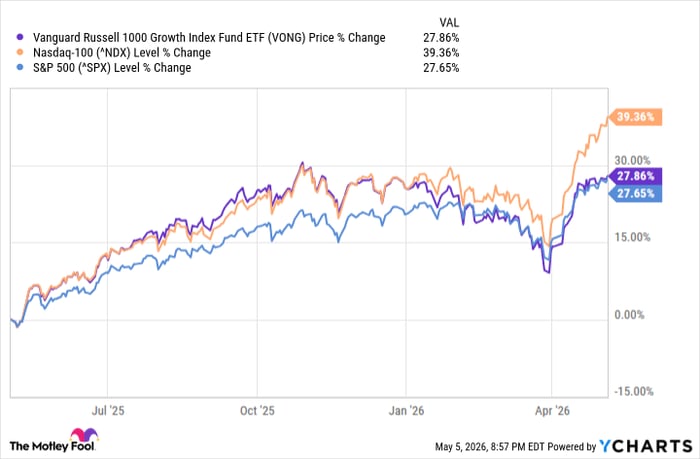
But this ETF has a few limitations that make it not the best choice for many investors. And for the past year, the fund has underperformed the tech-heavy Nasdaq-100 index while staying about even with the S&P 500.
Will AI create the world's first trillionaire? Our team just released a report on the one little-known company, called an "Indispensable Monopoly" providing the critical technology Nvidia and Intel both need. Continue »
Two other Vanguard ETFs could be a better buy than VONG. Let's look at a few reasons not to buy the Vanguard Russell 1000 Growth ETF -- and what to buy instead.
VONG data by YCharts
Lacking diversity
Don't let the number "1000" in the name of the fund fool you. The Vanguard Russell 1000 Growth ETF holds only 387 stocks and is top-heavy with tech names.
As I write this, about 59% of the fund's holdings are in the technology sector. The top five holdings are all prominent tech stocks -- Nvidia (NASDAQ: NVDA), Apple (NASDAQ: AAPL), Microsoft (NASDAQ: MSFT), Broadcom (NASDAQ: AVGO), and Amazon (NASDAQ: AMZN) -- which make up nearly 43% of the fund.
That heavy emphasis on just a few big-name tech stocks makes this growth ETF feel like it's not diversified enough. In the past year, it has barely outperformed the more diversified S&P 500, while falling short of the higher growth of the tech-heavy Nasdaq-100. If you want to make a concentrated investment in tech stocks, or if you want to own a broader range of stocks outside of tech, there are better ways to do it.
Here are two other low-cost Vanguard ETFs that might make better sense for most investors.

Image source: Getty Images.
What to buy instead: VGT
The Vanguard Information Technology ETF (NYSEMKT: VGT) offers exposure to 317 stocks, and they're all in the technology sector. The fund's top categories include semiconductors (34.2%), technology hardware (18.9%), systems software (14.9%), application software (11.2%), and semiconductor materials & equipment (5.8%).
The Vanguard Information Technology ETF has an expense ratio of only 0.09%. For the past 10 years, it's delivered average annual returns (by net asset value) of 24%, strongly outperforming VONG, which has earned 18% per year in that time frame.
What to buy instead: VOO
What if you want to diversify beyond tech stocks? One easy way to do it is to buy the Vanguard S&P 500 ETF (NYSEMKT: VOO). This S&P 500 tracker charges a low expense ratio of 0.03% to invest in the top 500 largest publicly traded U.S. stocks.
The fund's holdings include 504 stocks. Although information technology stocks account for 32.9% of the fund's holdings, this ETF also offers solid diversification across financials (12.6%), communication services (10.3%), consumer discretionary (9.9%), and healthcare (9.5%).
In the past 10 years, the Vanguard S&P 500 ETF has delivered average annual returns (by net asset value) of 15%. That's a lower ROI than the other two tech-heavy funds I've talked about, but past performance doesn't guarantee future results. Diversifying away from the tech sector could offer lower risk and less volatility.
For me, owning 387 growth stocks with the Vanguard Russell 1000 Growth ETF feels like an uncomfortable middle ground. If you want to go all-in on tech stocks, buy VGT (or a Nasdaq-100-tracking ETF). If you want more diversification, buy a simple S&P 500 index ETF like VOO.
Should you buy stock in Vanguard Scottsdale Funds - Vanguard Russell 1000 Growth ETF right now?
Before you buy stock in Vanguard Scottsdale Funds - Vanguard Russell 1000 Growth ETF, consider this:
The Motley Fool Stock Advisor analyst team just identified what they believe are the 10 best stocks for investors to buy now… and Vanguard Scottsdale Funds - Vanguard Russell 1000 Growth ETF wasn’t one of them. The 10 stocks that made the cut could produce monster returns in the coming years.
Consider when Netflix made this list on December 17, 2004... if you invested $1,000 at the time of our recommendation, you’d have $471,827!* Or when Nvidia made this list on April 15, 2005... if you invested $1,000 at the time of our recommendation, you’d have $1,319,291!*
Now, it’s worth noting Stock Advisor’s total average return is 986% — a market-crushing outperformance compared to 207% for the S&P 500. Don't miss the latest top 10 list, available with Stock Advisor, and join an investing community built by individual investors for individual investors.
See the 10 stocks »
*Stock Advisor returns as of May 10, 2026.
Ben Gran has no position in any of the stocks mentioned. The Motley Fool has positions in and recommends Amazon, Apple, Broadcom, Microsoft, Nvidia, and Vanguard S&P 500 ETF. The Motley Fool has a disclosure policy.
Recommended Articles


