


Here's Why GE Healthcare Shares Slumped This Week
Key Points
GE Healthcare's stock dropped 11.3% after Q1 2026 earnings.
Rising costs are pressuring margins, leading to lowered EPS guidance.
Long-cycle sales delay the impact of price increases on revenue.
- 10 stocks we like better than GE HealthCare Technologies ›
Inflationary pressures are starting to bite into profit margins for some companies, particularly those with long, complex sales cycles, such as GE Healthcare (NASDAQ: GEHC). That's why the company's stock declined 11.3% in a week after it released its first-quarter 2026 earnings.
GE Healthcare lowers guidance
The healthcare company sells relatively high-ticket imaging and visualization equipment, which tends to have long sales cycles, making it difficult for the company to immediately raise prices to offset cost inflation. While it also sells shorter cycle products like patient care equipment and pharmaceutical diagnostics, it's not enough to give it the agility to deal with rising costs.
Will AI create the world's first trillionaire? Our team just released a report on the one little-known company, called an "Indispensable Monopoly" providing the critical technology Nvidia and Intel both need. Continue »
Unfortunately, costs are rising, with GE Healthcare management outlining $250 million in increased costs, comprising $100 million from memory chips, $100 million from oil and freight costs, and $50 million from raw materials, including tungsten metal. These impacts are set to reduce earnings per share (EPS) by $0.43 in 2026. Management expects to take cost-mitigation actions that will improve EPS by $0.17 and implement price increases, resulting in a $0.06 improvement, alongside a $0.05 improvement from non-operational matters.
When all is said and done, the net impact in 2026 is a $0.15 reduction in EPS, which is why management lowered its full-year EPS guidance to $4.80 to $5 from a previous range of $4.95 to $5.15.
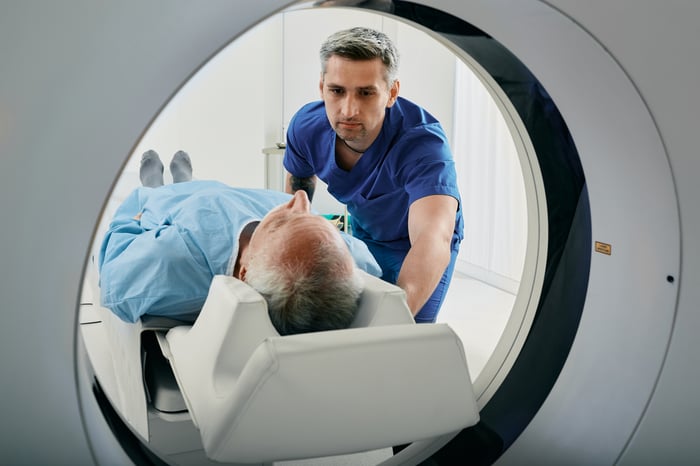
Image source: Getty Images.
Where next for GE Healthcare
Interestingly, the company maintained its full-year organic revenue guidance of 3%-4%, implying the problem is cost pressure on margins rather than a decline in revenue growth prospects. Those problems look likely to persist through 2026 because, as noted earlier, a lot of the company's sales are long-cycle, so it will take time to work through the backlog on previous pricing before the newly priced orders start to convert into revenue. As such, expect the company's revenue and margin outlook to improve later in the year and into 2027, making the stock attractive to long-term investors looking to buy on a dip.
Should you buy stock in GE HealthCare Technologies right now?
Before you buy stock in GE HealthCare Technologies, consider this:
The Motley Fool Stock Advisor analyst team just identified what they believe are the 10 best stocks for investors to buy now… and GE HealthCare Technologies wasn’t one of them. The 10 stocks that made the cut could produce monster returns in the coming years.
Consider when Netflix made this list on December 17, 2004... if you invested $1,000 at the time of our recommendation, you’d have $496,473!* Or when Nvidia made this list on April 15, 2005... if you invested $1,000 at the time of our recommendation, you’d have $1,216,605!*
Now, it’s worth noting Stock Advisor’s total average return is 968% — a market-crushing outperformance compared to 202% for the S&P 500. Don't miss the latest top 10 list, available with Stock Advisor, and join an investing community built by individual investors for individual investors.
See the 10 stocks »
*Stock Advisor returns as of May 2, 2026.
Lee Samaha has no position in any of the stocks mentioned. The Motley Fool has positions in and recommends GE HealthCare Technologies. The Motley Fool has a disclosure policy.
Recommended Articles


