


Joby Aviation Just Completed Its First Test Flight to JFK Airport. Here's Why I'm Still Not Buying
Key Points
Electric vertical takeoff and landing (eVTOL) vehicles are one of the most hyped new technologies.
Companies like Archer Aviation and Joby Aviation still haven't earned material revenue.
Urban air taxis still have a lot of hurdles to pass before becoming a viable business.
- 10 stocks we like better than Joby Aviation ›
The market has been buzzing about electric vertical takeoff and landing (eVTOL) vehicles for years now, though the two public companies in the space, Archer Aviation and Joby Aviation (NYSE: JOBY), are still development-stage companies with essentially no revenue.
However, Joby took a significant step forward just days ago when it successfully performed its first test flights from Manhattan to JFK Airport.
Will AI create the world's first trillionaire? Our team just released a report on the one little-known company, called an "Indispensable Monopoly" providing the critical technology Nvidia and Intel both need. Continue »
Joby stock rose on the news as the event offered both proof-of-concept of its commuter flights and served as a marketing vehicle, earning it coverage in a number of news outlets.
Joby is testing the flights from the city's three heliports to JFK, and the rides have been called flying cars and compared to the "Jetsons" in the process. Flight times could be as little as five minutes.
Despite the feat of engineering and even the beaten-down stock price, due in part to the turmoil in the Middle East, I'm staying on the sidelines on the eVTOL stocks for one big reason: the economics still don't make sense.
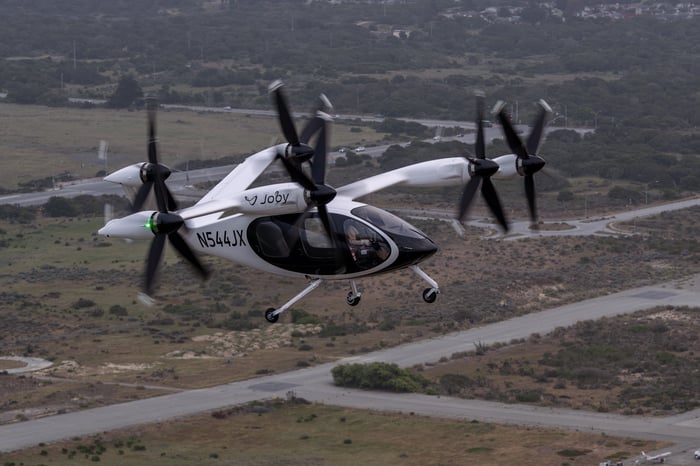
Image source: Joby Aviation.
Crunching the numbers
Joby and Archer intend to commercialize their technology through two primary verticals: transportation and defense. Of those, transportation has gotten the most attention as these innovators have envisioned high-traffic networks of flights in major metro areas, starting with places like Dubai and New York.
However, the value proposition for these flights may not be as strong as the bulls like to think. First, while flight time may be as little as five minutes, you still have to get to the heliport first, which significantly narrows the addressable market. If you have to walk more than a few blocks, especially with luggage, then you're probably more likely to take a cab, ridesharing vehicle, or public transportation, in which case you might as well use that to get to JFK or the destination in question. Additionally, the eVTOL won't take you directly to the terminal door the way a cab would. The eVTOL lands in a dedicated heliport. Passengers then take a shuttle to the nearest AirTrain station and then catch the AirTrain to their terminal. Even if everything goes smoothly, it seems hard to imagine the door-to-door trip taking less than half an hour. That's still faster than vehicle transportation would likely be, but it's definitely less convenient than the five-minute point-to-point flight makes it sound.
Joby has not announced its pricing yet, but it's believed it will cost around $200 per seat, which is similar to Blade, the pre-existing helicopter service that Joby acquired when it bought Blade's mobility business for up to $125 million.
A cab ride from Midtown Manhattan to JFK costs close to $100, but that ride can hold four passengers for that price. If you're traveling solo, it might be reasonable to pay the premium for an eVTOL, but with two or more people, it becomes much harder to swallow.
Can Joby avoid Blade's pitfall?
The biggest question facing Joby and Archer is whether they can overcome challenges that stymied the helicopter operators that have already provided this service, including Blade.
Among the challenges Blade ran into was that urban air mobility only appealed to a narrow socioeconomic slice of the market, operating costs were high, and infrastructure was scarce, limiting the availability of point-to-point air taxi rides.
eVTOLs promise to be less noisy and have lower operating costs than traditional helicopters, but the essential demand and infrastructure problems remain the same.
At this point, I think the use case for these "urban air taxis" is simply too limited for them to work at scale. Whenever they launch commercially, Joby and Archer are likely to benefit from a honeymoon effect, but once the novelty wears off, they will have to make economic sense for the businesses to succeed. Right now, the odds still seem against this technology going mainstream.
Should you buy stock in Joby Aviation right now?
Before you buy stock in Joby Aviation, consider this:
The Motley Fool Stock Advisor analyst team just identified what they believe are the 10 best stocks for investors to buy now… and Joby Aviation wasn’t one of them. The 10 stocks that made the cut could produce monster returns in the coming years.
Consider when Netflix made this list on December 17, 2004... if you invested $1,000 at the time of our recommendation, you’d have $492,752!* Or when Nvidia made this list on April 15, 2005... if you invested $1,000 at the time of our recommendation, you’d have $1,327,935!*
Now, it’s worth noting Stock Advisor’s total average return is 991% — a market-crushing outperformance compared to 201% for the S&P 500. Don't miss the latest top 10 list, available with Stock Advisor, and join an investing community built by individual investors for individual investors.
See the 10 stocks »
*Stock Advisor returns as of April 28, 2026.
Jeremy Bowman has no position in any of the stocks mentioned. The Motley Fool has no position in any of the stocks mentioned. The Motley Fool has a disclosure policy.
Recommended Articles


