


3 Monster Stocks to Hold for the Next 20 Years
Key Points
Okta reported impressive 2025 earnings per share that grew more than 200%.
ASML is the only company that makes extreme ultraviolet lithography machines.
Midstream energy operator Enbridge boasts 31 consecutive years of dividend increases.
- 10 stocks we like better than Okta ›
Investing with a 20-year horizon requires looking past quarterly volatility and focusing on structural shifts in the global economy.
Okta (NASDAQ: OKTA), ASML Holding (NASDAQ: ASML), and Enbridge (NYSE: ENB) are all set to benefit from long-term trends in technology and industry. Okta's shares are down more than 12% this year, while Enbridge and ASML are up more than 11% and 36%, respectively.
Will AI create the world's first trillionaire? Our team just released a report on the one little-known company, called an "Indispensable Monopoly" providing the critical technology Nvidia and Intel both need. Continue »
Yet, all three companies enjoy competitive moats that will drive revenue growth for decades. Here's why I like each stock for the next 20 years.
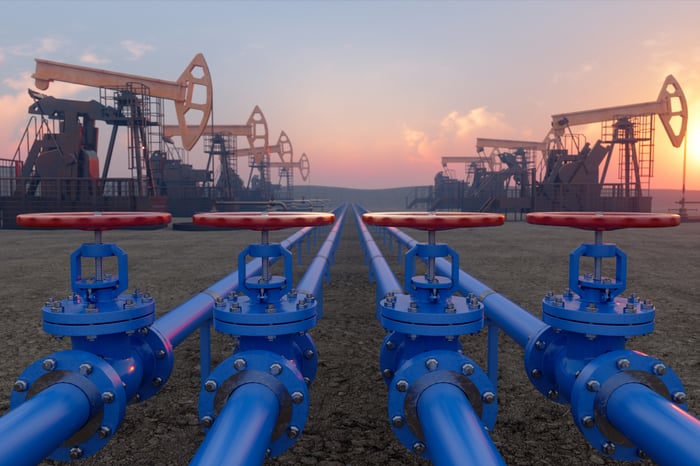
Image source: Getty Images.
Okta is the guard dog of cybersecurity
In the past, cybersecurity focused on protecting a physical office or a closed private network, but as permanent hybrid work and cloud-based operations become the norm, the network perimeter has evaporated.
In this new environment, identity is the constant. Whether an employee is logging in from a coffee shop or an automated bot is accessing a server, verifying who is requesting access is the most critical security layer. Okta's position as a cloud-native, independent provider of workforce identity (employees) and customer identity (users) makes it a utility platform for the modern internet.
Unlike tech competitors such as Microsoft and its EntraID, a cloud-based identity and access management (IAM) service, Okta does not care which ecosystem a company uses. If a company uses Amazon Web Services (AWS) from Amazon for cloud, Gmail from Alphabet for email, and Slack from Salesforce for communication, Okta integrates seamlessly across all of them.
As companies increasingly adopt best-of-class software stacks rather than sticking to a single vendor, Okta serves as a connector that ties disparate systems together. Over 20 years, as new tech giants emerge and old ones fade, Okta's ability to remain the universal translator for login credentials provides it with a durable moat.
It has an outstanding growth profile
In 2025, Okta showed strong results, reporting yearly revenue of $2.92 billion, an increase of 12%, with subscription revenue climbing 12% to $2.86 billion. Earnings per share (EPS) were $1.31, up 208%. In 2026, the company anticipates revenue of $3.17 billion to $3.19 billion, up 9% at the midpoint, and non-GAAP EPS of $3.74 to $3.82, up 8% at the midpoint.
By consolidating its various services into a single platform, the San Francisco company increases its stickiness. Once a company has integrated its entire employee lifecycle and customer login portal into Okta, the switching costs become incredibly high, creating a reliable stream of recurring revenue that can compound over decades.
ASML has a huge moat
ASML, based in the Netherlands, is the only company in the world that manufactures EUV (extreme ultraviolet) lithography machines. These machines, used to print the microscopic patterns onto silicon wafers that become the world's most advanced semiconductor chips, are roughly the size of a bus, cost more than $200 million (or upwards of $350 million for the new "High-NA" models), and have been called the most sophisticated machines ever built.
The barrier to entry for a competitor is huge. It took ASML nearly three decades of research and development and billions in investment to perfect EUV. For a rival to catch up now would require decades of trial and error and a supply chain of thousands of specialized partners that simply doesn't exist elsewhere.
High-yield exposure to every megatrend
While specific tech companies (such as those in AI, cloud computing, or EV manufacturing) may rise and fall over 20 years, they all share one common requirement: more powerful, more efficient chips. ASML acts as a toll booth for the entire semiconductor industry.
Whether the next two decades are dominated by artificial general intelligence, the Internet of Things (IOT), autonomous transportation, or quantum computing, none of it can happen without the lithography steps that ASML controls. By holding ASML, you aren't trying to guess which software or hardware company wins.
Impressive margins, steady growth
In the first quarter of fiscal 2026, ASML reported revenue of €8.8 billion ($10.3 billion), up 13.3%, and EPS of €7.15 ($8.4 billion), up 19.2%. It also provided 2026 guidance for annual revenue between €36 billion ($42.2 billion) and €40 billion ($46.9 billion), up 30% at the midpoint, and for annual gross margin between 51% and 53%.
The most promising metric for long-term investors is its reported €46.5 billion ($54.5 billion) in customer commitments for systems and services over the next five years. Roughly 83% of the 2026 revenue target is already covered by existing orders, providing significant protection against a sudden economic downturn.
Enbridge can easily adapt to a lower-carbon future
Midstream operator Enbridge is seen as an oil and gas pipeline company, but its current strategy focuses on becoming a diversified energy delivery utility that can survive the transition to a lower-carbon economy.
The company is seeing significant growth in demand for its natural gas services as data centers require a steady stream of power and Enbridge, after purchasing three gas utilities from Dominion Energy in 2023 for $14 billion, is now the largest natural gas utility provider in North America. The company is also ramping up its renewable power offerings, with solar and wind power projects in Europe and the U.S.
The company's miles of pipelines are a type of moat
The Canadian energy company, through its 18,085 miles of pipelines, transports approximately 30% of all crude oil produced in North America and nearly 20% of the natural gas consumed in the U.S. These are mission-critical assets that are nearly impossible to replicate today due to regulatory and environmental hurdles, giving existing pipelines immense scarcity value over the next two decades.
Those pipelines are essentially toll booths that pay off regardless of oil or natural gas prices. In 2025, the company reported EPS of CAD $3.23 ($2.36), up 38%, and adjusted earnings before interest, taxes, deprecation, and amortization (EBITDA) of CAD $19.9 billion ($14.6 billion), up 7%.
Different reasons to stay the course
Okta and ASML are both expected to ride the growth of artificial intelligence and data center needs over the next 20 years, making them revenue growth machines. Enbridge's yearly revenue has only grown 78% over the past 10 years, lower that Okta's or ASML's, but it makes up for that with a dividend that it has increased for 31 consecutive years, including a 3% bump this year, delivering a yield at its current share price of around 5.15%, another great reason to hold onto the stock for 20 years.
Should you buy stock in Okta right now?
Before you buy stock in Okta, consider this:
The Motley Fool Stock Advisor analyst team just identified what they believe are the 10 best stocks for investors to buy now… and Okta wasn’t one of them. The 10 stocks that made the cut could produce monster returns in the coming years.
Consider when Netflix made this list on December 17, 2004... if you invested $1,000 at the time of our recommendation, you’d have $492,752!* Or when Nvidia made this list on April 15, 2005... if you invested $1,000 at the time of our recommendation, you’d have $1,327,935!*
Now, it’s worth noting Stock Advisor’s total average return is 991% — a market-crushing outperformance compared to 201% for the S&P 500. Don't miss the latest top 10 list, available with Stock Advisor, and join an investing community built by individual investors for individual investors.
See the 10 stocks »
*Stock Advisor returns as of April 28, 2026.
James Halley has positions in ASML, Alphabet, Enbridge, and Microsoft. The Motley Fool has positions in and recommends ASML, Alphabet, Amazon, Enbridge, Microsoft, Okta, and Salesforce. The Motley Fool recommends Dominion Energy. The Motley Fool has a disclosure policy.
Recommended Articles


