


Should You Buy the $1.75 Trillion SpaceX IPO? Here Is What History Says
Key Points
Should SpaceX achieve its target IPO price, it would be one of the world's most valuable businesses.
However, an analysis of recent high-profile technology IPOs illustrates mixed results for investors.
While SpaceX could be the largest IPO in history, there may be better opportunities to buy the stock later on.
- 10 stocks we like better than Palantir Technologies ›
Elon Musk's SpaceX is eyeing what could be the largest initial public offering (IPO) in history. With whispers of a valuation near $2 trillion, the IPO has ignited extreme hype.
Yet the real question is whether jumping into SpaceX at launch makes financial sense. History offers a sobering counterpoint: High-profile IPOs often deliver sizzling opening-day pops, leaving investors to confront harsh realities afterward.
Will AI create the world's first trillionaire? Our team just released a report on the one little-known company, called an "Indispensable Monopoly" providing the critical technology Nvidia and Intel both need. Continue »
Examining SpaceX's potential alongside the post-IPO trajectories of recent technology listings reveals a pattern that smart investors should not ignore.
Image source: Getty Images.
SpaceX's lofty ambitions and the fuel behind the frenzy
Should SpaceX achieve its $2 trillion target market cap, the company would immediately sit among the world's most valuable companies from day one. On the surface, the hype narrative around SpaceX is understandable. The company has revolutionized reusable rockets, secured lucrative contracts from NASA, and turned Starlink into a fast-growing satellite internet service.
The potential of next-generation space technology combined with Musk's personal brand has created an unrelenting buzz drawing in both retail investors and institutional giants eager to own a stake in the final frontier.
High-profile IPO analyses
Analyzing some of the most celebrated IPOs in recent history illustrates that even the most high-profile names struggle to sustain their debut glow.
PLTR data by YCharts
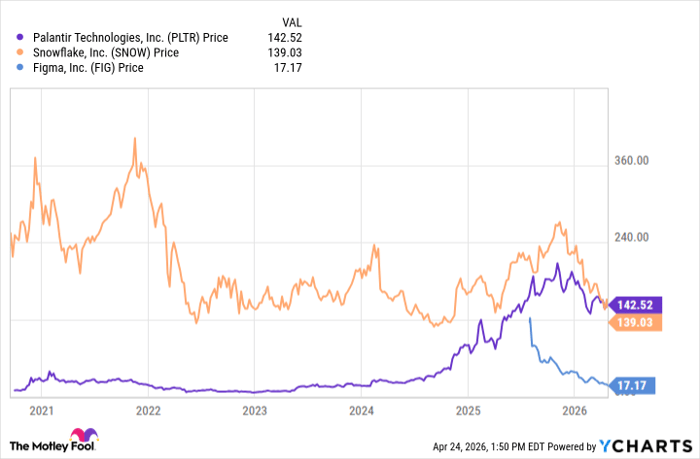
Palantir Technologies (NASDAQ: PLTR) went public via direct listing in 2020 at a price around $10. While shares initially climbed amid data analytics excitement and consistent cheerleading from investment personalities like Cathie Wood, Palantir stock later plunged more than 60% in 2022 as concerns around growth started to mount. It took almost three years and a generational tailwind from artificial intelligence (AI) demand for the stock to not only recover but eventually surge well beyond its IPO levels.
Snowflake's (NYSE: SNOW) 2020 debut was even more explosive: Priced at $120, shares opened at $245 and closed near $254 on day one. By late 2021, Snowflake stock was briefly touching $400. As the graph shows, shares gave back much of this premium. Currently, Snowflake stock hovers around $140 -- still above the offer price but far below its peak.
Figma (NYSE: FIG) listed last year at $33. Shares rocketed to over $115 on opening day before crashing in epic fashion. Within months, Figma was 50% below its IPO price and so far has not proven a path to rebounding.
What does history suggest will happen with the SpaceX IPO?
The case studies explored above share a similar arc. Massive pops driven by growth narratives, followed by lock-up expirations and the market's demand for measurable earnings power over ambitious visions.
Buying into IPO momentum carries explicit risks. The initial surge often reflects underpricing mixed with retail jitters rather than sound fundamentals. This sets the stage for sharp reversals if growth decelerates or sentiment turns. Lock-up expirations subsequently trigger waves of selling.
Palantir's multi-year recovery shows that exceptional businesses can eventually reward holders, but only those with relentless patience and conviction. On the other hand, Snowflake and Figma are reminders that even strong brands can drown below IPO prices for extended periods when expectations outrun reality.
For SpaceX, the same dynamics apply. Its sky-high target valuation leaves virtually zero margin for execution slips in an already capital-intensive industry. Investors tempted by the IPO are better off waiting for the dust to settle when actual financial performance can be judged. While history does not guarantee SpaceX will falter, it strongly recommends against assuming the debut will be the best entry point.
Should you buy stock in Palantir Technologies right now?
Before you buy stock in Palantir Technologies, consider this:
The Motley Fool Stock Advisor analyst team just identified what they believe are the 10 best stocks for investors to buy now… and Palantir Technologies wasn’t one of them. The 10 stocks that made the cut could produce monster returns in the coming years.
Consider when Netflix made this list on December 17, 2004... if you invested $1,000 at the time of our recommendation, you’d have $492,752!* Or when Nvidia made this list on April 15, 2005... if you invested $1,000 at the time of our recommendation, you’d have $1,327,935!*
Now, it’s worth noting Stock Advisor’s total average return is 991% — a market-crushing outperformance compared to 201% for the S&P 500. Don't miss the latest top 10 list, available with Stock Advisor, and join an investing community built by individual investors for individual investors.
See the 10 stocks »
*Stock Advisor returns as of April 28, 2026.
Adam Spatacco has positions in Palantir Technologies and Tesla. The Motley Fool has positions in and recommends Figma, Palantir Technologies, Snowflake, and Tesla. The Motley Fool has a disclosure policy.
Recommended Articles


