


Surpassing Nvidia and TSMC. SK Hynix 72% Operating Margin Supports Strongest Ever Financial Report
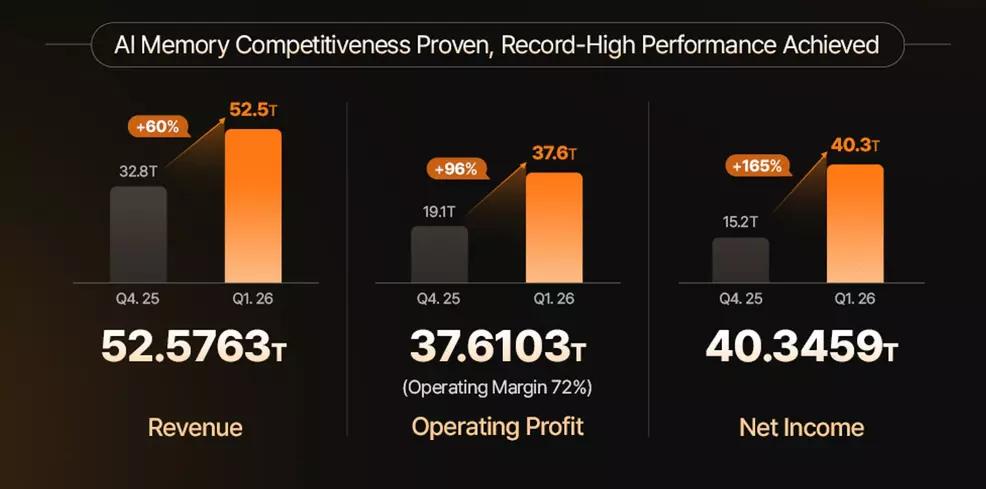
TradingKey - On Thursday morning, South Korean memory chip giant SK Hynix disclosed its most stellar quarterly results since its inception, with both revenue and profit indicators hitting record highs; quarterly revenue surpassed the 50 trillion won mark for the first time, as its profitability stood out in the global semiconductor industry.
According to the latest earnings report, SK Hynix achieved operating revenue of 52.58 trillion won in the first quarter of fiscal year 2026, a 160% surge from the previous quarter and a massive 298% increase compared to the same period in 2025; operating profit reached 37.61 trillion won, skyrocketing 196% quarter-on-quarter and 505% year-on-year.
The corresponding operating margin rose to 72%, setting a record high for a single quarter since the company's inception. For an asset-heavy memory manufacturer like SK Hynix, such strong profit elasticity is relatively rare.
From a cross-industry perspective, SK Hynix's 72% operating margin not only exceeded the semiconductor industry peak of 65% set by Nvidia ( NVDA) in the fourth quarter of 2025, but also significantly outperformed Taiwan Semiconductor Manufacturing Co. ( TSM )'s 58.1% operating margin in the first quarter of 2026.
Regarding the reasons for the significant growth in performance, SK Hynix attributed it to the continuous rise in prices for DRAM and NAND flash products, as well as the increasing proportion of high-value-added products in its revenue mix.
Management emphasized that the strategic demand for high-performance memory chips from AI computing is becoming increasingly prominent, while global high-end memory capacity remains tight. This supply-demand imbalance is expected to persist for an extended period, providing support for product prices to remain elevated.
Although the first quarter is typically a traditional off-season for the memory chip industry, massive investment in AI infrastructure has created strong incremental demand, driving the company's profitability upward against the trend.
Following the upbeat earnings report, the company's stock price rose by as much as 3.6% in early South Korean trading before narrowing its gains to close 0.16% higher.
SK Hynix Accelerates Capacity Expansion
Driven by the surge in demand for AI computing power, a fierce battle for technology and market share is unfolding in the global DRAM market.
Mirae Asset Securities estimates that the average selling price of DRAM rose 60.8% quarter-on-quarter in the first quarter, while NAND flash increased by 55.3%. As data center investment scales up, demand for enterprise-grade solid-state drives (SSDs) has also seen significant growth.
The latest monitoring data from Counterpoint Research shows that, propelled by the continuous rise in memory prices, the DRAM market has achieved 30% quarter-on-quarter growth for two consecutive quarters. The core driver of this price rally is the explosive demand for High Bandwidth Memory (HBM) triggered by AI chips.
According to company earnings reports, current customer demand has fully outstripped supply capacity. Based on this market dynamic, SK Hynix has designated 2026 as a critical period for strategic capacity expansion—capital expenditure for the current fiscal year will increase significantly year-on-year, focusing on Yongin cluster infrastructure, M15X production line ramp-up, and key equipment procurement.
SK Hynix has explicitly stated that its investment scale in 2026 will be significantly higher than the 30.2 trillion won planned for 2025, with a core focus on M15X technology lines, Yongin campus infrastructure, and EUV equipment deployment. As of the end of the first quarter this year, the company's cash and cash equivalents reached 54.3 trillion won, while interest-bearing debt dropped to 19.3 trillion won, resulting in a net cash reserve of 35 trillion won.
Simultaneously, SK Hynix is advancing an approximately 19 trillion won investment plan for an advanced packaging plant and will procure EUV equipment with a total value of about 11.95 trillion won from ASML by 2027. It is evident that industry profits are gradually shifting from corporate income statements toward equipment procurement, packaging technology upgrades, and capacity expansion.
SK Hynix stated: "We will strategically expand our production scale to actively respond to medium-to-long-term demand growth, and we will ensure supply stability and financial soundness."
SK Hynix Bets on AI Memory
In the core AI field of HBM, the company is collaborating deeply with customers to advance HBM4 development, with plans to achieve a mass production ramp-up according to the agreed schedule.
Meanwhile, in the DRAM sector, the company has taken the lead in completing the development of the industry's first 1cnm LPDDR6, which will be supplied at scale in the second half of the year alongside a leading smartphone customer's next-generation flagship model; additionally, mass production has begun for the 1cnm 192GB SOCAMM2, optimized for NVIDIA's Vera Rubin platform.
In the NAND flash sector, the PQC21 client SSD, utilizing CTF architecture and 321-layer QLC technology, has been launched; for enterprise SSDs (eSSD), a balanced product line of high-performance TLC and high-capacity QLC has been established, and the company will leverage Solidigm's technical advantages in high-capacity QLC eSSDs to deepen its competitiveness in the AI data center and AI PC storage markets.
SK Hynix assesses that artificial intelligence is evolving from the large model training stage toward autonomous AI, and the proliferation of real-time inference loop scenarios will continue to broaden memory demand fundamentals, with both DRAM and NAND flash categories benefiting from this long-term trend.
To this end, the company has clarified that it will cover diverse demand scenarios through continuous product iterations; specifically for HBM products, it will strengthen full-chain delivery capabilities across four dimensions—performance, yield, quality, and supply stability—to match the structural growth demands of the AI era.
Recommended Articles


