


Will Eli Lilly's New GLP-1 Pill Get the Stock Get Back to a $1 Trillion Valuation?
Key Points
Eli Lilly has another promising drug in its portfolio with Foundayo.
Its growth rate has been more than 40% in recent quarters due to the success of its current GLP-1 drugs.
The stock's valuation is high, but a premium may be warranted given its growth prospects.
- 10 stocks we like better than Eli Lilly ›
The trillion-dollar club is an exclusive one, featuring some of the most successful and promising companies in the world. Joining the ranks and reaching a $1 trillion valuation is a milestone. But staying there is also a challenge.
Eli Lilly (NYSE: LLY) became the first healthcare company to reach $1 trillion in market cap last year. However, given its poor start to 2026, it has fallen well below that. Entering trading on Monday, the company's valuation was around $830 billion.
Will AI create the world's first trillionaire? Our team just released a report on the one little-known company, called an "Indispensable Monopoly" providing the critical technology Nvidia and Intel both need. Continue »
There has been more excitement around the stock lately with the approval of its GLP-1 weight loss pill. Could that give the stock the boost it needs to get back to a $1 trillion valuation this year?

Image source: Getty Images.
A stronger growth rate could lead to much more bullishness
On April 1, the Food and Drug Administration approved Foundayo, which is Eli Lilly's weight loss drug. The pill will be easier for people to take than an injectable and help reach a broader range of patients, who may not have wanted to take an injectable. Eli Lilly's growth rate has been elevated in recent years due to the success of Mounjaro and Zepbound, its GLP-1 drugs that are already generating billions in revenue, and this approval could give it a further boost.
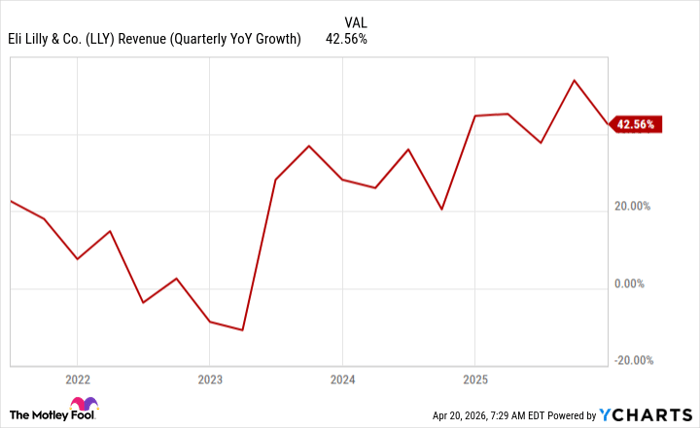
LLY Revenue (Quarterly YoY Growth) data by YCharts
If Eli Lilly maintains a high growth rate of over 40%, it could become too attractive an option for growth investors to pass up. The big question, however, is whether all this has already been effectively priced into Eli Lilly's share price.
The stock is pricey, but it may still rise higher anyway
Although Foundayo's approval was a positive development for Eli Lilly, it hasn't led to its shares taking off. The big reason why is that the market was widely expecting approval to happen, given how well the drug was performing in clinical trials. It would have been more of a surprise if regulators hadn't approved the drug.
Currently, Eli Lilly's stock trades at more than 40 times its trailing earnings. And although that's down from more than 70 times earnings a year ago, it's still a fairly high price premium, and one investors may balk at paying given the growing competition in the GLP-1 space.
Nonetheless, there may still be room for the stock to get back to $1 trillion if its financial results get a boost from Foundayo. The consensus analyst price target for the stock is $1,224, which implies an upside of around 32%; Eli Lilly's shares would need to rise by just 20% to reach a $1 trillion valuation.
Although its valuation is high, Eli Lilly is likely to be part of the trillion-dollar club yet again; it's just a matter of how quickly that happens. If you're a long-term investor, this can be an excellent stock to simply buy and hold.
Should you buy stock in Eli Lilly right now?
Before you buy stock in Eli Lilly, consider this:
The Motley Fool Stock Advisor analyst team just identified what they believe are the 10 best stocks for investors to buy now… and Eli Lilly wasn’t one of them. The 10 stocks that made the cut could produce monster returns in the coming years.
Consider when Netflix made this list on December 17, 2004... if you invested $1,000 at the time of our recommendation, you’d have $524,786!* Or when Nvidia made this list on April 15, 2005... if you invested $1,000 at the time of our recommendation, you’d have $1,236,406!*
Now, it’s worth noting Stock Advisor’s total average return is 994% — a market-crushing outperformance compared to 199% for the S&P 500. Don't miss the latest top 10 list, available with Stock Advisor, and join an investing community built by individual investors for individual investors.
See the 10 stocks »
*Stock Advisor returns as of April 20, 2026.
David Jagielski, CPA has no position in any of the stocks mentioned. The Motley Fool has no position in any of the stocks mentioned. The Motley Fool has a disclosure policy.
Recommended Articles


