


As Trump Leans on Missile Defense in His Iran Strategy, Raytheon Has Never Been More Critical
Key Points
RTX may be a winner as the U.S. re-arms following the ongoing war in Iran.
The conflict involves significant usage of Raytheon-produced missiles, and those stockpiles need to be replenished.
Uncle Sam is already committed to replacement orders.
- 10 stocks we like better than RTX ›
Geopolitical situations can change at a moment's notice. The war in Iran proves as much. Last Friday, it sure looked like the Strait of Hormuz was going to open in earnest. By Saturday, Iran had retaken control of the critical waterway and even fired on some ships attempting to pass through. As of Monday morning, tensions were back on the rise, and shipping disruptions were casting doubt on a fragile ceasefire set to expire this week.
The situation is clearly tense and volatile, and without the benefit of a crystal ball, no one really knows what will happen next. Still, there are lessons for investors. For example, when cooler heads seemed to prevail last week, equities rallied, but some industrial stocks, namely those in the aerospace and defense sector, languished.
Will AI create the world's first trillionaire? Our team just released a report on the one little-known company, called an "Indispensable Monopoly" providing the critical technology Nvidia and Intel both need. Continue »
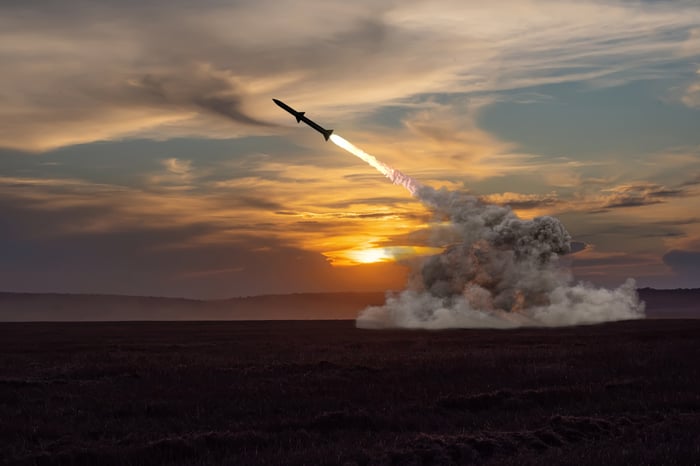
RTX stock could take off as the U.S. boosts orders for Raytheon missiles. Image source: Getty Images.
Just look at Raytheon parent RTX (NYSE: RTX). That aerospace and defense stock lost 2.55% last week as the broader market rallied amid hopes that tensions in the Middle East were cooling and that U.S.-Iran negotiations were progressing. One look at that glum price action, and it'd be easy for an investor to infer that RTX needs the war to rage on for its share price to rise.
Those are the types of dots market participants often associate with defense stocks and wars, but there's a different reality, suggesting that RTX is poised to be a winner even if this war resolves.
Uncle Sam needs missiles. RTX has 'em.
A quick history lesson: RTX, as it stands today, is the result of the marriage between Raytheon and United Technologies. The name Raytheon had been in use for a century before the 2023 rebranding to RTX.
Raytheon still falls under the RTX umbrella, which is relevant to investors because it's one of the leading manufacturers of missiles used by the U.S. military. Using those missiles is exactly what the military has done since the start of the war in Iran. Just look at the statistics regarding the Raytheon-produced Tomahawk missile. In just the first month of the war, the U.S. flew 319 of those weapons, equivalent to 10% of its total stockpile.
Investors experienced with aerospace stocks know that nearly all large-scale products produced by the industry, whether commercial aircraft or military gear, take time to build. Typically, Raytheon can produce 500 Tomahawks per year, but due to rapid depletion, it has procured an order from the government to double that figure.
The Tomahawk is just one example of a Raytheon product the U.S. is depending on in this war. Others include air-to-air defense missiles (think Top Gun) and interceptor missiles. That's all "mission critical" stuff, and the government is boosting orders for it. So much so that RTX is pledging to, in some cases, quadruple current rates of production.
RTX may be a post-war "buy"
Periods of war and flirtations with armed conflict seem to stir up sayings such as "peace through strength" and the like. One way to interpret that phrase is that rearmament is a priority for the U.S. government because military strength can serve as a deterrent. If the "bad guys" act up, the reprisal will be undesirable.
RTX stands to benefit from those schools of thought because it's more practical to rearm and leverage new military tools for deterrence than to be caught flat-footed without enough equipment should another conflict pop up elsewhere.
Not to be lost in this conversation is the old-school line of thinking that wars are good for the economy. That dates back to World War II, and while it's not always true, rearmament does jibe with politicians' efforts to rejuvenate American manufacturing. RTX is relevant on that front because much of the gear the government is asking the company to speed up production of is manufactured in Alabama, Arizona, and Massachusetts.
Should you buy stock in RTX right now?
Before you buy stock in RTX, consider this:
The Motley Fool Stock Advisor analyst team just identified what they believe are the 10 best stocks for investors to buy now… and RTX wasn’t one of them. The 10 stocks that made the cut could produce monster returns in the coming years.
Consider when Netflix made this list on December 17, 2004... if you invested $1,000 at the time of our recommendation, you’d have $524,786!* Or when Nvidia made this list on April 15, 2005... if you invested $1,000 at the time of our recommendation, you’d have $1,236,406!*
Now, it’s worth noting Stock Advisor’s total average return is 994% — a market-crushing outperformance compared to 199% for the S&P 500. Don't miss the latest top 10 list, available with Stock Advisor, and join an investing community built by individual investors for individual investors.
See the 10 stocks »
*Stock Advisor returns as of April 20, 2026.
Todd Shriber has no position in any of the stocks mentioned. The Motley Fool has positions in and recommends RTX. The Motley Fool has a disclosure policy.
Recommended Articles


