


Trump's Iran Strategy Puts Palantir in the Spotlight -- but Is This Defense‑Data Stock Built for Long‑Term Investors?
Key Points
The U.S. military is heavily using Palantir's technology in the war with Iran.
The company's artificial intelligence solutions are in strong demand, and customers have been signing new multiyear contracts with it.
Palantir's valuation remains high even after a significant share price drop in 2026.
- 10 stocks we like better than Palantir Technologies ›
The U.S. war with Iran has further elevated the profile of Palantir Technologies (NASDAQ: PLTR). President Donald Trump praised the company on his social media platform, stating, "Palantir Technologies (PLTR) has proven to have great war fighting capabilities and equipment."
The tech titan's ability to analyze vast amounts of data and sift out actionable insights through artificial intelligence has given it a groundbreaking role in the conflict. According to Palantir Chief Technology Officer Shyam Sankar, the war with Iran is "the first large-scale combat operation that was really driven... with AI."
Will AI create the world's first trillionaire? Our team just released a report on the one little-known company, called an "Indispensable Monopoly" providing the critical technology Nvidia and Intel both need. Continue »
Although Palantir's current role in the limelight may make it seem like a defense sector company, that may not last, especially after Trump leaves office. This raises the question: Is the stock a worthwhile long-term investment?
Image source: Getty Images.
Palantir's business growth
Despite its role assisting the U.S. government, particularly its military and intelligence arms, Palantir's shares are down about 20% this year through April 16. That decline is in part a result of Wall Street's "Great Rotation" away from tech stocks. The company's actual financial performance, however, remains outstanding.
In the fourth quarter, revenue rose a whopping 70% year over year to $1.4 billion. Breaking that top-line figure down further delivers useful insights. Government sales comprised $730 million of the total, a 60% year-over-year increase. This segment could see further growth in Q1 due to the Iran conflict.
Yet what's more telling about Palantir's long-term business prospects is the portion of revenue it's getting from the commercial sector. Here, Q4 sales were $677 million, representing an impressive 82% year-over-year jump. That shows the company is successfully capturing new non-government customers.
Palantir's AI achievements
Palantir's commercial business is quickly growing thanks to its Artificial Intelligence Platform (AIP). For example, in March, the company extended its partnership with Stellantis for an additional five years. The automaker is using AIP to bring AI to its operations.
The Stellantis deal is just the tip of the iceberg. Palantir is joining forces with fintech company Moder to build an AI-powered platform for the mortgage industry. And it signed a multiyear deal to expand its partnership with GE Aerospace in March, also involving the use of AIP.
This customer demand validates Palantir CEO Alex Karp's assertion that, "We are still at the very start of things. This remains the beginning, the first moment of a first chapter."
That sentiment makes sense, as organizations around the world are concluding that they will need to either adopt artificial intelligence tools or risk falling into obsolescence. This has led to numerous ambitious forecasts for the growth of the AI market. Statista, for example, predicts that the size of the space will expand from $335 billion in 2026 to a jaw-dropping $1.3 trillion by 2032.
Palantir is benefiting from the AI tailwind, as its Q4 results attest, and there's no sign that a slowdown in sales is coming anytime soon. The company is guiding for revenue to accelerate to $1.5 billion in Q1, a massive increase from the prior-year period's $883.9 million.
Not only that, management is driving that growth without sacrificing financial health. Palantir exited 2025 with a spectacular balance sheet. Total assets were $8.9 billion, with $1.4 billion of that in cash and equivalents, and $5.8 billion in marketable securities. Total liabilities were $1.4 billion, but more than $450 million of that was deferred revenue, which will eventually be recognized as sales, and the company has no debt.
The long-term investment thesis
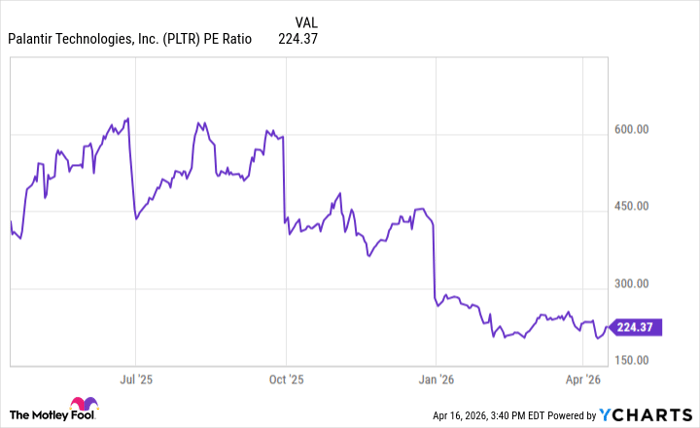
Palantir's robust business growth resulted in Q4 net income of $611.6 million compared to $76.9 million in the prior-year period. In spite of that impressive bottom-line increase coupled with this year's share price decline, its stock valuation remains high: It still trades at a price-to-earnings ratio of more than 200.
Data by YCharts.
Even so, as the chart shows, Palantir's earnings multiple is around its 52-week low. This suggests that if you're interested in buying shares, now looks like a good time to do so.
Beyond the U.S. conflict with Iran, Palantir's potential for business expansion remains vast, as exemplified by its significant commercial sales growth. This, combined with rapidly rising profits and an excellent balance sheet, points to the tech company being a solid long-term investment.
Should you buy stock in Palantir Technologies right now?
Before you buy stock in Palantir Technologies, consider this:
The Motley Fool Stock Advisor analyst team just identified what they believe are the 10 best stocks for investors to buy now… and Palantir Technologies wasn’t one of them. The 10 stocks that made the cut could produce monster returns in the coming years.
Consider when Netflix made this list on December 17, 2004... if you invested $1,000 at the time of our recommendation, you’d have $581,304!* Or when Nvidia made this list on April 15, 2005... if you invested $1,000 at the time of our recommendation, you’d have $1,215,992!*
Now, it’s worth noting Stock Advisor’s total average return is 1,016% — a market-crushing outperformance compared to 197% for the S&P 500. Don't miss the latest top 10 list, available with Stock Advisor, and join an investing community built by individual investors for individual investors.
See the 10 stocks »
*Stock Advisor returns as of April 17, 2026.
Robert Izquierdo has positions in Palantir Technologies. The Motley Fool has positions in and recommends GE Aerospace and Palantir Technologies. The Motley Fool recommends Stellantis. The Motley Fool has a disclosure policy.
Recommended Articles


