


Meet the 2 Vanguard ETFs That Are Issuing 6-for-1 Stock Splits in April. Here's Why Both Are Buys Now.
Key Points
Vanguard's growth-focused ETFs have rewarded patient investors.
There are significant differences in allocation between the Vanguard Growth ETF and the Vanguard S&P 500 Growth ETF.
Before buying either ETF, it’s worth considering how its holdings would alter your overall portfolio's allocation.
- 10 stocks we like better than Vanguard Growth ETF ›
Will AI create the world's first trillionaire? Our team just released a report on the one little-known company, called an "Indispensable Monopoly" providing the critical technology Nvidia and Intel both need. Continue »
Investment management firm Vanguard is executing forward share splits on five of its equity index exchange-traded funds (ETFs) -- including 6-for-1 splits on the Vanguard Growth ETF (NYSEMKT: VUG) and the Vanguard S&P 500 Growth ETF (NYSEMKT: VOOG).
In a press release, Vanguard cited ETF market prices, bid-ask spreads, and trading volume as reasons it is issuing splits to improve investor outcomes.
The splits will bring the Growth ETF and S&P 500 Growth ETF from triple-digit prices to around $70 per share or lower. The Growth ETF is $420.01 per share at the time of this writing, and the S&P 500 ETF is $391.94 per share.
Here are the key differences between the two ETFs, and why both are great buys now.

Image source: Getty Images.
Two historically strong ETFs
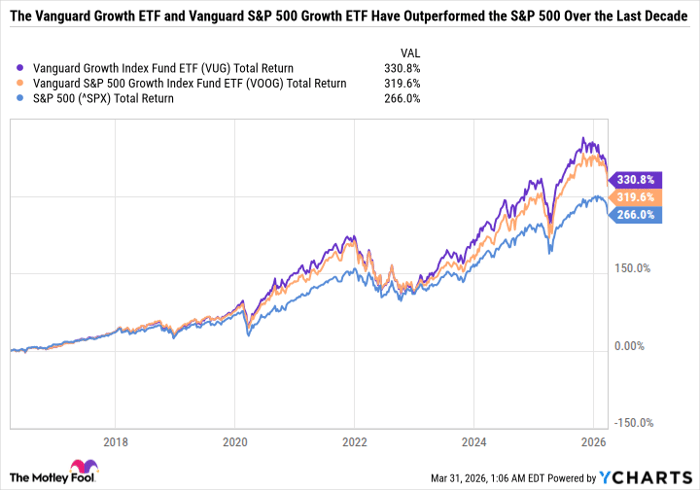
The Vanguard Growth ETF is the firm's flagship growth fund. It has $335.9 billion in net assets at the time of this writing, which is significantly more than $21.9 billion in net assets for the S&P 500 Growth ETF. The Growth ETF has slightly outperformed the S&P 500 Growth ETF over the last decade. But most funds have outperformed the S&P 500 (SNPINDEX: ^GSPC).
Data by YCharts.
The Vanguard Growth ETF has 151 holdings compared to 140 for the S&P 500 Growth ETF. Despite the similar historical performance and total number of holdings, the growth ETFs have noteworthy differences.
Two key differences
The biggest difference between the two funds is their allocation to Apple. The Growth ETF has a massive 12.2% weighting in Apple compared to just 6.4% for the S&P 500 Growth ETF. The lower Apple weighting allows the S&P 500 Growth ETF to allocate more to Nvidia, Microsoft, Alphabet, Broadcom, and Meta Platforms (among other names). Interestingly, the Growth ETF also has higher weightings in Amazon and Tesla.
Another key difference is that the S&P 500 Growth ETF allocates 3.1% to Berkshire Hathaway and 1.7% to JPMorgan Chase -- whereas the Growth ETF doesn't hold either of those stocks. So while the Growth ETF has just a 2% weighting in the financials sector, the S&P 500 Growth ETF is much higher at 9.7%.
The better ETF to buy now
Both ETFs are excellent low-cost ways to get exposure to leading growth stocks. The Vanguard Growth ETF has a lower expense ratio of 0.03% compared to 0.07% for the S&P 500 Growth ETF. But even $10,000 invested in the S&P 500 Growth ETF would generate just $4 in additional annual fees compared to the Growth ETF.
Given that the expense ratios are essentially a toss-up, the decision on which fund to buy now should come down to differences in how each fund weights its top holdings.
Investors who want more exposure to Apple -- and to a lesser extent, Amazon, and Tesla -- should go with the Growth ETF. But investors who want less Apple and more exposure to Nvidia, other leading growth stocks, and financials should go with the S&P 500 Growth ETF.
Given Apple and Tesla are my two least favorite "Magnificent Seven" stocks, the S&P 500 Growth ETF is my preferred choice -- but it all comes down to which megacap growth stocks you think are the best buys now and how each ETF complements your existing portfolio holdings.
Should you buy stock in Vanguard Growth ETF right now?
Before you buy stock in Vanguard Growth ETF, consider this:
The Motley Fool Stock Advisor analyst team just identified what they believe are the 10 best stocks for investors to buy now… and Vanguard Growth ETF wasn’t one of them. The 10 stocks that made the cut could produce monster returns in the coming years.
Consider when Netflix made this list on December 17, 2004... if you invested $1,000 at the time of our recommendation, you’d have $515,294!* Or when Nvidia made this list on April 15, 2005... if you invested $1,000 at the time of our recommendation, you’d have $1,077,442!*
Now, it’s worth noting Stock Advisor’s total average return is 914% — a market-crushing outperformance compared to 184% for the S&P 500. Don't miss the latest top 10 list, available with Stock Advisor, and join an investing community built by individual investors for individual investors.
See the 10 stocks »
*Stock Advisor returns as of April 2, 2026.
JPMorgan Chase is an advertising partner of Motley Fool Money. Daniel Foelber has positions in Nvidia. The Motley Fool has positions in and recommends Alphabet, Amazon, Apple, Berkshire Hathaway, JPMorgan Chase, Meta Platforms, Microsoft, Nvidia, Tesla, and Vanguard Growth ETF and is short shares of Apple. The Motley Fool recommends Broadcom. The Motley Fool has a disclosure policy.
Recommended Articles


