


The JPMorgan Equity Premium Income ETF (JEPI) and the JPMorgan Nasdaq Equity Premium Income ETF (JEPQ) Have a Glaring Flaw. Here's Why They Could Still Be Buys.
Key Points
Covered call ETFs are ideally suited for investors seeking monthly passive income rather than potential long-term gains.
However, these ETFs can be volatile.
They will likely underperform their benchmark indexes over the long term.
- 10 stocks we like better than JPMorgan Equity Premium Income ETF ›
The JPMorgan Equity Premium Income ETF (NYSEMKT: JEPI) and the JPMorgan Nasdaq Equity Premium Income ETF (NASDAQ: JEPQ) -- commonly referred to by their tickers as "JEPI" and "JEPQ" rather than formal names -- are two relatively new actively managed exchange-traded funds (ETFs) for generating monthly passive income.
JEPI hit the scene in May 2020, followed by JEPQ in May 2022. JEPI already has over $43 billion in net assets, compared to over $33 billion for JEPQ.
Will AI create the world's first trillionaire? Our team just released a report on the one little-known company, called an "Indispensable Monopoly" providing the critical technology Nvidia and Intel both need. Continue »
The funds have gained considerable interest for their sky-high yields, with JEPI sporting a 30-day SEC yield of 7.6% compared to 11.4% for JEPQ. Here's why both funds are excellent tools for generating passive income, but have a glaring flaw that may be a deal-breaker for certain long-term investors.

Image source: Getty Images.
Generating income from the major indexes
The stocks in the S&P 500 yield an average of just 1.1%, while the Nasdaq-100, which contains the 100 largest non-financial stocks in the Nasdaq, yields an average of 0.5%. So funds that track these indexes, like the Vanguard S&P 500 ETF (NYSEMKT: VOO) or the Invesco QQQ Trust (NASDAQ: QQQ), aren't the best tools for generating passive income.
JEPI holds S&P 500 stocks and sells out-of-the-money call options to generate monthly income, and to a lesser extent, equity-linked notes. JEPQ does a similar strategy with the Nasdaq-100.
Out-of-the-money covered calls have a strike price above the current index price, but they still cap upside potential. This is especially true in cases where indexes are rising quickly and outpacing the gains from call premiums. This happened in 2025 when the Invesco QQQ and Vanguard S&P 500 outperformed JEPI and JEPQ by total return, which factors in gains and dividends.
However, JEPI and JEPQ will outperform the major indexes if call premiums outpace broader market gains, which can occur in sideways and down markets.
Limited downside protection
The glaring flaw of JEPI and JEPQ is that they only protect against some of the downside risk of market volatility.
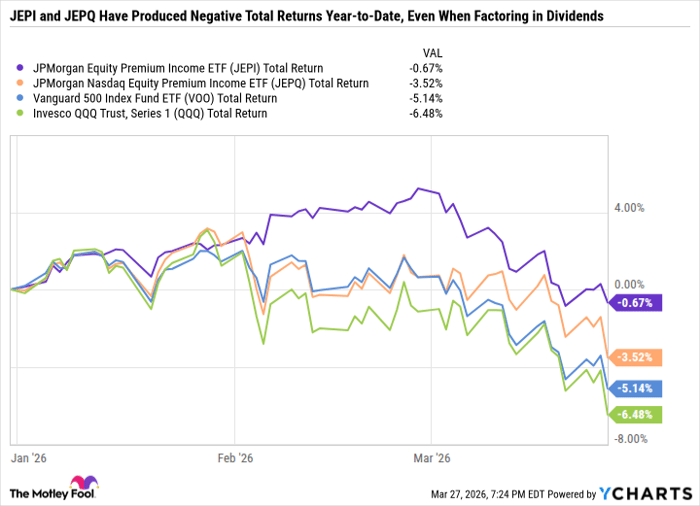
The protection is better if an index falls gradually over an extended timeframe and new calls are written each month. But JEPI and JEPQ will get hit hard by a short and sudden sell-off, as we saw in April 2025 and now March 2026.
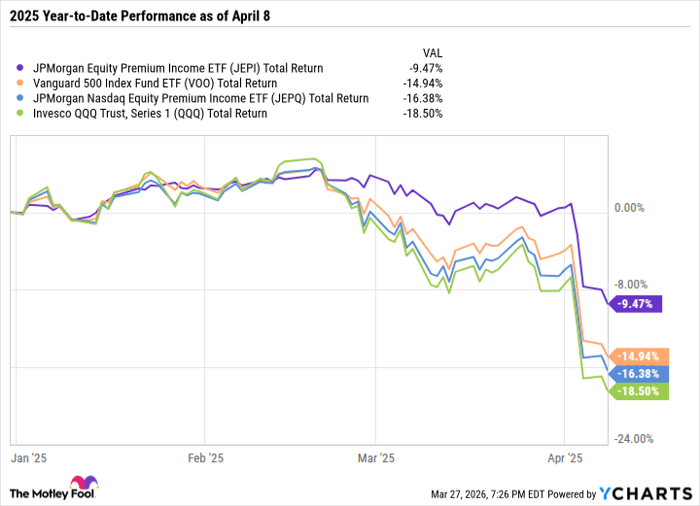
Here's a look at how these ETFs were performing year to date at the peak of the tariff-induced sell-off on April 8, 2025.
Data by YCharts.
As you can see in the chart, JEPQ, in particular, was down almost as much as the Invesco QQQ Trust, simply because the sell-off occurred so quickly that it eroded the protection of the call premiums.
Here's how they are performing year to date as of market close on March 27.
Data by YCharts.
Reasons to buy or avoid
JEPI and JEPQ aren't a good fit for risk-averse investors seeking passive income, because they can be volatile. That's a red flag for folks looking to preserve their capital in retirement.
These ETFs will also likely underperform their respective indexes over the long term, as has been the case for both funds since their inception.
However, both funds could still be good buys for investors who don't mind volatility and value generating monthly passive income over the potential upside of the S&P 500 or the Nasdaq-100.
Should you buy stock in JPMorgan Equity Premium Income ETF right now?
Before you buy stock in JPMorgan Equity Premium Income ETF, consider this:
The Motley Fool Stock Advisor analyst team just identified what they believe are the 10 best stocks for investors to buy now… and JPMorgan Equity Premium Income ETF wasn’t one of them. The 10 stocks that made the cut could produce monster returns in the coming years.
Consider when Netflix made this list on December 17, 2004... if you invested $1,000 at the time of our recommendation, you’d have $518,530!* Or when Nvidia made this list on April 15, 2005... if you invested $1,000 at the time of our recommendation, you’d have $1,069,165!*
Now, it’s worth noting Stock Advisor’s total average return is 915% — a market-crushing outperformance compared to 183% for the S&P 500. Don't miss the latest top 10 list, available with Stock Advisor, and join an investing community built by individual investors for individual investors.
See the 10 stocks »
*Stock Advisor returns as of April 1, 2026.
JPMorgan Chase is an advertising partner of Motley Fool Money. Daniel Foelber has positions in JPMorgan Equity Premium Income ETF and JPMorgan Nasdaq Equity Premium Income ETF. The Motley Fool has positions in and recommends JPMorgan Chase and Vanguard S&P 500 ETF. The Motley Fool recommends Nasdaq. The Motley Fool has a disclosure policy.
Recommended Articles


