


What Happens if the S&P 500 Joins the Nasdaq and Dow in Correction Territory?
Key Points
The stock market sell-off continues as investor uncertainty remains high.
The influence of big tech stocks extends far beyond the Nasdaq.
But other pockets of the market paint a more optimistic picture.
- 10 stocks we like better than NASDAQ Composite Index ›
On March 26, the Nasdaq Composite (NASDAQINDEX: ^IXIC) entered a correction, closing down more than 10% from its high. The Dow Jones Industrial Average (DJINDICES: ^DJI) joined the Nasdaq in a correction on March 27.
As of market close on March 30, the Nasdaq was down 13.3% from its all-time high, the Dow is slightly out of correction territory, down 9.9%, and the S&P 500 (SNPINDEX: ^GSPC) is down 9.1%.
Will AI create the world's first trillionaire? Our team just released a report on the one little-known company, called an "Indispensable Monopoly" providing the critical technology Nvidia and Intel both need. Continue »
Here's what would happen if all three indexes fell into a correction, and how to navigate market volatility.

Image source: Getty Images.
Three readings on the market
The major indexes are often oversimplified to reflect market movements -- the S&P 500 for the general market, the Nasdaq for growth stocks, and the Dow for blue chip value stocks.
But because the bulk of market gains have been driven by tech-focused megacap companies in recent years, the S&P 500 has become somewhat of a large-cap growth index in its own right. Meanwhile, over half of the Nasdaq-100 -- which is the 100 largest non-financial Nasdaq components by market cap -- is weighted in just five stocks: Nvidia, Alphabet, Apple, Microsoft, and Amazon.
These companies are disproportionately dragging down the index, with all five stocks down more from their highs than the Nasdaq.
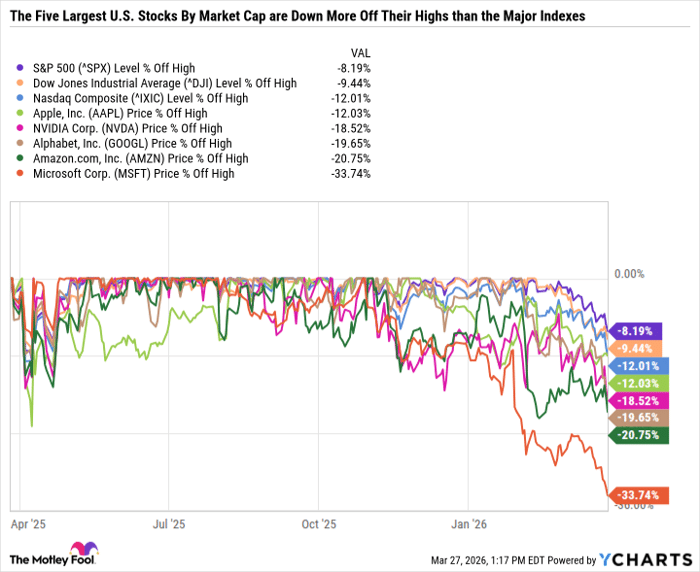
^SPX data by YCharts
You may be surprised that the Dow is underperforming the S&P 500, given that value stocks typically hold up better during a sell-off. In fact, many value-focused sectors are outperforming the major indexes this year. The energy sector is up 40.2% year to date, and the materials, utilities, industrials, and consumer staples sectors have also posted gains.
But the Dow is still down big because it has become more balanced across sectors and reflective of the broader market. Nvidia and Amazon were both added to the Dow in 2024, joining Microsoft and Apple. Financials and tech now combine for a whopping 43% of the Dow's weighting.
The Dow is no longer an "industrials" index, as the name implies.
A concentrated sell-off
Concentration is a double-edged sword, as it can accelerate gains over the long term but also magnify a sell-off. The largest growth stocks no longer just dominate the Nasdaq -- they also influence the S&P 500, and, increasingly, the Dow.
The key takeaway is that the U.S. stock market is much more growth- and tech-focused than in the past, and, compared to other markets, this has paid off over the long run and will continue to pay off if themes like cloud computing and artificial intelligence (AI) accelerate earnings growth. But that growth focus puts a lot of emphasis on companies to deliver on high expectations, which can lead to rapid selling during times of uncertainty.
Despite geopolitical tensions, the Vanguard Total International Stock ETF is down less than 1% year to date. And the S&P 500 Equal Weight index, which weights each S&P 500 component equally rather than by market cap -- is also down less than 1% year to date. So despite big losses in the major indexes, most stocks are actually holding up pretty well.
In sum, if the S&P 500 joins the Nasdaq and Dow in a correction, it most likely means that the biggest tech and financials are falling further. But it doesn't necessarily mean that all stocks are falling.
When all three indexes are in a correction, it signals that industry-leading companies across sectors are under pressure -- creating opportunities for growth, income, and value investors. Now is a perfect time to review your watchlist to find companies that you've been wanting to buy, but may have passed on for valuation reasons.
Should you buy stock in NASDAQ Composite Index right now?
Before you buy stock in NASDAQ Composite Index, consider this:
The Motley Fool Stock Advisor analyst team just identified what they believe are the 10 best stocks for investors to buy now… and NASDAQ Composite Index wasn’t one of them. The 10 stocks that made the cut could produce monster returns in the coming years.
Consider when Netflix made this list on December 17, 2004... if you invested $1,000 at the time of our recommendation, you’d have $518,530!* Or when Nvidia made this list on April 15, 2005... if you invested $1,000 at the time of our recommendation, you’d have $1,069,165!*
Now, it’s worth noting Stock Advisor’s total average return is 915% — a market-crushing outperformance compared to 183% for the S&P 500. Don't miss the latest top 10 list, available with Stock Advisor, and join an investing community built by individual investors for individual investors.
See the 10 stocks »
*Stock Advisor returns as of April 1, 2026.
Daniel Foelber has positions in Nvidia. The Motley Fool has positions in and recommends Alphabet, Amazon, Apple, Microsoft, Nvidia, and Vanguard Total International Stock ETF and is short shares of Apple. The Motley Fool has a disclosure policy.
Recommended Articles


