


Should You Buy the Invesco QQQ ETF During the Stock Market Sell-Off? History Offers a Clear Answer.
Key Points
The Nasdaq-100 hosts the 100 most valuable nonfinancial companies listed on the Nasdaq stock exchange, with around 60% of its portfolio parked in technology stocks.
The index is down almost 7% from its record high amid rising economic uncertainty and geopolitical tensions.
The Invesco QQQ ETF tracks the performance of the Nasdaq-100, and history suggests there is rarely a bad time to buy it.
- 10 stocks we like better than Invesco QQQ Trust ›
Over 3,500 companies have chosen to go public through the Nasdaq stock exchange. The Nasdaq-100 index tracks the performance of the top 100 (by value) companies, excluding banks and other financial institutions.
Since the technology sector is home to more trillion-dollar companies than any other sector, it boasts a dominant weighting of almost 60% in the Nasdaq-100. That means companies at the cutting edge of industries like artificial intelligence (AI) have a significant influence over the performance of the index, which is why it typically delivers higher returns than more diversified indexes like the S&P 500.
Will AI create the world's first trillionaire? Our team just released a report on the one little-known company, called an "Indispensable Monopoly" providing the critical technology Nvidia and Intel both need. Continue »
But that can also be a recipe for volatility. The Nasdaq-100 is currently trading down 8.8% from its all-time high amid rising economic uncertainty and geopolitical tensions, whereas the S&P 500 has declined by a lesser 7%.
The Invesco QQQ Trust (NASDAQ: QQQ) is an exchange-traded fund (ETF) that tracks the performance of the Nasdaq-100 by holding the same stocks and maintaining similar weightings. Is the recent sell-off a buying opportunity for investors? Here's what history says.

Image source: Getty Images.
Tech stocks tend to lead the market higher
The Nasdaq-100 (and by extension, the Invesco QQQ ETF) invests across 10 different economic sectors, but as I mentioned earlier, almost 60% of the value of its entire portfolio is parked in technology stocks. The tech sector is home to five companies valued at $1 trillion or more, and four of them are among the top holdings in the Nasdaq-100:
- Nvidia: $4.2 trillion
- Apple: $3.64 trillion
- Microsoft: $2.84 trillion
- Taiwan Semiconductor Manufacturing: $1.71 trillion (not in the Nasdaq-100, because it's listed on the New York Stock Exchange)
- Broadcom: $1.47 trillion
Over the last decade, Nvidia, Apple, Microsoft, and Broadcom have delivered an eye-popping median return of 1,400%. They contributed to a 452% return in the Nasdaq-100 over that period, which was twice the return of the S&P 500.
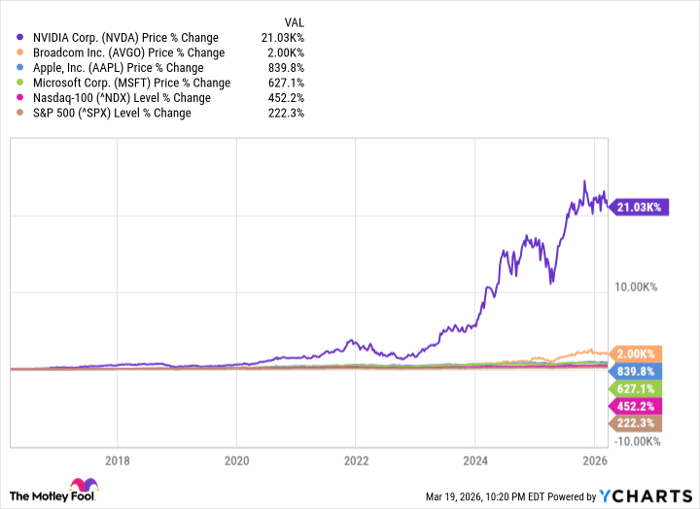
Data by YCharts.
The Nasdaq-100 also holds large positions in other trillion-dollar giants like Alphabet, Amazon, Tesla, and Meta Platforms. They don't fall into the tech sector specifically, but they are extremely active in emerging industries like artificial intelligence (AI), and their respective stocks have also delivered blistering returns over the last decade.
There are many up-and-coming stocks that could also help drive the Nasdaq-100 higher over the long term:
- Advanced Micro Devices, which competes with Nvidia in the market for AI data center chips.
- Micron Technology, which supplies data center memory hardware to both Nvidia and AMD
- Palantir Technologies, which developed a series of AI-powered software platforms to help organizations extract maximum value from their internal data.
- Netflix, which operates the world's largest streaming service for movies and television shows.
- CrowdStrike, which developed an AI-powered, all-in-one cybersecurity platform for enterprises.
There is rarely a bad time to invest
Volatility is a normal part of the investing journey. Enduring stock market declines is the price of admission for an opportunity to earn significant returns over the long term. The Nasdaq-100 has experienced five bear markets since the Invesco QQQ ETF was established in 1999, which are defined by peak-to-trough declines of 20% or more.
Each bear market was caused by an entirely different event, like the bursting of the dot-com bubble in the year 2000, the global financial crisis in 2008, the COVID-19 pandemic in 2020, the inflation crisis in 2022, and the Trump administration's "Liberation Day" tariffs in 2025. In other words, it's practically impossible to predict when the stock market might slip into bear territory, so staying the course -- even during the most unsettling periods -- is the secret to success.
In fact, the Invesco ETF has still produced a compound annual return of 10.3% since 1999, even after accounting for every sell-off, correction, and bear market along the way. Plus, returns have accelerated to 20.3% per year over the last decade thanks to incredible growth in industries like cloud computing and AI. Therefore, investors who simply stayed in the market over the last 27 years would have done exceptionally well.
AI stocks are likely to continue driving the broader market higher, and with technologies like robotics, autonomous vehicles, and even quantum computing quickly gaining momentum, it's reasonable to expect the Invesco QQQ ETF to trend higher over the long term. As a result, now might be a great time to buy.
Should you buy stock in Invesco QQQ Trust right now?
Before you buy stock in Invesco QQQ Trust, consider this:
The Motley Fool Stock Advisor analyst team just identified what they believe are the 10 best stocks for investors to buy now… and Invesco QQQ Trust wasn’t one of them. The 10 stocks that made the cut could produce monster returns in the coming years.
Consider when Netflix made this list on December 17, 2004... if you invested $1,000 at the time of our recommendation, you’d have $495,179!* Or when Nvidia made this list on April 15, 2005... if you invested $1,000 at the time of our recommendation, you’d have $1,058,743!*
Now, it’s worth noting Stock Advisor’s total average return is 898% — a market-crushing outperformance compared to 183% for the S&P 500. Don't miss the latest top 10 list, available with Stock Advisor, and join an investing community built by individual investors for individual investors.
See the 10 stocks »
*Stock Advisor returns as of March 23, 2026.
Anthony Di Pizio has no position in any of the stocks mentioned. The Motley Fool has positions in and recommends Advanced Micro Devices, Alphabet, Amazon, Apple, CrowdStrike, Meta Platforms, Micron Technology, Microsoft, Netflix, Nvidia, Palantir Technologies, Taiwan Semiconductor Manufacturing, and Tesla and is short shares of Apple. The Motley Fool recommends Broadcom and Nasdaq. The Motley Fool has a disclosure policy.
Recommended Articles


