


Down Almost 9% in 1 Week, Is This Your Chance to Buy Starbucks Stock?
Key Points
Starbucks posted 4% global comparable store sales growth in its fiscal first quarter as turnaround efforts gained traction.
The company's operating margin contracted significantly.
With the stock trading at roughly 41 times management's full-year adjusted earnings forecast, shares still leave little room for error.
- 10 stocks we like better than Starbucks ›
Shares of Starbucks (NASDAQ: SBUX) have taken a beating recently, plunging nearly 9% over the past week as of this writing.
The steep drop contrasts with some good news about the company's turnaround efforts earlier this year. In late January, the coffee giant said it returned to transaction growth at its U.S. stores.
Will AI create the world's first trillionaire? Our team just released a report on the one little-known company, called an "Indispensable Monopoly" providing the critical technology Nvidia and Intel both need. Continue »
With the stock selling off even as the underlying business shows early signs of a potential turnaround, is this a buying opportunity?
Then again, maybe the stock's recent pullback makes sense. Not only does the valuation look stretched, but investors may be concerned about the heavy costs required to fuel its recent growth.
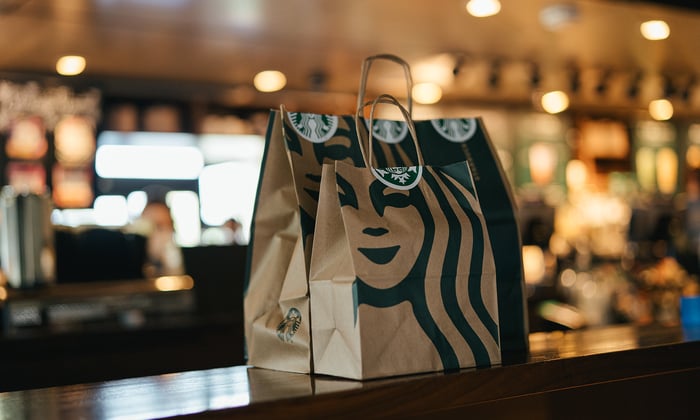
Image source: Starbucks.
Returning to top-line growth
Highlighting the company's underlying momentum, Starbucks' fiscal first-quarter revenue rose 6% year over year to $9.9 billion.
And the growth was driven by exactly what investors want to see: more customers coming through the doors. Starbucks' global comparable store sales -- a metric tracking sales at company-operated stores open for at least 13 months -- increased 4%. This marks a massive improvement from the 4% decline the company posted in the same quarter last year, showing how the company's story has shifted dramatically. Even more encouraging, this global growth was fueled primarily by a 3% increase in comparable transactions, showing that the company's strategic pivot is resonating with consumers.
The strength was broad-based, too. North America comparable sales rose 4%, while international comparable sales climbed 5%.
Starbucks CEO Brian Niccol was pleased with the company's progress.
"In the U.S., where much of our turnaround work has been focused, company-operated transaction comps grew year over year for the first time in eight quarters, and we grew transactions across all dayparts in the quarter," Niccol said during the company's fiscal first-quarter earnings call.
The cost of the turnaround
But this growth comes at a cost. To get customers back into its stores, Starbucks is spending heavily.
Demonstrating the toll these investments are taking on profitability, the company's non-GAAP (adjusted) operating margin contracted 180 basis points year over year to 10.1% in the fiscal first quarter. Management noted that a significant portion of this contraction in North America was driven by support investments in its "Back to Starbucks" plan, alongside stubborn product and distribution inflation.
And this margin compression acted as a severe headwind to the company's earnings-per-share trajectory. Starbucks' adjusted earnings per share came in at $0.56 for the quarter, down 19% from the prior year.
Of course, management anticipated these costs as part of its strategic overhaul. But it's still telling.
A frothy valuation
This brings us to the core issue: valuation.
Does a near-9% drop in one week make Starbucks stock a bargain? Not quite. Even after the recent pullback, shares remain priced at a premium.
Looking at management's full-year fiscal 2026 guidance, the company expects non-GAAP earnings per share to land between $2.15 and $2.40. As of this writing, shares trade at about 41 times the midpoint of this forecast.
At this multiple, a successful turnaround is already priced into the stock. A valuation like this assumes that Starbucks will expand margins while maintaining its newfound transaction growth without any major slip-ups. In other words, the valuation doesn't seem to leave any room for bear-case scenarios, such as a longer-than-expected turnaround or macroeconomic pressures forcing consumers to cut back on discretionary spending.
Zooming out, the company's top-line recovery is still in its early innings. While one quarter of positive meaningful transaction growth is a step in the right direction, it doesn't immediately erase the challenges of the past two years. Rebuilding the Starbucks brand into one that consistently produces strong growth for shareholders could take time. And the heavy investments required to do so will likely continue to weigh on free cash flow.
While I like the progress Starbucks is making on the top line, I'm not buying the stock here. The business is clearly moving in the right direction, but the stock arguably remains too expensive relative to what the underlying business is demonstrating.
Should you buy stock in Starbucks right now?
Before you buy stock in Starbucks, consider this:
The Motley Fool Stock Advisor analyst team just identified what they believe are the 10 best stocks for investors to buy now… and Starbucks wasn’t one of them. The 10 stocks that made the cut could produce monster returns in the coming years.
Consider when Netflix made this list on December 17, 2004... if you invested $1,000 at the time of our recommendation, you’d have $508,877!* Or when Nvidia made this list on April 15, 2005... if you invested $1,000 at the time of our recommendation, you’d have $1,115,328!*
Now, it’s worth noting Stock Advisor’s total average return is 936% — a market-crushing outperformance compared to 189% for the S&P 500. Don't miss the latest top 10 list, available with Stock Advisor, and join an investing community built by individual investors for individual investors.
See the 10 stocks »
*Stock Advisor returns as of March 18, 2026.
Daniel Sparks has no position in any of the stocks mentioned. The Motley Fool has positions in and recommends Starbucks. The Motley Fool has a disclosure policy.
Recommended Articles


