


Where Will Micron Stock Be in 5 Years?
Key Points
Accelerating investments in AI infrastructure bode well for memory and storage chips.
Micron is a key player in the high-bandwidth memory (HBM) landscape.
Wall Street is bullish on Micron's growth prospects over the next few years.
- 10 stocks we like better than Micron Technology ›
As generative AI applications become increasingly integrated into corporate workflows and consumer products, demand for memory and storage solutions is on the rise. With shares of Micron Technology (NASDAQ: MU) skyrocketing 239% last year and another 33% so far in 2026, smart investors are asking the following question: How much longer can Micron's rally last?
Let's explore the tailwinds fueling Micron's current momentum and assess the durability of the company's growth during the artificial intelligence (AI) infrastructure boom.
Will AI create the world's first trillionaire? Our team just released a report on the one little-known company, called an "Indispensable Monopoly" providing the critical technology Nvidia and Intel both need. Continue »

Image source: Micron Technology.
Why is Micron stock soaring?
Microsoft, Amazon, Alphabet, and Meta Platforms are doubling down on procuring GPU clusters for their AI data centers. This year the hyperscalers are forecast to eclipse $600 billion on AI capital expenditures (capex).
Micron's momentum is currently fueled by these accelerating investments in AI infrastructure. The company's high-bandwidth memory (HBM) solutions are essential integrators for the graphics processing units (GPUs) and accelerators powering large language models (LLMs).
How sustainable is the AI memory supercycle?
Historically, the market for memory and storage chips was highly cyclical -- experiencing sharp peaks and valleys tied to upgrade cycles in consumer electronic devices. Thanks to AI, this narrative is changing. According to Micron's management, the HBM market is expected to grow at a 40% annual growth rate through 2028 -- reaching a size of $100 billion.
While these estimates may appear overzealous, consider that Micron is already sold out of its HBM products for this year. Under these demand conditions, prices for DRAM (dynamic random access memory) and NAND chips have soared by as much as 60% and 38%, respectively, during the first few months of the year -- giving Micron enormous levels of pricing power.
These dynamics underscore that HBM is not a commodity; rather, it's a fast-growing, integral component of the broader AI chip value chain. Considering the market for AI memory is highly fragmented -- with Samsung and SK Hynix being the other major players -- Micron appears well-positioned to experience robust sales growth complemented by high profit margins over the next couple of years.
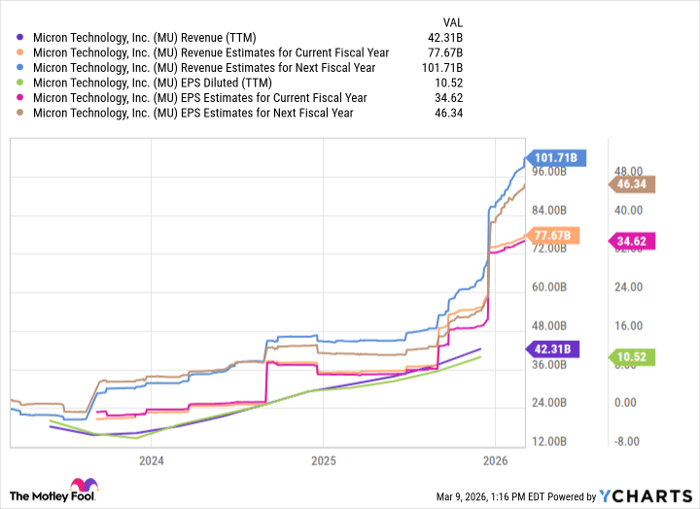
MU Revenue (TTM) data by YCharts
How much higher can Micron stock go?
With AI adoption showing no signs of slowing down, in combination with limited competitive dynamics, the AI memory supercycle could very well last the rest of the decade and perhaps move further into the 2030s.
Here's the hard part to digest: Capex budgets and infrastructure buildouts will inevitably change from year to year. This makes it nearly impossible to say with any accuracy how big Micron's business could become by early next decade.
With that said, the company's modest valuation profile offers some clues to potential share price gains. As of this writing (March 9), Micron boasts a forward price-to-earnings (P/E) ratio of 11 -- roughly half the forward earnings multiple of the Nasdaq-100.
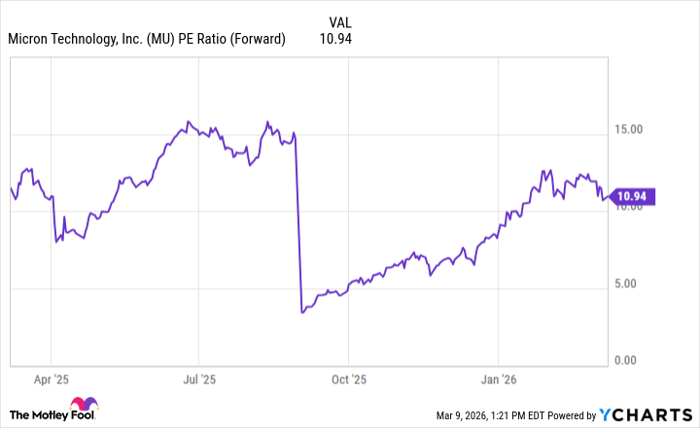
MU PE Ratio (Forward) data by YCharts
Even if Micron's growth begins to plateau or show some signs of maturing, I think meaningful upside is still reasonable. Over the next five years, I think Micron stock could feasibly double from where it is today. Under the most bullish conditions, Micron could even be on its way to a stock price of $1,000 (or more) and enter the trillion-dollar club should the company achieve a premium multiple and trade in line with the broader tech sector.
Should you buy stock in Micron Technology right now?
Before you buy stock in Micron Technology, consider this:
The Motley Fool Stock Advisor analyst team just identified what they believe are the 10 best stocks for investors to buy now… and Micron Technology wasn’t one of them. The 10 stocks that made the cut could produce monster returns in the coming years.
Consider when Netflix made this list on December 17, 2004... if you invested $1,000 at the time of our recommendation, you’d have $511,735!* Or when Nvidia made this list on April 15, 2005... if you invested $1,000 at the time of our recommendation, you’d have $1,140,464!*
Now, it’s worth noting Stock Advisor’s total average return is 946% — a market-crushing outperformance compared to 191% for the S&P 500. Don't miss the latest top 10 list, available with Stock Advisor, and join an investing community built by individual investors for individual investors.
See the 10 stocks »
*Stock Advisor returns as of March 13, 2026.
Adam Spatacco has positions in Alphabet, Amazon, Meta Platforms, and Microsoft. The Motley Fool has positions in and recommends Alphabet, Amazon, Meta Platforms, Micron Technology, and Microsoft. The Motley Fool has a disclosure policy.
Recommended Articles


