


The Economy Just Did This for Only the 13th Time in the Past 85 Years; History Shows It Usually Leads to a Bear Market
Key Points
Monthly nonfarm payroll growth has historically been highly correlated with broader economic trends.
The February 2026 report was the fifth negative one in the past nine months; historically, that has occurred with almost every recession in the past 80-plus years.
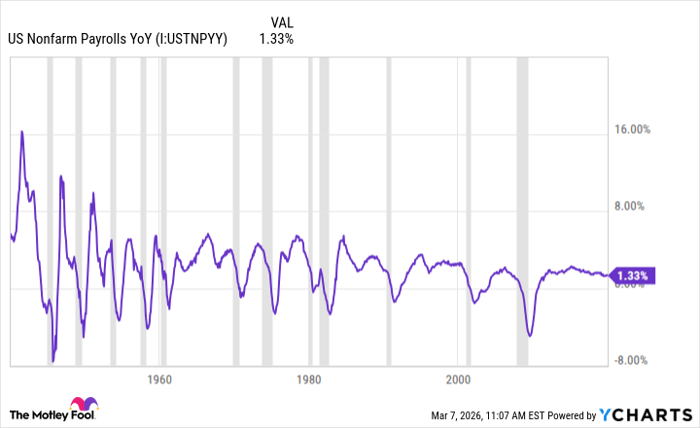
Year-over-year nonfarm payroll growth is close to turning negative, which has happened with every past recession.
- 10 stocks we like better than S&P 500 Index ›
The February nonfarm payroll report came in way below expectations. The economy lost 92,000 jobs, although the overall unemployment rate remained at a low 4.4%. Perhaps just as importantly, the January number was revised lower by 4,000 jobs, and December's was revised down by a whopping 65,000 jobs.
That brings the total number of jobs created over the last 12 months to just 156,000. To put that into context, the economy was frequently creating that many jobs in a single month as recently as 2023:
Will AI create the world's first trillionaire? Our team just released a report on the one little-known company, called an "Indispensable Monopoly" providing the critical technology Nvidia and Intel both need. Continue »
| Month | Nonfarm Payroll Monthly Job Change |
|---|---|
| March 2025 | +67,000 |
| April 2025 | +108,000 |
| May 2025 | +13,000 |
| June 2025 | -20,000 |
| July 2025 | +64,000 |
| August 2025 | -70,000 |
| September 2025 | +76,000 |
| October 2025 | -140,000 |
| November 2025 | +41,000 |
| December 2025 | -17,000 |
| January 2026 | +126,000 |
| February 2026 | -92,000 |
| Total | +156,000 |
Data source: U.S. Bureau of Labor Statistics.
Stagnant job growth is one of the biggest red flags in the economy. It suggests that perhaps companies don't see growth ahead that warrants increasing head count. Companies could also be cutting costs to manage a particularly lean period. Whatever the reason, it's a fairly strong indication that growth is slowing, or companies think it could slow.
That, of course, spills down to consumers. If workers are losing their jobs or believe they're at risk of losing their jobs, they tend to cut back on spending. Less income and spending translates to slower economic growth, higher default rates on debt, and a number of other consequences.
Image source: Getty Images.
It's easy to see how this could easily spiral into recession.
And unfortunately, this pattern that we've seen over the past 12 months is rare -- and not in a good way.
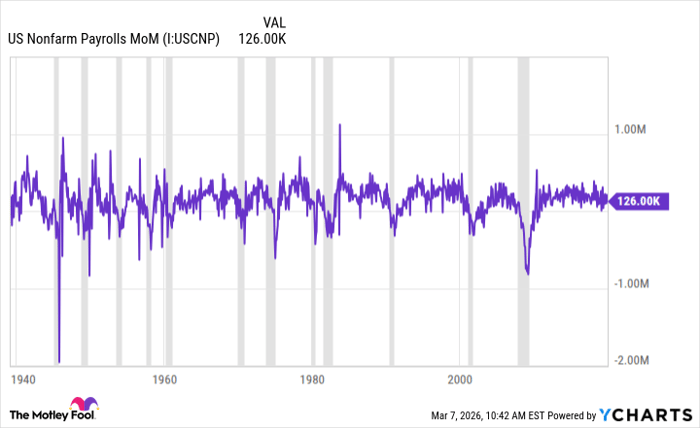
Nonfarm payroll growth has been negative in five of the previous nine months. Since the Bureau of Labor Statistics began releasing this report back in 1939, this "5 in 9" stretch has happened only 13 times. When it happens, it tends to correlate highly with periods of economic stress, recession, and bear-market corrections of at least 20% in the S&P 500 (SNPINDEX: ^GSPC).
If you want evidence of why this trend is so worrisome right now, consider the times it's happened before:
- 2026
- 2008-2010
- 2001-2003
- 1990-1991
- 1982-1983
- 1975
- 1970
- 1960-1961
- 1957-1958
- 1954
- 1952
- 1949
- 1944-1945
Now, we can overlay the nonfarm payroll data with historical recessions:
US Nonfarm Payrolls MoM data by YCharts.
Almost every one of those "5 in 9" periods coincides with a recession.
Again, this should be fairly intuitive. Slowdowns in the labor market are almost always part of broader economic slowdowns. What's interesting in 2026 is that, thus far, there's been little sign of imminent recession from the major indicators.
According to FactSet Research Systems, the estimated year-over-year earnings growth rate for the first quarter of 2026 is 11.5%. If that turns out to be the final number, it would mark the 11th consecutive quarter of year-over-year earnings growth, and the sixth consecutive quarter of double-digit growth.
U.S. gross domestic product (GDP) grew at an annualized 1.4% in Q4 2025. That marks the 14th time in the past 15 quarters that GDP growth has been positive.
With those growth rates, it's tougher to make the recession argument. The massive investments being made in artificial intelligence (AI) might be masking some underlying weakness. But earnings growth and GDP growth are major reasons that U.S. equity prices have held up so well to this point.
Overall, we can't ignore what the jobs market is telling us. Here's one final way of looking at the situation. Every time year-over-year nonfarm payroll has turned negative, it has been tied to a recession:
US Nonfarm Payrolls YoY data by YCharts.
We're not there yet in 2026, but growth is negative over the past 10 months. And two of the biggest monthly gains are about to roll off the 12-month rolling average. So it's quite possible, maybe even likely, that we'll get there once the April report is released.
Either way, this is a strong historical recessionary signal. Savvy investors would be wise not to ignore it.
Should you buy stock in S&P 500 Index right now?
Before you buy stock in S&P 500 Index, consider this:
The Motley Fool Stock Advisor analyst team just identified what they believe are the 10 best stocks for investors to buy now… and S&P 500 Index wasn’t one of them. The 10 stocks that made the cut could produce monster returns in the coming years.
Consider when Netflix made this list on December 17, 2004... if you invested $1,000 at the time of our recommendation, you’d have $522,791!* Or when Nvidia made this list on April 15, 2005... if you invested $1,000 at the time of our recommendation, you’d have $1,132,678!*
Now, it’s worth noting Stock Advisor’s total average return is 952% — a market-crushing outperformance compared to 191% for the S&P 500. Don't miss the latest top 10 list, available with Stock Advisor, and join an investing community built by individual investors for individual investors.
See the 10 stocks »
*Stock Advisor returns as of March 11, 2026.
David Dierking has no position in any of the stocks mentioned. The Motley Fool has positions in and recommends FactSet Research Systems. The Motley Fool has a disclosure policy.
Recommended Articles


