


Is It Smart to Buy Stocks Right Now? Warren Buffett's Best Advice for Dealing With Market Uncertainty.
Key Points
Stocks have climbed to very high valuations over the past three years and now face significant uncertainty.
Buffett used a basic investment philosophy to grow Berkshire Hathaway, and it still applies today.
For those struggling to follow the philosophy, he offers a simple antidote to succeed.
- 10 stocks we like better than Vanguard S&P 500 ETF ›
The thought of investing in the stock market right now might fill you with trepidation. The S&P 500 and the Nasdaq Composite have been on phenomenal runs over the last three years. But uncertainty has started to force stock prices to waver in early 2026, and that escalated recently with President Donald Trump's strike on Iran.
Stock prices have seen an uptick in volatility, and the S&P 500's flat performance for the year so far belies the significant swings we've seen in many sectors year to date. It's no wonder many investors are considering sitting on the sidelines to await more clarity or just selling stocks outright.
Will AI create the world's first trillionaire? Our team just released a report on the one little-known company, called an "Indispensable Monopoly" providing the critical technology Nvidia and Intel both need. Continue »
In times of uncertainty, it can be worth revisiting what some of the best investors in history have done and what they recommend to others. And few were more forthcoming with their insights and advice than Warren Buffett.
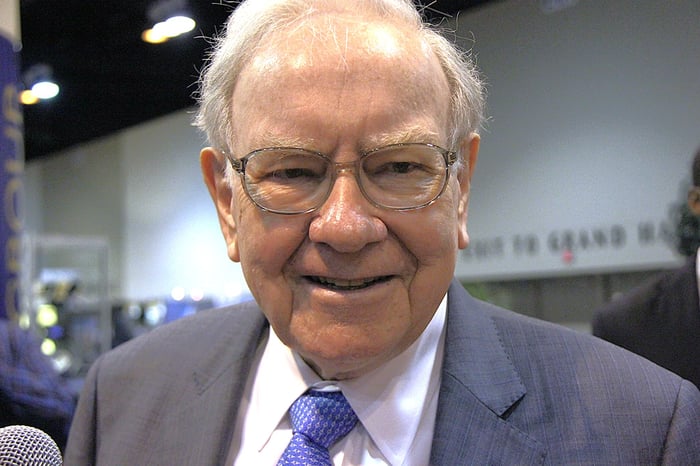
Image source: The Motley Fool.
The simple investment philosophy behind Buffett's success
In Buffett's 1986 letter to Berkshire Hathaway (NYSE: BRKA) (NYSE: BRKB) shareholders, he laid out a simple strategy that has enabled the company to deliver phenomenal returns to shareholders over the years. It's advice that he has repeated numerous times throughout history and bears repeating again at this moment.
"We simply attempt to be fearful when others are greedy and to be greedy when others are fearful."
That advice notably came at a time that was similar to today. Earlier in the letter, Buffett explained to shareholders that few investment opportunities looked appealing. He echoed that again in his 2024 letter to shareholders and backed it up with 13 straight quarters of net stock sales in Berkshire's marketable equity portfolio.
He expounded on this idea at Berkshire's 2010 shareholder meeting, especially noting the dangers of getting caught up in a cycle of fear. "If you have a temperament that when others are fearful, you're going to get scared yourself, you know, you are not going to make a lot of money in securities over time," he told the audience.
He went on to say that the conviction to buy, sell, or hold stocks has to come from within. He explained that he could tell someone it's a great time to buy and help them build the courage to buy stocks. But that person could run into someone else next week who says we're headed for disaster, and they would sell.
Thankfully, Buffett offers an antidote for those who can't build that conviction.
Buffett's advice for becoming an above-average investor
The average investors will often get caught up in the throes of fear or greed, and the result is consistent underperformance of the funds they buy. Morningstar provides an annual report detailing how much investors underperform compared to simply investing a lump sum into the funds they bought.
Over the 10 years ending in 2024, the average investor underperformed by 1.2 percentage points per year. That compounds to become quite a bit over a decade and a huge amount over a lifetime. Buffett provides a solution for investors battling the sway of fear and greed that makes it much easier to ignore the noise generated by the markets.
First, he recommends that investors without the acumen or inclination to analyze individual businesses buy an S&P 500 index fund like the Vanguard S&P 500 ETF (NYSEMKT: VOO). But he warns, "The main danger is that the timid or beginning investor will enter the market at a time of extreme exuberance and then become disillusioned when paper losses occur."
As the Morningstar study repeatedly points out, the forces of greed and fear can still negatively affect the investment decisions of so-called "passive investors." That's where Buffett's advice is key: "The antidote to that kind of mistiming is for an investor to accumulate shares over a long period and never to sell when the news is bad and stocks are well off their highs."
In other words, Buffett recommends that most investors use something akin to dollar-cost averaging to build their stake in an S&P 500 index fund. That can prevent someone with a lump sum to invest from hesitating to make that first purchase or waiting to make that next purchase. And if they can ignore the news, all the better.
But that advice applies to everyone, even buyers of individual stocks. If you've bought a great company at a fair price, you should be willing to hold it as the news turns bad and the price goes down. As long as nothing fundamental has changed in the business, it may be an opportunity to buy more. If the price goes up, it may still be a great buy, but there may be other opportunities to pursue.
Nobody knows where the market will head from here, or how geopolitical situations will unfold. But investors need to prepare for the forces of greed and fear and know how to combat them.
Should you buy stock in Vanguard S&P 500 ETF right now?
Before you buy stock in Vanguard S&P 500 ETF, consider this:
The Motley Fool Stock Advisor analyst team just identified what they believe are the 10 best stocks for investors to buy now… and Vanguard S&P 500 ETF wasn’t one of them. The 10 stocks that made the cut could produce monster returns in the coming years.
Consider when Netflix made this list on December 17, 2004... if you invested $1,000 at the time of our recommendation, you’d have $530,233!* Or when Nvidia made this list on April 15, 2005... if you invested $1,000 at the time of our recommendation, you’d have $1,119,682!*
Now, it’s worth noting Stock Advisor’s total average return is 955% — a market-crushing outperformance compared to 191% for the S&P 500. Don't miss the latest top 10 list, available with Stock Advisor, and join an investing community built by individual investors for individual investors.
See the 10 stocks »
*Stock Advisor returns as of March 11, 2026.
Adam Levy has no position in any of the stocks mentioned. The Motley Fool has positions in and recommends Berkshire Hathaway and Vanguard S&P 500 ETF. The Motley Fool has a disclosure policy.
Recommended Articles


