


2 Dow Jones Dividend Stocks to Double Up on and Buy in March
Key Points
Home Depot and Sherwin-Williams benefit from lower interest rates.
Home Depot is a pure-play North American company, whereas Sherwin-Williams is multinational.
Home Depot has a higher yield, but Sherwin-Williams has a better track record of boosting its payout.
- 10 stocks we like better than Home Depot ›
The Dow Jones Industrial Average (DJINDICES: ^DJI) contains 30 industry-leading components -- almost all of which pay dividends. These companies act as bellwethers for their respective sectors, making the Dow a good starting point for investors looking for dividend stocks to round out their portfolios.
Here's why the recent sell-off in Dow stocks Home Depot (NYSE: HD) and Sherwin-Williams (NYSE: SHW) is a buying opportunity for long-term investors.
Will AI create the world's first trillionaire? Our team just released a report on the one little-known company, called an "Indispensable Monopoly" providing the critical technology Nvidia and Intel both need. Continue »

Image source: Getty Images.
A swift sell-off
Last week, Home Depot fell 6% and Sherwin-Williams fell 9%. This was far worse than the 2% sell-off in the S&P 500 (SNPINDEX: ^GSPC) as supply chain disruptions, higher oil prices, geopolitical tensions, and economic uncertainty weighed on consumer discretionary, industrial, and materials stocks.
Both stocks had been up big year to date as mortgage interest rates hit their lowest point since 2022. Lower interest rates reduce borrowing costs, making it less expensive to buy or refinance a home. However, as research from The Motley Fool shows, the average cost of a mortgage refinance is $3,398. So homeowners only refinance if there's a big enough difference between their existing interest rate and the new rate for it to make sense.
Lower interest rates also make it more affordable to fund do-it-yourself home improvement projects and are generally good for economic growth -- benefiting the commercial and industrial customers.
Home Depot has been waiting years for rates to come down, with management tempering investor expectations but preparing for a multi-year expansion period with major acquisitions that target professional contractors.
Meanwhile, Sherwin-Williams is generally more diversified than Home Depot because it is vertically integrated through manufacturing and distribution and has a massive commercial and industrial business that makes it less vulnerable to slowdowns in consumer discretionary spending on do-it-yourself projects.
Sherwin-Williams is delivering far better results than Home Depot
Sherwin-Williams has been executing at a high level, with steady earnings growth and high margins. Home Depot has failed to return to its record performance from a few years ago, when interest rates were lower and consumers were spending heavily on home improvement projects during the COVID-19 pandemic.

HD Operating Margin (TTM) data by YCharts
Because Sherwin-Williams is more diversified and less cyclical, it has historically commanded a higher multiple than Home Depot.
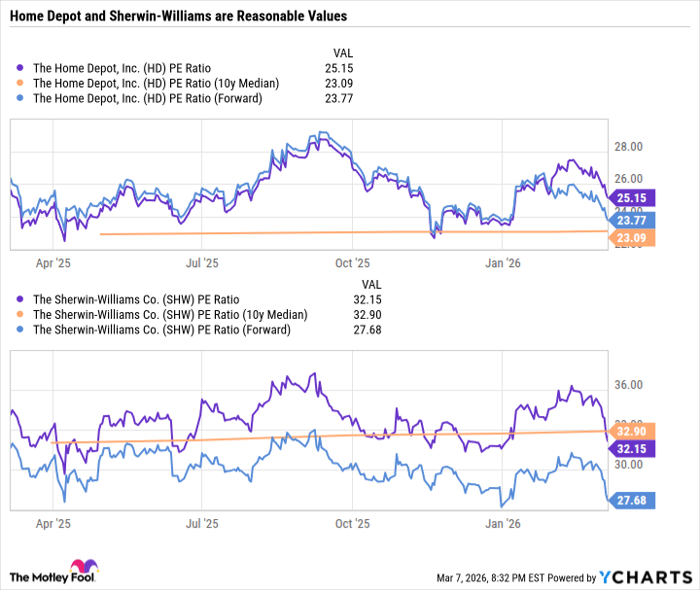
HD PE Ratio data by YCharts
Both stocks are reasonably good values now, with Sherwin-Williams hovering around its 10-year average price-to-earnings ratio and Home Depot trading at a slight premium. Although, bear in mind that Home Depot could become too cheap to ignore if the cycle shifts and its earnings growth rapidly accelerates.
Stable and growing dividends
Home Depot has boosted its dividend payout every year since 2010 and yields 2.6%.
Meanwhile, Sherwin-Williams just raised its dividend for the 47th consecutive year, but it only yields 1% because the stock has performed so well.
Both companies regularly repurchase stock, which accelerates earnings growth.
Two dividend stocks to buy now
Home Depot and Sherwin-Williams are coiled springs for growth if interest rates keep falling. In the meantime, both companies generate plenty of cash flow to cover their dividends and buy back stock.
Home Depot will likely appeal more to value and passive-income investors. It's the better buy for investors looking for a concentrated bet on a recovery in the North American housing market and consumer spending.
Sherwin-Williams is a more diversified business with a global customer base spanning different segments. But it's also pricier and sports a lower yield.
Should you buy stock in Home Depot right now?
Before you buy stock in Home Depot, consider this:
The Motley Fool Stock Advisor analyst team just identified what they believe are the 10 best stocks for investors to buy now… and Home Depot wasn’t one of them. The 10 stocks that made the cut could produce monster returns in the coming years.
Consider when Netflix made this list on December 17, 2004... if you invested $1,000 at the time of our recommendation, you’d have $530,233!* Or when Nvidia made this list on April 15, 2005... if you invested $1,000 at the time of our recommendation, you’d have $1,119,682!*
Now, it’s worth noting Stock Advisor’s total average return is 955% — a market-crushing outperformance compared to 191% for the S&P 500. Don't miss the latest top 10 list, available with Stock Advisor, and join an investing community built by individual investors for individual investors.
See the 10 stocks »
*Stock Advisor returns as of March 11, 2026.
Daniel Foelber has no position in any of the stocks mentioned. The Motley Fool has positions in and recommends Home Depot. The Motley Fool recommends Sherwin-Williams. The Motley Fool has a disclosure policy.
Recommended Articles


