


How Quickly Can Ford Reverse This $16 Billion Problem?
Key Points
Ford has lost more than $16 billion on its EV business since 2022.
Ford's next big EV push will come in 2027.
Reversing massive EV losses is a huge opportunity for investors.
- These 10 stocks could mint the next wave of millionaires ›
Investors in Ford Motor Company (NYSE: F) and General Motors (NYSE: GM) are all too aware that companies can sometimes be both right and wrong at the same time. In this instance, Ford and GM, along with many competitors, jumped ahead on electric vehicle (EV) strategies that will very likely prove correct in the long term, but were extremely costly in the meantime because the U.S. market simply wasn't ready yet.
With 2025 in the books, Ford has lost more than $16 billion on its electric vehicle business since 2022. The question has always been when those hefty losses would reverse -- and now we finally have our answer.
Will AI create the world's first trillionaire? Our team just released a report on the one little-known company, called an "Indispensable Monopoly" providing the critical technology Nvidia and Intel both need. Continue »
How costly?
Ford recently reported its fourth quarter and full-year results, and its Model-e was again dragging down the company's bottom line. Ford lost $4.8 billion in its Model-e division despite producing only three EV models. That was a slight improvement from the prior year's more than $5 billion loss, but the automaker still expects to lose between $4 billion and $4.5 billion in 2026.
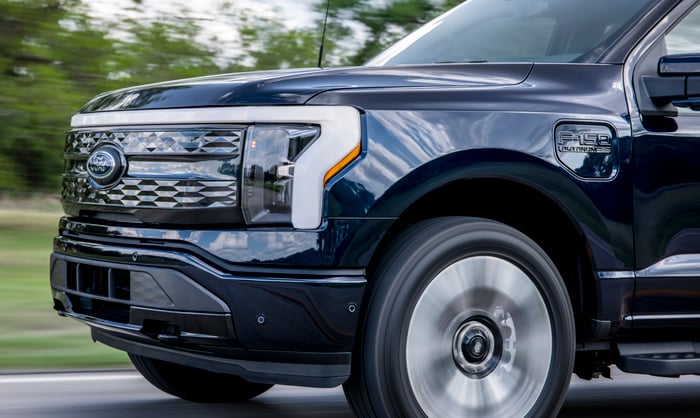
Image source: Ford Motor Company.
Obviously, $16 billion in EV losses since 2022 is a lot. Had the automaker used those funds on share repurchases, it could have rivaled General Motors. While Ford returns the vast majority of value to shareholders via its dividend, GM opts to reduce its shares outstanding. GM launched $10 billion in buybacks in 2023, followed by new $6 billion authorizations in each of 2024 and 2025. But look at the graph below to see the significant reduction in shares outstanding, and the stock price reaction.
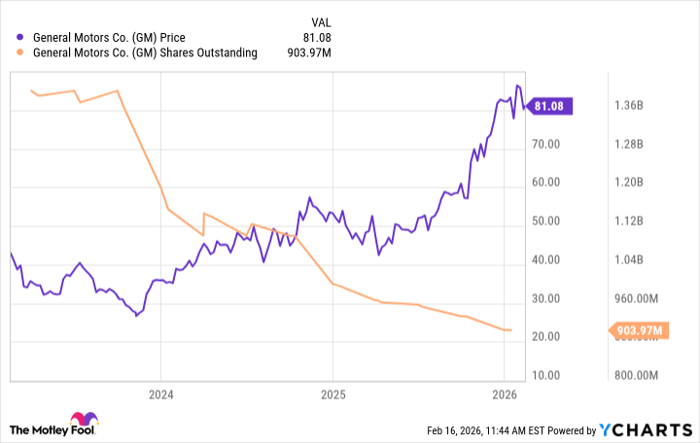
GM data by YCharts
That helps put in perspective for investors why it's important to reverse Ford's EV losses and use that valuable capital elsewhere. The question remains: When will Ford's EV losses end?
When will losses reverse?
Unfortunately, for investors, the answer to that question isn't ideal. While Ford is feverishly taking costs out of its EV operations, the truth is its next big push in EVs won't be until 2027, when the company's new "assembly tree" production approach, combined with its Universal EV Platform, will begin producing Ford's new midsize electric truck with a price around $30,000. That means Ford doesn't expect to break even on its EV division until around 2029, according to the company's CFO, Sherry House, on Ford's fourth-quarter conference call.
Ford and many other automakers jumped the gun on their EV ambitions, and it's costing them a pretty penny -- remember that Ford took a $19.5 billion special charge to pivot its EV strategy. However, for patient investors it also offers opportunity and upside, because reversing those EV losses by 2029 opens up a lot of capital that can be better spent on high-return projects, or be returned to shareholders via buybacks or its dividend. Ford will be a better investment going forward, but it's not yet firing on all cylinders.
Where to invest $1,000 right now
When our analyst team has a stock tip, it can pay to listen. After all, Stock Advisor’s total average return is 889%* — a market-crushing outperformance compared to 193% for the S&P 500.
They just revealed what they believe are the 10 best stocks for investors to buy right now, available when you join Stock Advisor.
See the stocks »
*Stock Advisor returns as of February 18, 2026.
Daniel Miller has positions in Ford Motor Company and General Motors. The Motley Fool recommends General Motors. The Motley Fool has a disclosure policy.
Recommended Articles


