


Where Will BYD Stock Be in 5 Years?
Key Points
BYD’s vehicle sales skyrocketed over the past five years.
Its stock still looks cheap relative to its long-term growth potential.
- 10 stocks we like better than BYD Company ›
BYD (OTC: BYDDY), China's top automaker, has been a lackluster investment. Over the past five years, its stock has risen by less than 10% even as its shipments and revenue skyrocketed. Let's see why that happened, and if BYD's stock might bounce back over the next five years.
What happened to BYD?
BYD was originally a battery maker. But over the past two decades, it started selling its own gas-powered vehicles, plug-in hybrid EVs (PHEVs), and battery-powered EVs (BEVs). Its annual auto sales barely grew from 2009 through 2020, but they surged after it stopped producing its gas-only cars in 2022 and expanded its PHEV and BEV lineup.
Will AI create the world's first trillionaire? Our team just released a report on the one little-known company, called an "Indispensable Monopoly" providing the critical technology Nvidia and Intel both need. Continue »
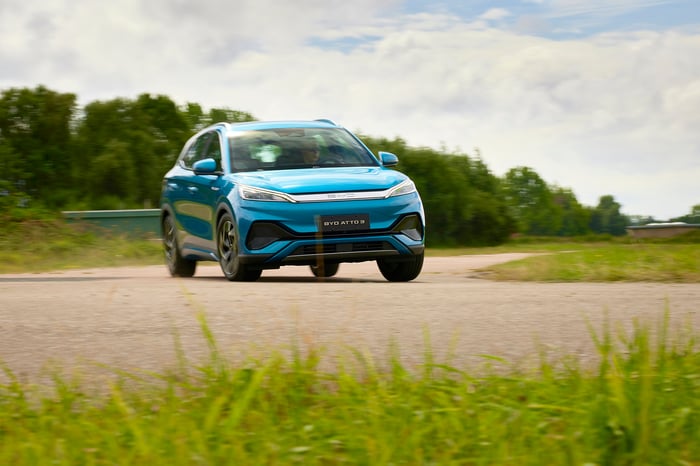
Image source: BYD.
To differentiate itself from its competitors, BYD developed its own lithium iron phosphate (LFP) batteries, which were safer, cheaper, and more power-efficient than lithium-ion batteries. It also unified its fragmented production lines under its e-Platform 3.0 architecture, which supports a wide range of vehicles, and vertically integrated most of its supply chain. It also expanded into dozens of countries to curb its dependence on the saturated Chinese market.
How fast is BYD growing?
From 2020 to 2025, BYD's total annual vehicle sales surged from 427,302 units to 4.6 million units. In 2025, it sold 2.26 million BEVs and overtook Tesla (NASDAQ: TSLA) for the first time as the world's top BEV maker. Analysts expect it to generate 847.4 billion yuan ($122.7 billion) in 2025, a more than fivefold increase from 153.5 billion yuan ($22.2 billion) in 2020.
Analysts also expect BYD to generate 35.1 billion yuan ($5.1 billion) in net income in 2025, a more than eightfold increase from 4.2 billion yuan ($0.6 billion) in 2020. However, that would still represent a 13% year-over-year decline from 2024.
BYD's margins are under pressure amid inflationary headwinds and tougher competition in the cooling EV market. But it's offsetting that pressure by prioritizing sales of higher-margin premium vehicles (including the Han, Tang, Denza, and Yangwang) and PHEVs, producing more cost-efficient first-party components, and leveraging its scale to dilute expenses.
Where will BYD's stock be in five years?
From 2025 to 2027, analysts expect BYD's revenue to grow at a 15% CAGR. Yet its stock still trades at less than 1 times this year's sales -- presumably because trade tensions, the decelerating growth of the EV market, and macro headwinds in China are compressing its valuation.
But if BYD matches those estimates, continues to grow its top line at a 15% CAGR through 2031, and trades at a more generous five times sales by the final year, its stock could deliver a 12-bagger gain over the next five years. However, investors should brace for significant near-term volatility if trade tensions intensify or China experiences an economic slowdown.
Should you buy stock in BYD Company right now?
Before you buy stock in BYD Company, consider this:
The Motley Fool Stock Advisor analyst team just identified what they believe are the 10 best stocks for investors to buy now… and BYD Company wasn’t one of them. The 10 stocks that made the cut could produce monster returns in the coming years.
Consider when Netflix made this list on December 17, 2004... if you invested $1,000 at the time of our recommendation, you’d have $415,256!* Or when Nvidia made this list on April 15, 2005... if you invested $1,000 at the time of our recommendation, you’d have $1,133,904!*
Now, it’s worth noting Stock Advisor’s total average return is 889% — a market-crushing outperformance compared to 193% for the S&P 500. Don't miss the latest top 10 list, available with Stock Advisor, and join an investing community built by individual investors for individual investors.
See the 10 stocks »
*Stock Advisor returns as of February 18, 2026.
Leo Sun has no position in any of the stocks mentioned. The Motley Fool has positions in and recommends Tesla. The Motley Fool recommends BYD Company. The Motley Fool has a disclosure policy.
Recommended Articles


