


In December, I Picked the Schwab U.S. Dividend Equity ETF as My Top High-Yield ETF to Buy, and It's Already Up 15% in 2026. Here's Why It's Still a Buy Now.
Key Points
Unlike some income-focused ETFs, the Schwab U.S. Dividend Equity ETF doesn’t limit upside potential.
The fund is highly concentrated in value-oriented sectors such as energy, consumer staples, and healthcare.
The Schwab U.S. Dividend Equity ETF is best used as a core passive income holding rather than a trading tool.
- 10 stocks we like better than Schwab U.S. Dividend Equity ETF ›
When I picked the Schwab U.S. Dividend Equity ETF (NYSEMKT: SCHD) as a great buy for passive income investors in December, I certainly didn't expect it to rocket 14.7% higher less than six weeks into the new year, especially considering the S&P 500 (SNPINDEX: ^GSPC) is only up 1.3%.
Here's why this seemingly stodgy exchange-traded fund (ETF) is roaring to new heights and why it could still be a buy now.
Where to invest $1,000 right now? Our analyst team just revealed what they believe are the 10 best stocks to buy right now, when you join Stock Advisor. See the stocks »

Image source: Getty Images.
A high-yield ETF concentrated in value-focused sectors
Investors gravitate to the Schwab U.S. Dividend Equity ETF for its high yield, which is 3.5% at the time of this writing but was over 4% at certain points last year before the fund's recent run-up. The ETF offers investors a way to participate in the stock market and generate a high yield from a basket of stocks while incurring a mere 0.06% expense ratio, or $6 for every $10,000 invested. The fund has a significantly higher yield than other popular, low-cost ETFs. For example, the Vanguard High Dividend Yield ETF yields just 2.3%.
Some ETFs achieve higher yields by investing in a mix of stocks and bonds, or by selling covered calls on their equity holdings, which increases passive income but also caps upside. What makes the Schwab U.S. Dividend Equity ETF unique is that it is 100% invested in stocks. And it achieves its high yield by targeting sectors with industry-leading companies that prioritize returning capital to shareholders through dividends.
A staggering 54.6% of the ETF is invested in the energy, consumer staples, and healthcare sectors -- all of which are chock-full of high-yield stocks. By comparison, the S&P 500 allocates only 17.6% to these three sectors.
In recent years, the Schwab U.S. Dividend Equity ETF has underperformed the S&P 500 because it is underweight sectors like technology and communications that have been driving broader market returns. But so far in 2026, it's the stodgy sectors that are in the spotlight.
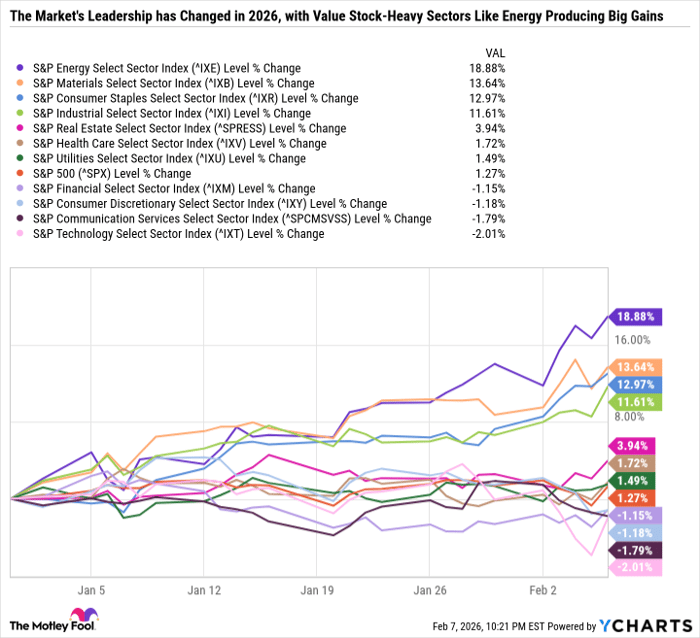
^IXE data by YCharts.
The energy sector -- which makes up 19.9% of the Schwab U.S. Dividend Equity ETF -- is crushing the S&P 500 in 2026. Consumer staples are also one of the best-performing sectors, whereas technology and communications have incurred minor sell-offs.
Achieving a high yield without compromising on diversification
Despite its recent run-up, there are plenty of reasons why the Schwab U.S. Dividend Equity ETF remains a solid buy now. The fund is heavily concentrated in large-cap stocks, with around 90% of the ETF invested in companies with market caps of at least $15 billion. What's more, the largest holding in the fund, which is Lockheed Martin, makes up 4.6% of the ETF. The fund is well balanced across industry leaders rather than relying on a handful of stocks to drive gains.
This is a fundamentally different strategy from market-cap weighted sector-focused ETFs. For example, the Vanguard Energy ETF has a high yield of 2.8%, but 38.2% of the fund is invested in just ExxonMobil and Chevron, which may not appeal to investors looking for more diversification.
Similarly, 45.2% of the Vanguard Consumer Staples ETF is invested in just four stocks -- Walmart, Costco Wholesale, Procter & Gamble, and Coca-Cola.
In addition to being highly diversified, the fund is still a good value, with a price-to-earnings ratio under 20. Although many energy and consumer staples stocks have run up so far this year, many of them still have low valuations.
The energy sector as a whole, even industry-leading names like ExxonMobil and Chevron, has historically traded at a discount to the S&P 500 due to the volatility of oil and gas prices and investor concerns about the future of oil and gas in a lower-carbon world.
Entering 2026, stocks like Procter & Gamble and Coca-Cola were trading at discounts to their historical valuations. Now, both stocks are closer to their average valuations.
Maintain a long-term focus
The investment thesis for the Schwab U.S. Dividend Equity ETF didn't change when the calendar turned to 2026. Rather, some short-term-minded investors are rotating out of high-growth sectors and into safer, dividend-paying value sectors. Tech stocks are under pressure as investors scrutinize capital expenditures and the payoff of artificial intelligence (AI) spending.
Because some Wall Street traders are short-term focused, they may sell out of some of these names and move into sectors where they think they can make a quick buck. As an individual investor, it's best not to try and time the market by rotating in and out of sectors or stocks. Instead, a better approach is to determine the role you want high-yield dividend stocks to play in your portfolio, how they can help you achieve your financial goals, and your preferred way of investing in them.
The Schwab U.S. Dividend Equity ETF has the qualities needed to anchor a passive-income-focused portfolio or to play a supporting role in a balanced portfolio. Either way, the ETF remains a buy now.
Should you buy stock in Schwab U.S. Dividend Equity ETF right now?
Before you buy stock in Schwab U.S. Dividend Equity ETF, consider this:
The Motley Fool Stock Advisor analyst team just identified what they believe are the 10 best stocks for investors to buy now… and Schwab U.S. Dividend Equity ETF wasn’t one of them. The 10 stocks that made the cut could produce monster returns in the coming years.
Consider when Netflix made this list on December 17, 2004... if you invested $1,000 at the time of our recommendation, you’d have $443,353!* Or when Nvidia made this list on April 15, 2005... if you invested $1,000 at the time of our recommendation, you’d have $1,155,789!*
Now, it’s worth noting Stock Advisor’s total average return is 920% — a market-crushing outperformance compared to 196% for the S&P 500. Don't miss the latest top 10 list, available with Stock Advisor, and join an investing community built by individual investors for individual investors.
See the 10 stocks »
*Stock Advisor returns as of February 12, 2026.
Daniel Foelber has positions in Procter & Gamble and Schwab U.S. Dividend Equity ETF and has the following options: short February 2026 $150 calls on Procter & Gamble. The Motley Fool has positions in and recommends Chevron, Costco Wholesale, Vanguard High Dividend Yield ETF, and Walmart. The Motley Fool recommends Lockheed Martin. The Motley Fool has a disclosure policy.
Recommended Articles


