




Despite Nearing a $2 Trillion Market Cap, Meta Platforms Just Missed a Golden Opportunity
Key Points
The "Magnificent Seven" -- led by Facebook parent Meta Platforms in 2026 -- have done most of the heavy lifting on Wall Street.
Meta's sustainable social media moat and its pristine balance sheet have made it a popular long-term investment.
However, Meta's board of directors just bypassed an opportunity to drive retail investor interest in its stock.
- 10 stocks we like better than Meta Platforms ›
Over the last three years, the bulls have been in firm control on Wall Street. While several can't-miss trends have provided a boost for the broader market, including the rise of artificial intelligence (AI) and the advent of quantum computing, it's the "Magnificent Seven" that have done most of the heavy lifting.
The Magnificent Seven represent seven of the most influential companies on Wall Street and account for more than half of all publicly traded stocks to have ever reached the trillion-dollar market cap plateau. Over the trailing decade, all seven of these industry leaders have, at a minimum, more than doubled the 258% cumulative return of the S&P 500.
Where to invest $1,000 right now? Our analyst team just revealed what they believe are the 10 best stocks to buy right now. Continue »
Meta Platforms (NASDAQ: META) is the "worst" performer of the bunch, with an aggregate trailing 10-year return of 539%. However, this social media titan has been crushing the benchmark S&P 500 over the last three years and, following the release of its fourth-quarter operating results, is the top-performing Magnificent Seven stock this year, through the end of January.
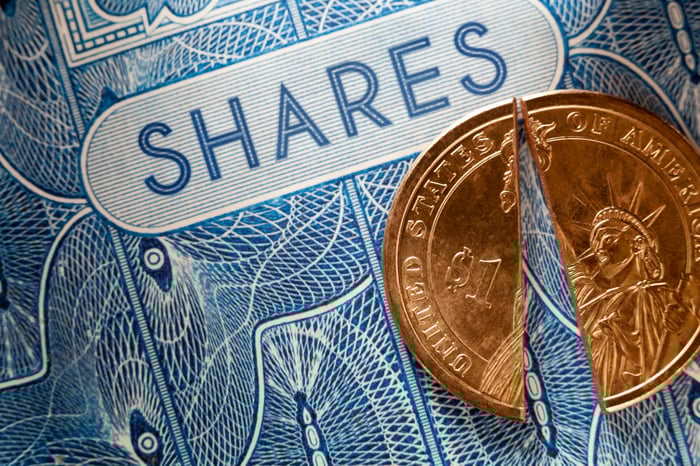
Image source: Getty Images.
While Meta's latest operating results highlight several reasons why it makes for a phenomenal long-term investment, it should be noted that the company's board missed a golden opportunity to further ignite retail investor interest in its stock.
A sustainable moat and pristine balance sheet are luxuries for Meta Platforms
Although AI is the talk of Wall Street, Meta's foundational operating segment continues to be its social media platforms, including Facebook, WhatsApp, Instagram, Threads, and Facebook Messenger, among others. In December, its family of apps attracted an average of 3.58 billion users daily.
No other social media-driven company comes close to luring as many people to its platforms daily as Meta. This makes it a logical choice for businesses looking to advertise and affords Meta a substantial degree of ad-pricing power.
With nearly 98% of its $201 billion in net sales coming from advertising in 2025, the company is also intricately tied to the health of the U.S. and global economy. Advertising is cyclical, and periods of economic expansion last significantly longer than recessions. Over time, Meta's core business should expand.
But as most investors are likely aware, CEO Mark Zuckerberg is sparing no expense when it comes to investing in the evolution of artificial intelligence. While some of these investments aren't going to bear immediate fruit for the company, Meta is already enjoying benefits from incorporating generative AI solutions into its social media advertising platforms. Giving businesses access to Gen-AI solutions enables them to create static and video messages for individual users. This can improve click-through rates and enhance Meta's ad-pricing power.
Something else Meta Platforms brings to the table for its investors is a cash-rich balance sheet. Zuckerberg's company closed out 2025 with $81.6 billion in cash, cash equivalents, and marketable securities. It also generated $115.8 billion in net cash from operating activities. Meta has the luxury of aggressively investing in game-changing technologies and growth initiatives without expecting an immediate return.
Meta's sustainable social media moat and its pristine balance sheet have made it a top-tier investment. But in spite of the company's consistent double-digit sales growth, Zuckerberg and Meta Platforms' other board members missed a surefire opportunity.

Image source: Getty Images.
Mark Zuckerberg and Meta's board just missed a no-brainer opportunity
Since Meta Platforms' initial public offering in mid-May 2012, its shares have climbed by almost 1,800%. While this is somewhat par for the course for Magnificent Seven stocks, Meta holds the unique distinction of being the only member to have never completed a stock split.
A stock split is an event that enables a publicly traded company to cosmetically adjust its share price and outstanding share count by the same magnitude. These changes are superficial in the sense that they don't alter a company's market cap or its underlying operating performance. In Meta's case, it appears to be long overdue for a forward stock split -- one that lowers its share price and increases its outstanding share count.
Typically, two criteria are needed to facilitate a forward split. The first and most well-known of the two is a nominally high share price. Retail investors who can't purchase fractional shares through their broker may not be able to open a position or add to an existing holding if the share price rises too high. Meta ended January at $716.50 per share, which has arguably entered the territory of being restrictive for everyday investors who can't buy fractional shares.
The other necessary factor is a large enough base of retail investor ownership. If only a small percentage of outstanding shares are held by non-institutional investors, there's rarely an incentive for a board of directors to push for a stock split. In Meta's case, 29.3% of its outstanding shares are held by non-institutional investors -- i.e., more than enough to incentivize a forward split.
Although Meta Platforms' operating results continue to speak for themselves, not declaring a first-ever stock split is a missed opportunity for two reasons.
To begin with, the stock market is historically pricey. We entered 2026 with the second-priciest market, dating back to the start of 1871. If the members of the Magnificent Seven are to push even higher, they're going to need the assistance of retail investors, who've progressively taken on a bigger role on Wall Street, as a percentage of total equities trading volume. If Meta doesn't make its shares more accessible to everyday investors, pushing its market cap past $2 trillion could prove challenging (at least in the short run).
The other reason a stock split would make perfect sense has to do with Mark Zuckerberg's desire to spend nothing short of a small fortune on AI. In 2026, the company intends to spend between $115 billion and $135 billion on capital expenditures, much of which will support its Meta Superintelligence Labs and core operations.
A stock split that makes shares of Meta more nominally accessible to everyday investors may enable them to look past Zuckerberg's spending spree.
While I fully expect Meta stock to head higher over the long term, Zuckerberg and his board look to have whiffed on a golden opportunity to put their company's stock at the center of Wall Street's stage.
Should you buy stock in Meta Platforms right now?
Before you buy stock in Meta Platforms, consider this:
The Motley Fool Stock Advisor analyst team just identified what they believe are the 10 best stocks for investors to buy now… and Meta Platforms wasn’t one of them. The 10 stocks that made the cut could produce monster returns in the coming years.
Consider when Netflix made this list on December 17, 2004... if you invested $1,000 at the time of our recommendation, you’d have $431,111!* Or when Nvidia made this list on April 15, 2005... if you invested $1,000 at the time of our recommendation, you’d have $1,105,521!*
Now, it’s worth noting Stock Advisor’s total average return is 906% — a market-crushing outperformance compared to 195% for the S&P 500. Don't miss the latest top 10 list, available with Stock Advisor, and join an investing community built by individual investors for individual investors.
See the 10 stocks »
*Stock Advisor returns as of February 5, 2026.
Sean Williams has positions in Meta Platforms. The Motley Fool has positions in and recommends Meta Platforms. The Motley Fool has a disclosure policy.
Recommended Articles


