




Is the Vanguard Russell 2000 Index Fund ETF a Buy Now?
Key Points
Small-caps are off to an impressive start in 2026, putting this ETF in the spotlight.
This Vanguard ETF features a sizable lineup of domestic small-cap firms.
It keeps with the Vanguard heritage of being inexpensive to own.
- 10 stocks we like better than Vanguard Russell 2000 ETF ›
Small-cap stocks are off to scintillating starts this year, with the widely followed Russell 2000 index climbing 5.31% in January. Obviously, that's good news for the various exchange-traded funds (ETFs) tracking that gauge, including the Vanguard Russell 2000 ETF (NASDAQ: VTWO).
In even better news, the prevailing sentiment on Wall Street is that smaller stocks can keep the good times going this year due to a variety of factors, including expectations of economic growth, declining interest rates, and earnings growth that beats those of their large-cap counterparts.
Where to invest $1,000 right now? Our analyst team just revealed what they believe are the 10 best stocks to buy right now. Continue »
This small-cap ETF is decent, but there are better options from the same issuer. Image source: Getty Images.
The state of the U.S. economy is material to this Vanguard fund because smaller companies are usually more domestically focused than their bigger rivals. As for lower interest rates, that would be an assist for this ETF because many small-cap firms need to borrow capital to fund growth objectives. Lower interest rates equal a lower cost of that capital. All that sounds good as it relates to this ETF, and it is, but investors should be selective with small-cap ETFs.
This ETF is fine, but investors can do better
The Russell 2000-tracking ETF isn't the only small-cap blend ETF in the Vanguard stable, and from the perspective of some experts, it's not the best of the issuer's batch of those products. It's actually not even the second-best as measured by 15-plus years of performance.
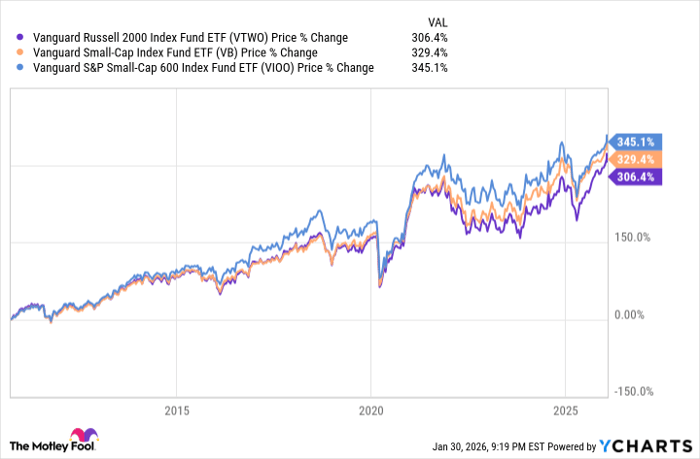
VTWO data by YCharts.
Let's focus on the competition with the Vanguard S&P SmallCap 600 ETF (NYSEMKT: VIOO), the light blue line in the chart above. As their names imply, the Russell 2000 tracker and that ETF are index funds, but they follow different indexes. Admittedly, index "nerdery" isn't everyone's cup of tea, so this will be a quick lesson.
Entering 2025, the S&P small-cap index beat the Russell 2000 in 20 full calendar years through the end of 2024. The reason for that outperformance essentially boils down to the S&P gauge requiring new additions to have a history of positive earnings. The Russell index doesn't feature that mandate.
This doesn't mean the Vanguard Russell 2000 ETF is damned to perpetual underperformance. There are periods, some measured in years, when junky small caps beat higher-quality peers, but some investors may not want to bank on that trend over the long haul.
And speaking of "junky," or not turning profits, before the 2008 global financial crisis, just 27% of the Russell 2000 was comprised of unprofitable firms. That figure vaulted to 46% as of December, according to J.P. Morgan Asset Management. This implies that 908 of the Vanguard Russell 2000's 1,974 holdings aren't making money. That's a lot.
Not all bad news with this ETF
To be fair, the Vanguard Russell 2000 small-cap ETF has some pluses. As noted above, it holds nearly 2,000 stocks, providing investors with a broad approach to domestic small-cap equities, and none of those holdings exceed a weight of 0.74%, confirming that single-stock risk is essentially nonexistent.
Additionally, this ETF's expense ratio is just 0.06% annually, or $6 on a $10,000 investment. That's way below the 0.97% average on similar funds. Indeed, there are some things to like about this ETF, but selective investors can do better elsewhere with the Vanguard S&P SmallCap 600 ETF.
Should you buy stock in Vanguard Russell 2000 ETF right now?
Before you buy stock in Vanguard Russell 2000 ETF, consider this:
The Motley Fool Stock Advisor analyst team just identified what they believe are the 10 best stocks for investors to buy now… and Vanguard Russell 2000 ETF wasn’t one of them. The 10 stocks that made the cut could produce monster returns in the coming years.
Consider when Netflix made this list on December 17, 2004... if you invested $1,000 at the time of our recommendation, you’d have $431,111!* Or when Nvidia made this list on April 15, 2005... if you invested $1,000 at the time of our recommendation, you’d have $1,105,521!*
Now, it’s worth noting Stock Advisor’s total average return is 906% — a market-crushing outperformance compared to 195% for the S&P 500. Don't miss the latest top 10 list, available with Stock Advisor, and join an investing community built by individual investors for individual investors.
See the 10 stocks »
*Stock Advisor returns as of February 4, 2026.
JPMorgan Chase is an advertising partner of Motley Fool Money. Todd Shriber has no position in any of the stocks mentioned. The Motley Fool has positions in and recommends JPMorgan Chase and Vanguard Index Funds-Vanguard Small-Cap ETF. The Motley Fool has a disclosure policy.
Recommended Articles


