




Apple's Surging iPhone Sales Aren't Really About AI...and That's a Good Thing
Key Points
Last quarter’s strong iPhone revenue growth is being interpreted as a sign that Apple’s AI efforts are paying off.
A closer look at where the company is on the developmental front, however, suggests this may not be the case.
There’s a far bigger and longer-lived dynamic with its iPhone business that’s now working in Apple’s favor.
- 10 stocks we like better than Apple ›
Apple (NASDAQ: AAPL) has finally jumped all the way on the artificial intelligence growth bandwagon. That's the prevailing narrative anyway. Following its recently reported fiscal first quarter's iPhone year-over-year revenue growth of 23%, the market's pretty well convinced the company's shrugged off its shaky iPhone-focused entry into the AI race. Except, that's probably not the case.
The suite of tools that make up Apple Intelligence doesn't look markedly different now than it did when it was first launched in October 2024. And, the new-and-improved version of its digital assistant Siri that was promised early last year still isn't available. There's a different reason consumers are suddenly so interested in the iPhone again. And unlike the demand that interest in an AI-powered handheld device might generate, the reason for this sudden swell of buying is apt to persist for at least a few years.
Where to invest $1,000 right now? Our analyst team just revealed what they believe are the 10 best stocks to buy right now. Continue »
That, however, is exactly what Apple and its shareholders should be hoping is the case.
Millions overdue for an upgrade
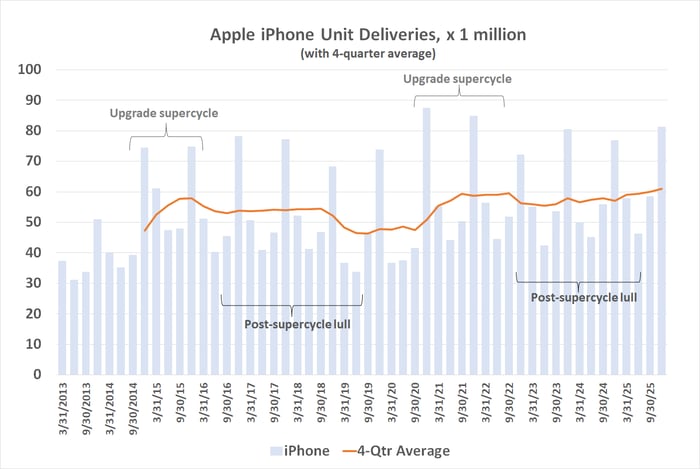
First things first. The company's touted comparison in and of itself is a bit misleading. Apple's iPhone revenue may have improved to the tune of 23% for the three-month stretch ended in December, but that doesn't mean it sold 23% more iPhones. Higher average selling prices did the bulk of this heavy lifting. IDC reports that unit sales of the popular smartphone only grew by a little less than 5% to 81.3 million devices.
Still, that's big. It's the most iPhones Apple has sold since the middle of the COVID-19 contagion, in fact, when pandemic-disrupted supply chains were finally restored following a years-long lull in demand.
Data source: IDC. Chart by author.
And the timeline of this cyclical ebb and flow is no trivial detail, either. It's now been more than four years since we've last seen a measurable spike in iPhone sales. That means iPhones currently in consumers' hands are, on average, about as old.
OK, there's not firm agreement on this exact average age. UBS said late last year that the average iPhone in the United States is roughly three years old, while CLSA suggests the global number is over six years. Separately but similarly, Wedbush Securities analyst Dan Ives said late last year that "315 million iPhone users of 1.5 billion users worldwide have not upgraded their phones in over 4 years, speaking to an upgrade opportunity on the horizon."
All the numbers point to the same ultimate conclusion. That is, a bunch of current iPhone owners just need a new phone whether or not the device's built-in technology is capable of handling artificial intelligence work on its own.
Supercycle of demand on the near horizon
And the data bears this out. A poll of buyers of the then-new iPhone 17 conducted by Consumer Intelligence Research Partners conducted in September 2025 indicates that 49% of these buyers were doing so simply because their "current phone needs replacing" for reasons like a cracked screen, performance issues, or battery problems.
New artificial intelligence features weren't the second-biggest reason this crowd was buying a new iPhone, either. A distant-second 19% of these buyers were purchasing a new mobile device because their previous one was lost, broken, or stolen. "New phone features" -- like AI tools -- were only the third-biggest reason people have wanted a new Apple-made phone, with a scant 14% of the smartphone's most recent buyers reporting this as their chief motivation.
Image source: Getty Images.
This isn't a bad thing for Apple and its investors. It's a good thing, in fact, in that it means the company doesn't need to hit an immediate home run with its AI efforts in order to jump-start a supercycle of iPhone upgrades that will drive long-awaited iPhone revenue growth. It just needs to continue making quality devices.
And that's what the analyst community largely expects, by the way. Loop Capital's analysts, for instance, wrote shortly after September's launch of the iPhone 17 series that "we are NOW at the front end of AAPL's long-anticipated adoption cycle that suggests ongoing iPhone shipment expansion through CY2027 [calendar year 2027]." Loop specifically predicts that unit sales will swell from about 240 million last year to more than a record-breaking 260 million next year.
Echoing this growth prediction for the iPhone during the same two-year time frame, aforementioned Wedbush analyst Ives commented around the same time that Apple's "focus on much-improved internal product efficiencies balanced with bold redesigns and practical new features interwoven with Apple Intelligence sets Apple up to launch toward an eventual supercycle over the next 12 to 18 months while the company looks to improve its AI strategy that's holding the stock back."
It matters simply because the iPhone accounts for half of Apple's revenue.
Undervalued in light of the actual potential upside
Don't read too much into the message. As Ives fairly pointed out, Apple's artificial intelligence offerings are certainly going to play at least some role in future demand for iPhones.
At the same time, it's not as if Apple's iPhone isn't facing other challenges including improved competition as well as the company's sheer size, which makes for tougher year-over-year comparisons. Most of the stock's gains since early 2025 have also already priced in much of the growth that's apt to be driven by the impending iPhone sales supercycle; shares are rather richly valued at roughly 30 times the current fiscal year's projected per-share earnings of $8.46, up 13% from last year's bottom line.
Nevertheless, this stock's current value still arguably understates the duration and potential upside of the iPhone upgrade cycle that appears to already be underway. That's particularly true given its pullback since early December. Bottom line? Apple stock was already a solid buy before its first-quarter numbers were released. It's an even better growth prospect now.
Should you buy stock in Apple right now?
Before you buy stock in Apple, consider this:
The Motley Fool Stock Advisor analyst team just identified what they believe are the 10 best stocks for investors to buy now… and Apple wasn’t one of them. The 10 stocks that made the cut could produce monster returns in the coming years.
Consider when Netflix made this list on December 17, 2004... if you invested $1,000 at the time of our recommendation, you’d have $446,319!* Or when Nvidia made this list on April 15, 2005... if you invested $1,000 at the time of our recommendation, you’d have $1,137,827!*
Now, it’s worth noting Stock Advisor’s total average return is 932% — a market-crushing outperformance compared to 197% for the S&P 500. Don't miss the latest top 10 list, available with Stock Advisor, and join an investing community built by individual investors for individual investors.
See the 10 stocks »
*Stock Advisor returns as of February 3, 2026.
James Brumley has no position in any of the stocks mentioned. The Motley Fool has positions in and recommends Apple. The Motley Fool has a disclosure policy.
Recommended Articles


