




Canadian Dollar crimps two-day losing streak on Tuesday
• The Canadian Dollar found fresh footing on Tuesday, keeping USD/CAD bids below 1.3700.
• Soft Canadian GDP data and falling oil prices weighed on the Loonie, while the Greenback recovered from Fed uncertainty.
• the US House passed $1 trillion spending deal to end partial US shutdown.
The Canadian Dollar (CAD) slowed its recent tumble against the US Dollar (USD) on Tuesday, too weak to push through near-term levels but also not strong enough to break through on the other side. The Loonie has shed ground for three of the last four trading sessions as softer domestic growth signals and renewed US Dollar strength reversed part of January's rally.
Recent Canadian data showed real Gross Domestic Product (GDP) flat in November, with a third contraction in four months across goods-producing industries led by a deepening slump in manufacturing. The manufacturing sector fell 1.3% month-over-month, with motor vehicles and parts output plunging 6.4% amid a global semiconductor shortage. This underlying weakness underscores that economic momentum remains fragile even as services provide only a limited offset.
House passes spending deal, ends partial shutdown
The US House of Representatives passed a more than $1 trillion spending package on Tuesday by a vote of 217 to 214, bringing an end to the partial government shutdown that began on January 31. The legislation, which had already passed the Senate on Friday, funds several of the government's largest departments through the end of the fiscal year in September, including the Pentagon, the Department of Health and Human Services, the Department of Transportation, the Department of Education, and the Department of Housing and Urban Development. President Trump endorsed the plan and is expected to sign it immediately.
The deal includes a two-week continuing resolution for the Department of Homeland Security, giving lawmakers more time to negotiate over guardrails on the Trump administration's immigration enforcement operations. Democratic appropriators praised the final package for staving off deep funding cuts the Trump administration had requested, including a proposed 50% slash to Centers for Disease Control and Prevention funding that was rejected. The resolution of the shutdown removes a source of near-term political uncertainty, though markets remain focused on broader fiscal concerns and upcoming economic data.
Daily digest market movers: CAD retreats as USD rebounds on shutdown resolution
• CAD weakened past 1.36 per USD on Tuesday, extending losses from 16-month highs near
1.35.
• Canadian GDP was flat in November, with manufacturing down 1.3% MoM; Q4 growth likely
contracted 0.1%.
• House passed $1 trillion spending deal (217-214) to end partial shutdown; DHS funded for two
more weeks.
• BoC held rates at 2.25% on January 28, citing elevated uncertainty around CUSMA
renegotiations.
• US ISM Manufacturing PMI surged to 52.6 in January, the first expansion in 12 months.
• DXY climbed toward 97.7 after Trump nominated Kevin Warsh as next Fed chair.
• WTI Crude Oil fell to $62/barrel as US-Iran talks eased geopolitical risk premium.
Canadian Dollar price forecast
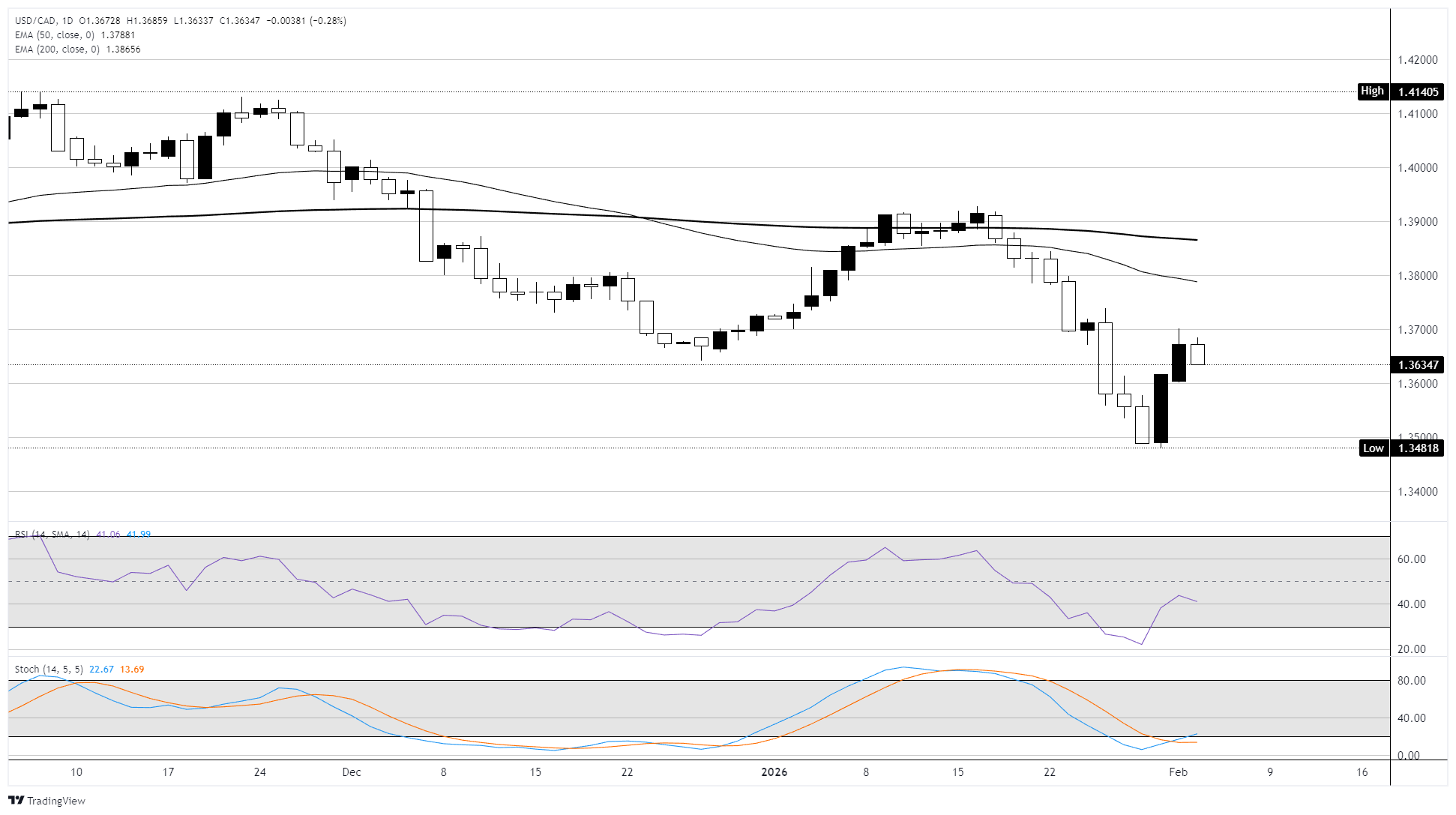
USD/CAD opened near 1.3670 on Tuesday, rebounding from the recent low near 1.3490 touched late last week. The pair has recovered sharply after testing sixteen-month lows, with the bounce gaining momentum as the Greenback finds renewed support. Price action has pushed back above the 50-day Exponential Moving Average (EMA), which sits near 1.37, signaling a potential shift in short-term momentum.
Support at 1.35, resistance at 1.39
The 200-day EMA at approximately 1.39 represents the next key resistance level, with a sustained break above this threshold needed to suggest a more meaningful reversal of the recent downtrend. On the downside, support is seen near the recent lows around 1.3490-1.3500, with a break below opening the door toward 1.3400. The Relative Strength Index (RSI) has rebounded from oversold territory and sits in the mid-40s, indicating neutral conditions with room for the pair to move in either direction.
Near-term bias tilts modestly higher
With Canadian fundamentals remaining soft and the US Dollar regaining traction on Fed uncertainty and strong economic data, the near-term bias for USD/CAD tilts modestly higher. The resolution of the partial US government shutdown removes one source of uncertainty, though markets remain focused on the upcoming CUSMA renegotiations and US labor market data. A sustained move above 1.3775-1.3800 would confirm renewed bullish momentum, while a failure to hold above the 50-day EMA could see the pair drift back toward multi-month lows.
USD/CAD daily chart
Canadian Dollar FAQs
The key factors driving the Canadian Dollar (CAD) are the level of interest rates set by the Bank of Canada (BoC), the price of Oil, Canada’s largest export, the health of its economy, inflation and the Trade Balance, which is the difference between the value of Canada’s exports versus its imports. Other factors include market sentiment – whether investors are taking on more risky assets (risk-on) or seeking safe-havens (risk-off) – with risk-on being CAD-positive. As its largest trading partner, the health of the US economy is also a key factor influencing the Canadian Dollar.
The Bank of Canada (BoC) has a significant influence on the Canadian Dollar by setting the level of interest rates that banks can lend to one another. This influences the level of interest rates for everyone. The main goal of the BoC is to maintain inflation at 1-3% by adjusting interest rates up or down. Relatively higher interest rates tend to be positive for the CAD. The Bank of Canada can also use quantitative easing and tightening to influence credit conditions, with the former CAD-negative and the latter CAD-positive.
The price of Oil is a key factor impacting the value of the Canadian Dollar. Petroleum is Canada’s biggest export, so Oil price tends to have an immediate impact on the CAD value. Generally, if Oil price rises CAD also goes up, as aggregate demand for the currency increases. The opposite is the case if the price of Oil falls. Higher Oil prices also tend to result in a greater likelihood of a positive Trade Balance, which is also supportive of the CAD.
While inflation had always traditionally been thought of as a negative factor for a currency since it lowers the value of money, the opposite has actually been the case in modern times with the relaxation of cross-border capital controls. Higher inflation tends to lead central banks to put up interest rates which attracts more capital inflows from global investors seeking a lucrative place to keep their money. This increases demand for the local currency, which in Canada’s case is the Canadian Dollar.
Macroeconomic data releases gauge the health of the economy and can have an impact on the Canadian Dollar. Indicators such as GDP, Manufacturing and Services PMIs, employment, and consumer sentiment surveys can all influence the direction of the CAD. A strong economy is good for the Canadian Dollar. Not only does it attract more foreign investment but it may encourage the Bank of Canada to put up interest rates, leading to a stronger currency. If economic data is weak, however, the CAD is likely to fall.
Recommended Articles


