




Could This ETF Be the Best Way to Play Rising Interest Rates in 2026?
Key Points
This ETF has rising rates protection in its DNA.
Despite its name, it can thrive even if rates don’t rise.
It has some other traits likely to surprise dividend investors.
- 10 stocks we like better than Fidelity Covington Trust - Fidelity Dividend ETF For Rising Rates ›
Much to the dismay of the White House, some corners of Wall Street, and plenty of retail investors, the Federal Reserve held interest rates unchanged this past Wednesday, dashing hopes of a January rate cut.
One meeting without a rate cut doesn't mean the central bank is suddenly turning hawkish and that monetary tightening is imminent. But for the sake of argument, let's consider the possibility that the macroeconomic environment rapidly shifts to the point that the Fed is backed into a corner and must raise rates.
Where to invest $1,000 right now? Our analyst team just revealed what they believe are the 10 best stocks to buy right now, when you join Stock Advisor. See the stocks »
There's an exchange-traded fund (ETF) for that, and it's the Fidelity Dividend ETF For Rising Rates (NYSEMKT: FDRR). Yes, this ETF protects in the event that 10-year Treasury yields rise, but even if that doesn't happen, the fund offers utility.

This ETF can thrive if rates rise or fall. Image source: Getty Images.
Rates up, rates down, this ETF can deliver
This $660 million Fidelity ETF follows an index of the same name. That gauge is "designed to reflect the performance of stocks of large and mid-capitalization dividend-paying companies that are expected to continue to pay and grow their dividends and have a positive correlation of returns to increasing 10-year U.S. Treasury yields," according to the issuer.
Dispensing with the financial jargon, some sectors can thrive even when those yields rise. Other sectors are considered rate-sensitive in a negative fashion. Historically, REITs and utilities have been in the latter category due to their capital-intensive nature. So, it's not surprising that the real estate and utilities sectors combine for just 4.1% of this ETF's roster.
The Fidelity rising rates ETF debuted in September 2016, and while that's not ancient in fund industry terms, those nine-plus years are instructive because the Fed has cut and raised rates over that time. For much of that period, the central bank pursued easy monetary policy, and yet the rising rates ETF has still delivered impressive performance since its inception helped in large part by significant exposure to technology stocks.
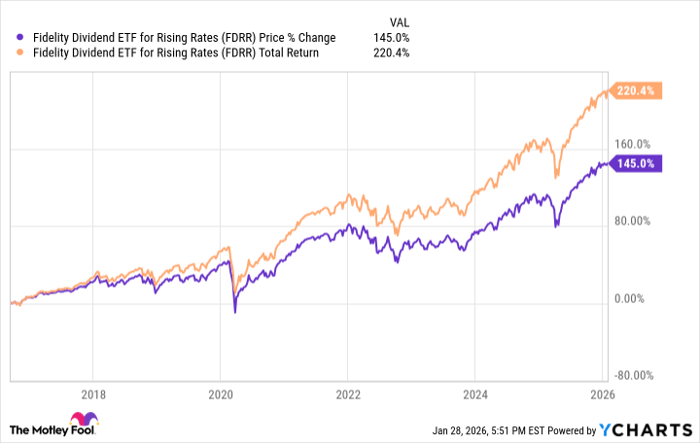
FDRR data by YCharts
Of course, investors are right to ask how a rising rates ETF performed amid Fed tightening. Good news: The Fidelity ETF answered that bell. Over the past five years, a period including 11 rate hikes spanning 2022 and 2023, the Fidelity fund was one of the best-performing dividend ETFs . In fact, just four rivals, including another Fidelity product, beat this dividend ETF over that period.
A sector surprise
Remember the talk above about this ETF's unsurprising lack of exposure to sectors inversely correlated to 10-year yields? Well, this ETF may have sector surprises for inexperienced investors, but the surprises are pleasant. Although it's not a growth fund in the strictest sense, it allocates about 32% of its weight to tech stocks.
That's almost in line with the S&P 500's 34% exposure to that sector and far above average among dividend ETFs. Fun fact: This ETF's weight to Nvidia is larger than what's found in a basic S&P 500 index fund. The Fidelity ETF's significant tech exposure stems from its focus on stocks that are positively correlated with 10-year Treasury yields. That exposure is a plus because the mega-cap tech names residing in this ETF are cash-rich and have pristine balance sheets, which are desirable traits when rates rise. At the same time, many rival ETFs focus on dividend increase streaks or yield, thereby depressing tech exposure.
Indeed, this Fidelity ETF uses a unique, though potentially rewarding methodology, and it can be accessed at a modest annual fee of 0.15%, or just $15 on a $10,000 stake.
Should you buy stock in Fidelity Covington Trust - Fidelity Dividend ETF For Rising Rates right now?
Before you buy stock in Fidelity Covington Trust - Fidelity Dividend ETF For Rising Rates, consider this:
The Motley Fool Stock Advisor analyst team just identified what they believe are the 10 best stocks for investors to buy now… and Fidelity Covington Trust - Fidelity Dividend ETF For Rising Rates wasn’t one of them. The 10 stocks that made the cut could produce monster returns in the coming years.
Consider when Netflix made this list on December 17, 2004... if you invested $1,000 at the time of our recommendation, you’d have $450,256!* Or when Nvidia made this list on April 15, 2005... if you invested $1,000 at the time of our recommendation, you’d have $1,171,666!*
Now, it’s worth noting Stock Advisor’s total average return is 942% — a market-crushing outperformance compared to 196% for the S&P 500. Don't miss the latest top 10 list, available with Stock Advisor, and join an investing community built by individual investors for individual investors.
See the 10 stocks »
*Stock Advisor returns as of February 2, 2026.
Todd Shriber has no position in any of the stocks mentioned. The Motley Fool has positions in and recommends Nvidia. The Motley Fool has a disclosure policy.
Recommended Articles


