




Read This Before Buying Beyond Meat Stock
Key Points
The initially high hopes investors had for Beyond Meat have given way to doubts about the market for its plant-based meat alternatives.
The company's financials reflect the diminishing popularity of its products.
- 10 stocks we like better than Beyond Meat ›
The swoon in Beyond Meat's (NASDAQ: BYND) stock in recent years has been dramatic. The stock that topped $230 per share soon after its 2019 initial public offering (IPO) slumped steeply in 2021 and 2022. That steady decline has continued, and in recent weeks, it dipped below $1 per share.
That extended drop occurred against a backdrop of falling popularity for the plant-based meats upon which the company bases its business. Ultimately, it points to a key investing lesson that Beyond Meat shareholders may have failed to heed.
Where to invest $1,000 right now? Our analyst team just revealed what they believe are the 10 best stocks to buy right now. Continue »
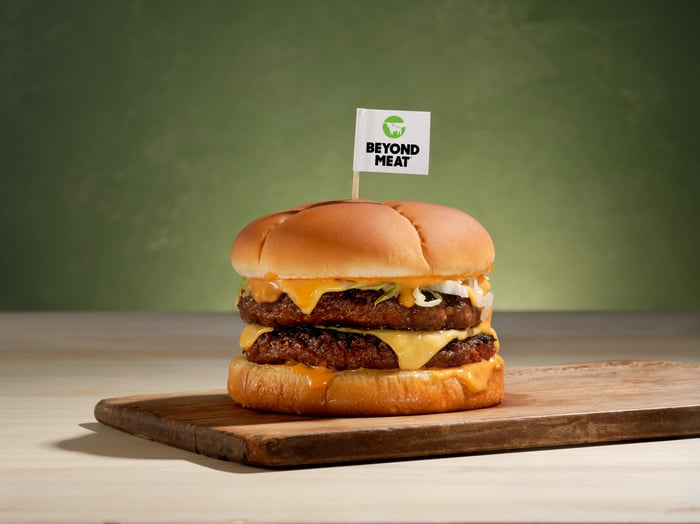
Image source: Beyond Meat.
What investors need to know about Beyond Meat
In hindsight, long-term shareholders in Beyond Meat stock could have probably avoided significant pain if they had followed one of the strategies Warren Buffett was famous for. When he was an active investor, he favored companies that sold products with high, sustainable demand and enjoyed robust competitive moats. Unfortunately, Beyond Meat lacked these essential characteristics.
Admittedly, this lack of sustainability was not obvious in the beginning. The company appeared to have solved a problem for many consumers by offering them a meat alternative that was similar to an animal product, but that wasn't one. That gave vegans and vegetarians new menu options in the form of meats that met the criteria of their diets. It also may have appealed to some health-conscious consumers as a sometime-substitute for meat since it is made with healthy ingredients such as beets, lentils, brown rice, avocado, and potatoes.
Nonetheless, the product appears to have failed to deliver on expectations. It costs consumers more than animal-based meat, which likely discouraged some people from even trying it.
Moreover, even among those who did experiment with it, many found the taste and texture unappealing. Also, some vegans or vegetarians follow those diets in part because they dislike the taste of meat, which means that they wouldn't enjoy even a reasonably good replica of animal protein.
Beyond Meat by the numbers
Beyond Meat's financials indicate its product is a fading fad. In the first nine months of 2025, its revenue fell by 14% year over year to $214 million.
Additionally, operating expenses rose, mostly because of a $77 million asset impairment. Still, even if one factors out the impairment, its other expenses only fell modestly. Between those two factors, its loss in the first three quarters of 2025 surged to $193 million compared to $115 million in the prior-year period. That loss is particularly troubling since the company holds only around $117 million in cash on its books.
Given that it has fallen to penny stock status, it's unlikely that it will find secondary stock sales a good option for raising funds. Also, with over $1.1 billion in convertible senior notes already on its balance sheet, Beyond Meat may struggle to borrow additional funds. Absent a recovery in sales, such conditions could force a bankruptcy sooner rather than later.
A fading food fad
Unfortunately for Beyond Meat investors, the company would need a true competitive moat to meaningfully lift the stock, and it doesn't have one.
The idea that vegans, vegetarians, and even health-conscious omnivores would flock to its plant-based alternative meats initially convinced investors that there was a huge and sustainable market for the company's offerings. Unfortunately, between its higher prices and mixed customer reviews, plant-based meat increasingly looks to have been a fad. As that fad fades, the company is left facing what may be insurmountable financial hurdles.
Investors can take this as a lesson: When considering adding a company to your portfolio, take care to gauge the long-term appeal of its core products. Since Beyond Meat's plant-based alternatives appear to lack sustained demand, investors should probably avoid its stock.
Should you buy stock in Beyond Meat right now?
Before you buy stock in Beyond Meat, consider this:
The Motley Fool Stock Advisor analyst team just identified what they believe are the 10 best stocks for investors to buy now… and Beyond Meat wasn’t one of them. The 10 stocks that made the cut could produce monster returns in the coming years.
Consider when Netflix made this list on December 17, 2004... if you invested $1,000 at the time of our recommendation, you’d have $448,476!* Or when Nvidia made this list on April 15, 2005... if you invested $1,000 at the time of our recommendation, you’d have $1,180,126!*
Now, it’s worth noting Stock Advisor’s total average return is 945% — a market-crushing outperformance compared to 197% for the S&P 500. Don't miss the latest top 10 list, available with Stock Advisor, and join an investing community built by individual investors for individual investors.
See the 10 stocks »
*Stock Advisor returns as of January 31, 2026.
Will Healy has no position in any of the stocks mentioned. The Motley Fool has positions in and recommends Beyond Meat. The Motley Fool has a disclosure policy.
Recommended Articles


