


3 Top Lesser-Known Space Stocks to Buy Now That Are Poised to Benefit From NASA's Artemis Moon Missions
Key Points
Artemis is a long-term NASA program, so it seems likely that some companies involved will benefit for some time.
Artemis contracts could move the needle more on smaller companies’ financials than on those of the massive prime contractors.
- 10 stocks we like better than Karman ›
NASA's Artemis II mission has been in the news a lot recently. That's because on Saturday, Jan. 17, the Space Launch System (SLS) rocket and Orion spacecraft were moved to Launch Pad 39B from the Vehicle Assembly Building (VAB) at Kennedy Space Center in Florida.
Before we get into the topic of stocks that could benefit from Artemis, it should be helpful for investors to understand the program.
Where to invest $1,000 right now? Our analyst team just revealed what they believe are the 10 best stocks to buy right now, when you join Stock Advisor. See the stocks »
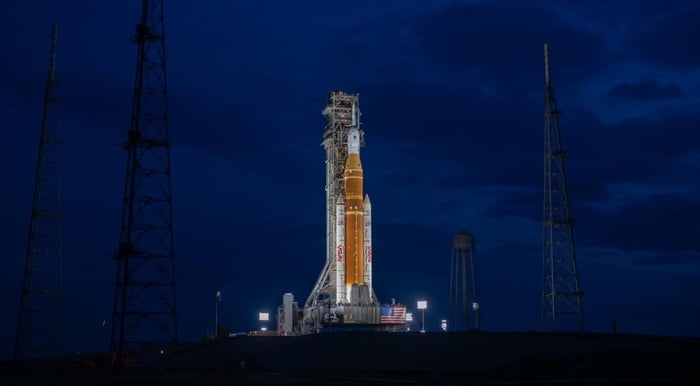
Image source: NASA/Brandon Hancock.
About the Artemis program
The move of the SLS and Orion to a launch pad was in preparation for Artemis II's approximately 10-day crewed flight test around the moon. The earliest launch window for the 4-crew mission opens on Friday, Feb. 6, at 9:41 p.m. ET and lasts for two hours.
Artemis II is one key step in NASA's Artemis program, whose ultimate goals are to once again land humans on the moon, establish a sustained human presence there, and ultimately explore Mars. It's been over 50 years since Americans landed on the moon during the Apollo program, which ended in 1972. Artemis is aptly named for Apollo's twin sister in ancient Greek mythology.
Artemis III "will send the first humans to explore the region near the lunar South Pole," and Artemis IV "debuts humanity's first lunar space station [called Gateway], a larger, more powerful version of the SLS rocket, and new mobile launcher," according to NASA. Artemis IV could occur as soon as September 2028. Then it seems likely either more key steps will occur or another program will follow whose goals are related to Mars.
Given that Artemis is a long-term program, it seems likely that some stocks will benefit from this program. But which stocks?
I'm going to address under-the-radar stocks rather than major aerospace and defense contractors. It's well known which huge companies are involved in Artemis. (Prime contractors and well-known key partners include -- but are not limited to -- Boeing, Lockheed Martin, Northrop Grumman, L3Harrris Technologies, Airbus, Amentum, Elon Musk's SpaceX, and Jeff Bezos' Blue Origin.) Moreover, Artemis contracts could move the needle more for smaller companies' financials than for those of large companies.
3 under-the-radar stocks that could benefit from NASA's Artemis program
Stocks listed in order of market cap.
| Company | Market Cap | Forward P/E | Wall Street's Estimated 5-Year Annualized EPS Growth | Year-to-Date 2026 Stock Return | 3-Year Stock Return |
|---|---|---|---|---|---|
| Karman Holdings (NYSE: KRMN) | $15.0 billion | 185 | 127% | 54.9% | N/A |
| MDA Space (OTC: MDAL.F) | $3.6 billion | 24 | N/A. 61% this year; 6.5% next year. | 48.5% | 477% |
| Graham Corp. (NYSE: GHM) | $775 million |
51 |
N/A. 10.8% this year; 58.7% next year. | 9.8% | 633% |
| S&P 500 Index | N/A | N/A | N/A | 2% | 78.9% |
Data sources: Yahoo! Finance, YCharts, and finviz.com. Forward P/E = forward price-to-earnings ratio. EPS = earnings per share. Data to Jan. 27, 2026.
Karman Holdings: A relatively new public company
Karman Holdings held its initial public offering (IPO) in February 2025. Because it's such a newly public company, it probably flies under the radar (pardon the pun) of many investors.
Karman was founded in early 2021 through a partnership between AMRO Fabricating, a leading manufacturer of large, lightweight metallic structures serving the aerospace and defense industries; Trive Capital, a Dallas-based private equity firm with investment expertise in the space and defense sectors; Aerospace Engineering Corp.; and AAE Aerospace. At that time, Karman was "focused on manufacturing complex systems for the space, missile, interceptor, and hypersonic markets."
Karman has made a handful of acquisitions over the last year. Its most recent acquisition occurred earlier this month, when it bought Seemann Composites LLC, including its subsidiary, Materials Sciences. This $220 million acquisition ($210 million in cash and $10 million in Karman stock) expands Karman's operations into the maritime defense market, a high priority for the U.S. Department of Defense.
As for Artemis, Karman "provides machining and welding services for multiple Artemis elements, including the primary structures for the SLS core stage, the Orion crew module, the launch abort system, and the forward skirt for future SLS solid rocket boosters," according to NASA.
Karman stock is only suitable for risk-tolerant investors. Along with the stock's valuation being very high (see forward P/E in the chart), Karman doesn't have much history as a publicly traded company. So, investors don't have a lot of key data on which to base their investment decisions.
MDA Space: A mid-cap Canadian company that's profitable
MDA Space is another stock that probably isn't well known, at least among U.S. investors. The company was founded in 1969 and held its IPO in 2021. It is based in Ontario, Canada, and its stock is listed on the Toronto Stock Exchange. MDA Space is Canada's biggest space company.
Most U.S. investors should stick to stocks traded on a major U.S. exchange, as foreign stocks traded only over the counter (OTC) in the U.S. pose additional risks, including low liquidity and currency translation.
That said, for very experienced investors, MDA Space looks promising. The company is profitable, experiencing strong growth, and has a huge backlog.
MDA is heavily involved in the Artemis program, primarily by supplying advanced robotics systems for the construction of moon infrastructure and exploration. Specifically, it is involved in developing the artificial intelligence (AI)-powered "Canadarm3" for the Gateway lunar space station and designing a robotic arm and interfaces for the new Lunar Terrain Vehicle (LTV). It also has other Artemis-related contracts. (If you're wondering which company's or companies' AI tech is being used for Canadarm3, I was, too. I'm trying to track down if Nvidia's AI chips are being used, as I suspect.)
Graham Corp.: A profitable long-established small-cap company
Graham Corp. is headquartered in Batavia, New York, and went public in 1968, though its roots date back to 1936. It designs and manufactures critical fluid, power, heat transfer, and vacuum systems for the defense, aerospace, energy, and process industries.
Graham's Barber-Nichols subsidiary, based in the Denver area, is working with Axiom Space to supply critical life-support components (oxygen fans and thermal loop pumps) for the AxEMU, a new spacesuit designed for the Artemis III mission.
The company is seeing a "meaningful momentum" across its businesses. In November, on its second-quarter fiscal 2026 earnings call, CEO Matt Malone said: "In the second quarter and first month of our fiscal 2026 third quarter, our Barber-Nichols subsidiary booked a series of new orders from six industry-leading customers in the commercial space launch market. These awards were for advanced turbomachinery and precision-engineered components supporting next-generation commercial launch in in-space systems and totaled $22 million."
Moreover, the energy end market is also doing well. Malone stated that the company is "seeing meaningful momentum in small modular nuclear reactors and cryogenic applications." Graham is involved in both the conventional and clean or renewable energy markets.
On the call, management said that the company closed the quarter with a book-to-bill ratio of 1.3x and drove backlog to a record $500.1 million, up 23% year over year. For context, the company's revenue was $66 million in the quarter, up 23% year over year. A book-to-bill ratio over 1.0 is usually a sign of growing demand for a company's products.
Should you buy stock in Karman right now?
Before you buy stock in Karman, consider this:
The Motley Fool Stock Advisor analyst team just identified what they believe are the 10 best stocks for investors to buy now… and Karman wasn’t one of them. The 10 stocks that made the cut could produce monster returns in the coming years.
Consider when Netflix made this list on December 17, 2004... if you invested $1,000 at the time of our recommendation, you’d have $462,174!* Or when Nvidia made this list on April 15, 2005... if you invested $1,000 at the time of our recommendation, you’d have $1,143,099!*
Now, it’s worth noting Stock Advisor’s total average return is 946% — a market-crushing outperformance compared to 196% for the S&P 500. Don't miss the latest top 10 list, available with Stock Advisor, and join an investing community built by individual investors for individual investors.
See the 10 stocks »
*Stock Advisor returns as of January 28, 2026.
Beth McKenna has positions in Nvidia. The Motley Fool has positions in and recommends Amentum, Boeing, Graham, L3Harris Technologies, and Nvidia. The Motley Fool recommends Lockheed Martin. The Motley Fool has a disclosure policy.
Recommended Articles


