




This Tech Stock Is a Blast From the Past -- and Just Hit All-Time Highs
Key Points
This company was a hit during the 1990s tech boom but fell from grace in the ensuing bust in the early 2000s.
Its technology remained relevant, but the stock languished for decades.
Now, it has soared back to all-time highs due to rising demand for data center applications.
- 10 stocks we like better than Rambus ›
For younger investors who've just gotten started in the past 20 years, it's difficult to explain exactly what it was like to go through the 1990s tech boom and the abrupt reversal in tech stocks in the early 2000s. The seemingly endless possibilities with internet-related efforts led to a huge amount of innovation, and investors were eager to participate in the good fortune of the companies that turned their innovation into fast-growing businesses. Yet once the bottom fell out of the market, even solid companies with good long-term growth prospects saw their shares plunge.
Many of those internet favorites of the 1990s never recovered. That makes the stocks that did bounce back that much more interesting. In looking at prospective stocks for the Voyager Portfolio, I ran across a stock that was a favorite on the Fool discussion boards during the tech boom. Rambus (NASDAQ: RMBS) took a long time to return to its former glory, but the semiconductor technology specialist has found new life in the AI boom.
Where to invest $1,000 right now? Our analyst team just revealed what they believe are the 10 best stocks to buy right now, when you join Stock Advisor. See the stocks »
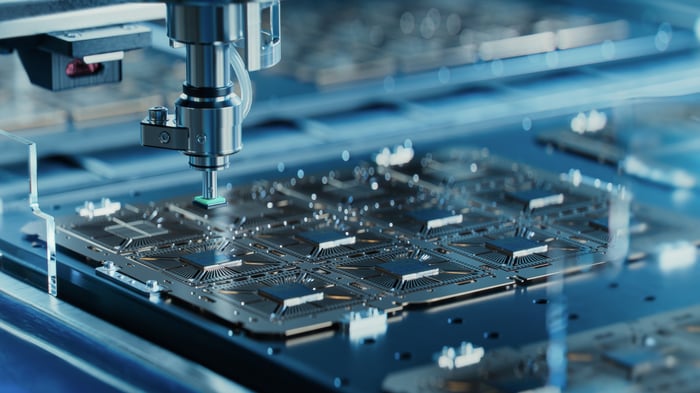
Image source: Getty Images.
Turning back the clock with Rambus
Rambus initially specialized in memory chips, which were important drivers of the PC revolution of the 1980s and 1990s. As microprocessors got faster, accessing memory became a bottleneck that limited advances in overall computing speed. With the introduction of Rambus dynamic random access memory (RDRAM), Rambus largely eliminated that bottleneck, as its RDRAM technology helped memory chips perform as much as 10 times better than the standard DRAM chips of the time.
Rambus got most of its revenue from licensing out its intellectual property to semiconductor manufacturers. When the tech boom ended, it put an end to the high-growth phase of Rambus' business. The company also ended up suing a number of industry leaders for alleged patent infringement, including Nvidia (NASDAQ: NVDA), Micron Technology (NASDAQ: MU), and Samsung, with mixed success.
How Rambus got its groove back
As recently as 2020, Rambus shares traded below $10, down 90% of their highs in 2000. Yet Rambus' leaders knew that the company had potential, and they set about putting a new strategic vision in place to take advantage of the best long-term growth prospects available.
The result has been a multi-faceted business that has been successful in many ways. Rambus ' DDR5 dual in-line memory module (DIMM) meets the latest standard for memory chips, and it has played an increasingly important role in data servers. In addition, Rambus' low-power compression attached memory modules (LPCAMM2) offer better performance for laptops and portable electronic devices, where power conservation is more of a concern.
Meanwhile, Rambus has also developed silicon intellectual property that is in high demand . Memory controllers, interconnect controllers, and video compression chips all make it easier for hardware to interface with memory chips. Security features including cipher engines, crypto cores, and root-of-trust applications are essential for data center and edge-computing cybersecurity, as well as in both consumer-facing industries like automobiles and public-sector government and defense applications.
All that jargon might be hard for non-tech-savvy investors to fully understand. The gist, though, is that Rambus technology makes it easier for companies involved in the production of high-performance semiconductor chips to exchange information at top speed, maintain the integrity of proprietary data, and use the full power of artificial intelligence to draw useful insights.
Turning potential into profit
The pieces of this strategy were in place for years, but it took a full commitment from Rambus to reap meaningful rewards from it. After seeing stagnant revenue and inconsistent profitability throughout most of the 2010s, Rambus looks like it has finally turned the corner financially over the past several years. The next article in this three-part series will focus more on Rambus' financials and how the stock has returned to record levels.
Should you buy stock in Rambus right now?
Before you buy stock in Rambus, consider this:
The Motley Fool Stock Advisor analyst team just identified what they believe are the 10 best stocks for investors to buy now… and Rambus wasn’t one of them. The 10 stocks that made the cut could produce monster returns in the coming years.
Consider when Netflix made this list on December 17, 2004... if you invested $1,000 at the time of our recommendation, you’d have $450,525!* Or when Nvidia made this list on April 15, 2005... if you invested $1,000 at the time of our recommendation, you’d have $1,133,107!*
Now, it’s worth noting Stock Advisor’s total average return is 937% — a market-crushing outperformance compared to 195% for the S&P 500. Don't miss the latest top 10 list, available with Stock Advisor, and join an investing community built by individual investors for individual investors.
See the 10 stocks »
*Stock Advisor returns as of January 23, 2026.
Dan Caplinger has positions in Nvidia. The Motley Fool has positions in and recommends Micron Technology and Nvidia. The Motley Fool has a disclosure policy.
Recommended Articles


