




Costco Really Wants Its Gold Star Members to Upgrade to Executive Status, and It's Dangling 3 Specific Perks to Entice Them
Key Points
The global retail industry is gigantic, with an addressable market estimated at $36.9 trillion by 2030.
Despite an abundance of competition, Costco Wholesale has managed to differentiate itself through its membership-driven operating model.
Costco has added or adjusted a trio of perks for its Executive cardholders, who account for more than 74% of the company's net sales.
- 10 stocks we like better than Costco Wholesale ›
For the last three years, the talk on Wall Street has centered on the rise of artificial intelligence (AI) and its potential to positively impact corporate growth and the lives of billions worldwide. But based on addressable opportunity, the global retail industry dwarfs the AI market.
According to a report from Mordor Intelligence, the worldwide retail industry is expected to expand from a $27.3 trillion market in 2025 to an estimated $36.9 trillion opportunity by 2030. For those keeping score at home, this translates to a compound annual growth rate that exceeds 6%.
Where to invest $1,000 right now? Our analyst team just revealed what they believe are the 10 best stocks to buy right now. Continue »
Although the retail industry is highly competitive, businesses that are able to stand out can reap significant rewards. Examples of leading retailers include e-commerce titan Amazon (NASDAQ: AMZN), retail kingpin Walmart (NASDAQ: WMT), and warehouse club Costco Wholesale (NASDAQ: COST).
Arguably, no retailer has had a more unique path to success than Costco, whose membership-based operating model fuels its growth.
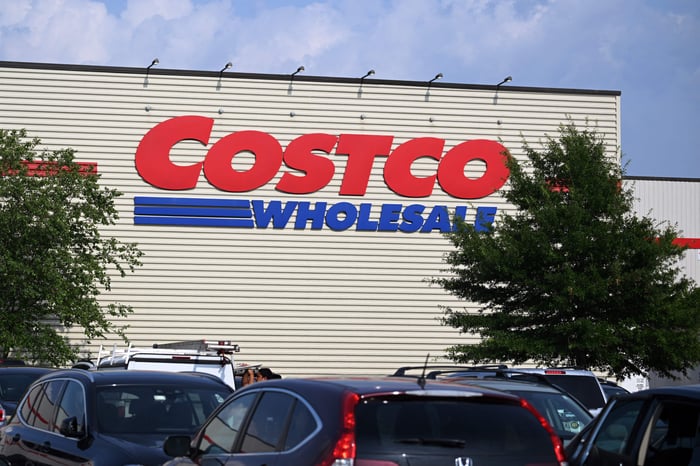
Image source: Costco Wholesale.
Differentiation has been central to Costco's long-term success
Based on data from the U.S. Bureau of Labor Statistics, there were more than 1 million private retail establishments in the U.S. in the third quarter of 2024. While Costco isn't competing with all 1 million-plus businesses, it's constantly battling to stay relevant and attract shoppers to its stores. Some of the strategies it relies on are straightforward, while others are truly unique.
For example, Costco uses its size to its advantage. Similar to Amazon and Walmart, it purchases products in bulk, which lowers the per-unit cost of each item. These cost savings can be passed along to its shoppers, thereby allowing it to undercut local stores and national grocery chains on price. Few retailers can match the value proposition that Costco brings to the table for its members.
To build on this point, Costco offers a wide range of basic necessities, including groceries and toiletries, as well as a broad assortment of discretionary goods. These necessities ensure shoppers will come to its stores in any economic climate. While the margins tend to be razor-thin on groceries, it takes just one or more discretionary item purchases for a shopper's trip to be highly profitable.
Costco also enhances the lure of its warehouses by carrying rare or one-off items, such as luxury jewelry and gold bars/ingots.
But the most significant differentiating factor for Costco Wholesale is its memberships. Members pay $65 (Gold Star and Business) or $130 (Executive) annually for the right to shop in its stores. It's only natural for these individuals to want to get the most out of their membership fee. This makes Costco a prime destination for large shopping trips and works toward keeping consumers within its ecosystem.

Image source: Getty Images.
Costco is introducing and updating perks to encourage Executive-level upgrades
As of the end of its fiscal first quarter for 2026 (Nov. 23, 2025), Costco had 81.4 million paying members worldwide, 39.7 million of which were Executive cardholders. However, the company is making a strong push, fueled by three new or adjusted perks, to entice tens of millions of U.S.-based Gold Star members to upgrade to Executive status.
For instance, when the company enacted its first membership fee increase since 2017 on Sept. 1, 2024, it also lifted the maximum annual 2% cash back reward from $1,000 to $1,250 for its Executive members. While purchases of gas, tobacco, alcohol (in most states), Costco gift cards, and membership fees don't count toward this 2% cash back reward, most in-store and online purchases will.
A second dangling carrot was added for Costco's Executive members on June 30, 2025. Beginning at the midpoint of last year, the company's highest-tier cardholders would receive a $10 monthly Instacart credit for same-day online delivery orders above $150 in the U.S. and Canada. Management fully understands the convenience that online shopping offers -- and 20.5% digitally enabled comparable sales growth in the fiscal first quarter suggests this perk is hitting home.
The third and easily most polarizing perk that Costco Wholesale bestowed on its Executive cardholders is special shopping hours. Beginning Sept. 2, 2025, Executive members can shop in Costco's stores exclusively from 9 a.m. to 10 a.m. on weekdays and Sundays, and from 9 a.m. to 9:30 a.m. on Saturdays. CEO Ron Vachris has noted in quarterly conference calls since implementing these new shopping hours for its top-tier members that it's had a positive impact on sales.
Although Costco aims to provide value to all 81.4 million of its members worldwide, encouraging domestic Gold Star member upgrades is vital to its long-term success. Membership fees account for the lion's share of Costco's profits and provide the necessary margin buffer to undercut other retailers on price.
Even though Executive cardholders account for less than 49% of paying members, their purchases totaled 74.3% of net sales for Costco during the fiscal first quarter of 2026. Keeping Executive members happy and ensuring that renewal rates remain in the low-to-mid 90% range in the U.S. and Canada is paramount to the company's success.
With Costco aggressively targeting membership upgrades, expect new perks to be added or adjusted in the new year (and beyond).
Should you buy stock in Costco Wholesale right now?
Before you buy stock in Costco Wholesale, consider this:
The Motley Fool Stock Advisor analyst team just identified what they believe are the 10 best stocks for investors to buy now… and Costco Wholesale wasn’t one of them. The 10 stocks that made the cut could produce monster returns in the coming years.
Consider when Netflix made this list on December 17, 2004... if you invested $1,000 at the time of our recommendation, you’d have $477,544!* Or when Nvidia made this list on April 15, 2005... if you invested $1,000 at the time of our recommendation, you’d have $1,122,686!*
Now, it’s worth noting Stock Advisor’s total average return is 952% — a market-crushing outperformance compared to 195% for the S&P 500. Don't miss the latest top 10 list, available with Stock Advisor, and join an investing community built by individual investors for individual investors.
See the 10 stocks »
*Stock Advisor returns as of January 16, 2026.
Sean Williams has positions in Amazon. The Motley Fool has positions in and recommends Amazon, Costco Wholesale, and Walmart. The Motley Fool recommends Instacart. The Motley Fool has a disclosure policy.
Recommended Articles


