




Warren Buffett Stepped Down, but His Timeless Investment Advice Can Help You Build Wealth for Years to Come
Key Points
He has often said buying a low-cost index fund like the Vanguard S&P 500 ETF is the best way for individuals to build wealth over the long term.
Although the index is very top-heavy, with one-third in tech stocks, it's highly diversified, too.
- 10 stocks we like better than Vanguard S&P 500 ETF ›
Warren Buffett served as the chief executive officer of Berkshire Hathaway (NYSE: BRK.A)(NYSE: BRK.B) from 1965 until the end of 2025, when he stepped down. During his 60-year tenure, he transformed Berkshire from a struggling textiles manufacturer into a $1 trillion conglomerate with more than 60 wholly owned subsidiaries, and minority stakes in more than 40 other companies.
Berkshire stock delivered a compound annual return of 19.7% during Buffett's time as CEO, which would have been enough to turn a mere $500 investment in 1965 into $24.2 million today. Buffett knows that typical investors would struggle to replicate his success, so he often recommends they buy a low-cost S&P 500 index fund instead of trying to pick individual stocks.
Where to invest $1,000 right now? Our analyst team just revealed what they believe are the 10 best stocks to buy right now. Continue »
In a 2013 letter to shareholders, he specifically recommended the Vanguard S&P 500 ETF (NYSEMKT: VOO) because of its ultra-low fees. Here's how this exchange-traded fund can help build wealth for decades.
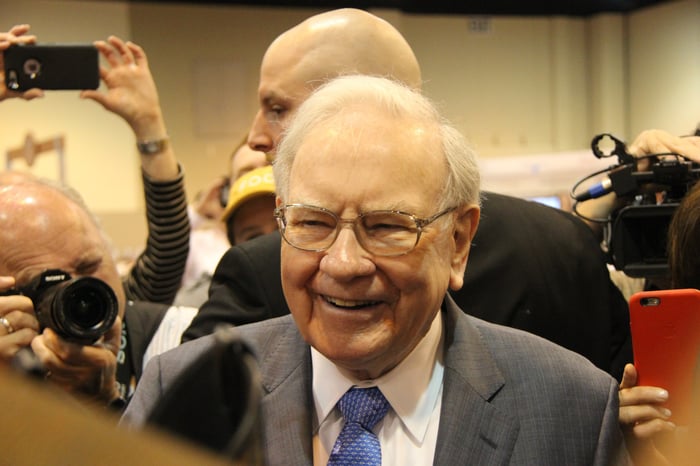
Image source: The Motley Fool.
A great index fund for investors of all experience levels
The S&P 500 is America's most widely followed stock market index because of its diverse composition, with 500 companies from 11 economic sectors represented. It is rebalanced quarterly, when stocks that no longer meet its strict criteria are removed and replaced with more suitable candidates.
To qualify for inclusion in the index, a company must be profitable, and it must have a market capitalization of at least $22.7 billion, among other things. But even after ticking all of those boxes, a special committee makes the final decision, which ensures only the highest quality companies make the cut.
The S&P 500 is weighted by market capitalization, meaning the most valuable companies in the index have a greater influence over its performance than the smallest. That's why information technology is the largest of the 11 sectors, with a weighting of 33.7% -- it's home to Nvidia, Apple, Microsoft, and Broadcom, which have a combined market cap of $13.5 trillion.
The next three largest S&P 500 sectors are as follows:
- Financials (13.5%), which includes companies like Berkshire Hathaway, JPMorgan Chase, and Visa.
- Consumer discretionary (10.6%), which is home to Amazon, Tesla, and McDonald's.
- Communication services (10.5%), which features Alphabet, Meta Platforms, and Netflix.
Healthcare, industrials, consumer staples, energy, utilities, materials, and real estate are the remaining seven sectors. So, although it's very top-heavy, the index is highly diversified.
The Vanguard S&P 500 ETF aims to maintain the same holdings with similar weightings to produce like-for-like performance, minus fees. Speaking of which, this is one of the cheapest index funds that investors will find. It has an expense ratio of 0.03%, which means an investment of $10,000 would incur an annual cost of just $3.
A stellar track record when it comes to building wealth
Investing is inherently risky, even when sufficiently diversified. Volatility is the price we pay for an opportunity to earn significant returns over the long run.
According to investment management firm Capital Group, the S&P 500 suffers a sell-off of at least 5% once per year, on average, and a correction of 10% or more every 2 1/2 years. Bear markets, which are defined by peak-to-trough declines of 20% or more, come around every six years or so.
But even after accounting for every sell-off, correction, and bear market since the S&P 500 was established in 1957, the index has still produced a compound annual return of 10.6%. That means a $10,000 investment 68 years ago would be worth $9.4 million today (assuming you reinvested all dividends).
Past performance isn't a guarantee of future results, but emerging industries like artificial intelligence (AI), robotics, autonomous driving, and even quantum computing have the potential to fuel significant returns in some of the most influential stocks in the S&P 500 from here, including Nvidia, Microsoft, Apple, Broadcom, and Alphabet. This could support continued upside in the index overall.
As long as investors think in decades rather than months or years, they are likely to be rewarded by taking Warren Buffett's advice and buying an index fund like the Vanguard S&P 500 ETF.
Should you buy stock in Vanguard S&P 500 ETF right now?
Before you buy stock in Vanguard S&P 500 ETF, consider this:
The Motley Fool Stock Advisor analyst team just identified what they believe are the 10 best stocks for investors to buy now… and Vanguard S&P 500 ETF wasn’t one of them. The 10 stocks that made the cut could produce monster returns in the coming years.
Consider when Netflix made this list on December 17, 2004... if you invested $1,000 at the time of our recommendation, you’d have $482,209!* Or when Nvidia made this list on April 15, 2005... if you invested $1,000 at the time of our recommendation, you’d have $1,133,548!*
Now, it’s worth noting Stock Advisor’s total average return is 968% — a market-crushing outperformance compared to 197% for the S&P 500. Don't miss the latest top 10 list, available with Stock Advisor, and join an investing community built by individual investors for individual investors.
See the 10 stocks »
*Stock Advisor returns as of January 14, 2026.
JPMorgan Chase is an advertising partner of Motley Fool Money. Anthony Di Pizio has no position in any of the stocks mentioned. The Motley Fool has positions in and recommends Alphabet, Amazon, Apple, Berkshire Hathaway, JPMorgan Chase, Meta Platforms, Microsoft, Netflix, Nvidia, Tesla, Vanguard S&P 500 ETF, and Visa. The Motley Fool recommends Broadcom and recommends the following options: long January 2026 $395 calls on Microsoft and short January 2026 $405 calls on Microsoft. The Motley Fool has a disclosure policy.
Recommended Articles


