


Hyundai and Boston Dynamics Push Humanoid Robots Forward
Key Points
Hyundai recently announced plans to build 30,000 robots per year.
The Atlas robot could start working in Hyundai factories as soon as 2028.
- These 10 stocks could mint the next wave of millionaires ›
Hyundai's Boston Dynamics made big news about robots at CES 2026. On Jan. 5, Boston Dynamics unveiled its fully electric humanoid robot called Atlas and said it will begin production immediately. The company said fleets are scheduled to ship to Hyundai's Robotics Metaplant Application Center (RMAC) and Google DeepMind in the coming months. Hyundai said it plans to put Atlas to work across its global network, including at its plant in Savannah, Georgia, starting in 2028.
Hyundai's stock price on Korean exchanges went up within a day of the announcement. Investors are excited by the possibility that Hyundai could be making a breakthrough in deploying AI humanoid robots in real-world settings.
Where to invest $1,000 right now? Our analyst team just revealed what they believe are the 10 best stocks to buy right now, when you join Stock Advisor. See the stocks »
But is the investor excitement about these robots warranted? Various companies have made big announcements in the past that "the robots are here," but their prognostications haven't always panned out.
Let's look at what makes Boston Dynamics' new Atlas humanoid robot so intriguing -- and why investors in robotics stocks might want to stay cautious.
Why Boston Dynamics' Atlas robot could be worth the hype
Robots in auto factories are nothing new. But Boston Dynamics' Atlas robot is special because it doesn't just look more like a human -- it might soon be able to replace or supplement the work of humans on the Hyundai factory assembly line.
Hyundai says the Atlas robot offers the following capabilities:
- Human-scale hands with tactile sensing
- Advanced rotational joints
- Ability to lift up to 110 pounds
- Ability to be taught tasks in under a day
- Autonomous operation with automatic battery replacement
- Ability to perform precision tasks and repetitive labor that humans would find exhausting
Hyundai plans to build 30,000 robots per year at a U.S. factory, and said it "expects humanoids to become the largest segment of the Physical AI market in the future and has set a goal to mass-produce the Atlas product model, deploying units at scale across industrial sites as production-ready humanoid robots."
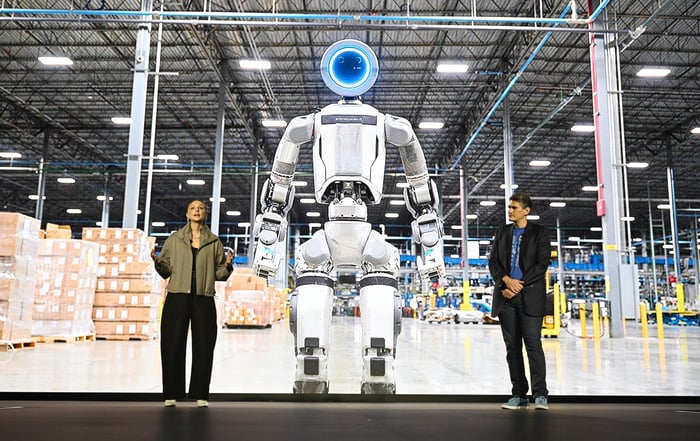
From left: Aya Durbin, humanoid application product lead at Boston Dynamics; an Atlast robot; Zachary Jackowski, vice president and general manager of Atlas at Boston Dynamics. Image source: Hyundai Motor Group.
Robots in the auto factory
Hyundai says that starting in 2028, "Atlas will be introduced on processes with proven safety and quality benefits, such as parts sequencing." The company intends to expand the robot's work applications to component assembly, and, "over time, Atlas will also take on tasks involving repetitive motions, heavy loads, and other complex operations -- ensuring safer working environments for factory employees."
If Hyundai can successfully build and deploy humanoid robots in its factories, this could also be good news for Toyota (which partners with Boston Dynamics on robotics research projects). Car companies could be the first big winners of the arrival of humanoid robots. But Boston Dynamics is also working on strategic partnerships with Nvidia and Google DeepMind from Alphabet.
Why investors should beware of robot hype
Humanoid robots are fascinating to watch, because they represent a dream of science fiction come to life. It's possible that Hyundai will crack the code on how to successfully build and deploy humanoid robots at scale in a way that boosts factory productivity.
But other companies have tried and failed to introduce useful, profitable robots. The recent history of humanoid robots has included a few overhyped failures and premature declarations of world-changing innovation.
In 2014, SoftBank launched a humanoid robot called Pepper that it intended to have interactive conversations with humans and provide customer service. But the robot was criticized for mechanical errors and failing at simple jobs. As of 2021, Pepper was no longer in production.
Another humanoid robot called NEO, made by start-up 1X, is intended to help with home chores. But journalists criticized the robot for failing to crack a walnut and needing 2 minutes to fold a sweater -- and the robot isn't autonomous; it's controlled by a human employee with a VR headset. NEO was rated as one of MIT Technology Review's worst technology flops of 2025.
Once-promising robot designs can disappoint and disappear. Samsung unveiled a round, yellow robot called Ballie in 2020. Although not a humanoid, Ballie was intended to be a robot home assistant that could adjust smart thermostats and lights, patrol the home, and project video onto walls. But six years later, the Ballie robot was not exhibited at CES 2026, and the company hasn't announced any plans to release it as a product.
Bloomberg's reporter at CES 2026 was skeptical of the humanoid robot demos they saw for home use -- saying it took a "painfully" long time to put one item of clothing into a washing machine -- but suggested that "deployment will accelerate more quickly in factories," where robots can learn repetitive tasks in a controlled, predictable environment.
We might not have sci-fi style robot housekeepers anytime soon, but research from Morgan Stanley forecasts that the humanoid robot market could reach $5 trillion and more than 1 billion humanoids deployed by 2050, with 90% used for commercial and industrial purposes. Morgan Stanley predicts that adoption of humanoid robots "should be relatively slow until the mid-2030s, accelerating in the late 2030s and 2040s."
Investors are understandably excited about robot technology, but the biggest payoffs might not happen for several years. Even if automakers and other manufacturing companies become the first companies to realize big gains from humanoids, it's best for investors to be patient. This complex and unpredictable technology could bring volatility and losses along the way.
Where to invest $1,000 right now
When our analyst team has a stock tip, it can pay to listen. After all, Stock Advisor’s total average return is 968%* — a market-crushing outperformance compared to 197% for the S&P 500.
They just revealed what they believe are the 10 best stocks for investors to buy right now, available when you join Stock Advisor.
See the stocks »
*Stock Advisor returns as of January 13, 2026.
Ben Gran has no positions in the stocks mentioned. The Motley Fool has positions in and recommends Alphabet and Nvidia. The Motley Fool has a disclosure policy.
Recommended Articles


