

At an 11-Year Low with a 4.9% Dividend Yield, Is This Value Stock a No-Brainer Buy for Passive Income in 2026?
Key Points
After a rough 2025, consumer staples stocks like Clorox are great buys for value investors seeking passive income.
Clorox has ripped off the proverbial bandage by guiding for weak results in its current fiscal year.
Clorox’s top brands and efficiency improvements will make it well positioned for a recovery in consumer spending.
- 10 stocks we like better than Clorox ›
Consumer staples was the worst-performing stock market sector in 2025, falling 1.2% compared to a 16.4% gain in the S&P 500 (SNPINDEX: ^GSPC). But Clorox (NYSE: CLX) lost 37.9% of its value.
Clorox's sell-off, paired with ongoing dividend raises, has pushed its yield to 4.9% at the time of this writing. Here's why Clorox is a no-brainer value stock for contrarian investors to buy in 2026.
Where to invest $1,000 right now? Our analyst team just revealed what they believe are the 10 best stocks to buy right now, when you join Stock Advisor. See the stocks »

Image source: Getty Images.
Clorox is nearing the finish line of a multiyear turnaround
Typically, a lot has to go wrong for a stock to underperform the broader market and its sector by such a wide margin. In the case of Clorox, its self-inflicted challenges clashed with broader sector slowdowns in consumer spending and cost pressures due to inflation and tariffs.
Clorox has been undergoing a multiyear turnaround, centered on maximizing the value of its top brands and enhancing internal processes and tools to reduce costs and increase margins.
Investor patience has been tested, as Clorox has been transparent about its current fiscal year being a transition period as it rolls out its new enterprise resource planning (ERP) system. Clorox's international operations, supply chain, finance, and data management were outdated, leaving the company vulnerable to a cyberattack in 2023. Updating these systems with a cloud-based platform should lead to improvements in efficiency.
But Clorox is setting near-term expectations very low. Its ERP transition led to abnormally large shipments to its retail partners at the end of fiscal 2025, which led to less demand at the start of fiscal 2026 (beginning July 1, 2025). Clorox expects full-year fiscal 2026 organic sales growth to decline by 5% to 9%, with a 7.5 basis point impact from the ERP transition. So organic sales are basically projected to be flat when taking out the impact of the transition. Similarly, earnings are expected to decline largely due to ERP transition impacts.

CLX data by YCharts
Given the weak expectations and Clorox's stock price hovering around an 11-year low, investors should focus on Clorox's direction over the next few years rather than its upcoming quarterly results.
Leveraging leading brands
The following management commentary is from Clorox's prepared remarks on its first-quarter fiscal 2026 earnings call.
Category growth rates have stabilized but remain below historical averages, while competitive intensity continues to be high as companies compete for share of wallet. Consumers remain under pressure, and this is driving value-seeking behaviors across all income segments.
With consumer spending under pressure, Clorox is delivering value to shoppers through smaller packaging to address affordability concerns, as well as bulk options with larger sizes for better value.
Clorox has several category-leading or near-category-leading brands that should help drive value as it adapts to changing consumer preferences and optimizes its internal processes. Clorox estimates that approximately 80% of its brands are either No. 1 or No. 2 in their respective categories. Aside from the flagship Clorox label, the company also owns top brands like Hidden Valley Ranch dressing, Pine-Sol cleaning products, Fresh Step cat litter, Glad bags and wraps, Brita, Burt's Bees, and more.
Clorox is a passive income powerhouse
After a period of self-induced blunders and a highly challenging operating environment, Clorox has the potential to return to a high-margin cash cow in the coming years. In the meantime, patient investors can benefit from Clorox's 4.9% dividend yield.
Last summer, Clorox raised its quarterly dividend to $1.24 per share -- marking the 48th consecutive annual increase. That puts Clorox on track to become a Dividend King by 2027. Dividend Kings are companies that have increased their dividends for at least 50 consecutive years. But very few Dividend Kings yield as much as Clorox, making it an appealing income stock to buy for investors looking to boost their passive income stream or supplement retirement income.
Despite languishing growth, Clorox's dividend is affordable, as earnings and free cash flow continue to exceed the dividend expense. Its balance sheet is in decent shape, with less than $3 billion in total net long-term debt and a financial debt-to-equity (D/E) ratio of 0.2.
Clorox is more leveraged than peers such as Kimberly Clark, Colgate-Palmolive, Church & Dwight, and Procter & Gamble by both D/E and debt to capital (D/C). Leverage ratios like D/E and D/C show how dependent a company is on debt financing, with lower ratios illustrating less reliance on debt to meet financial commitments.
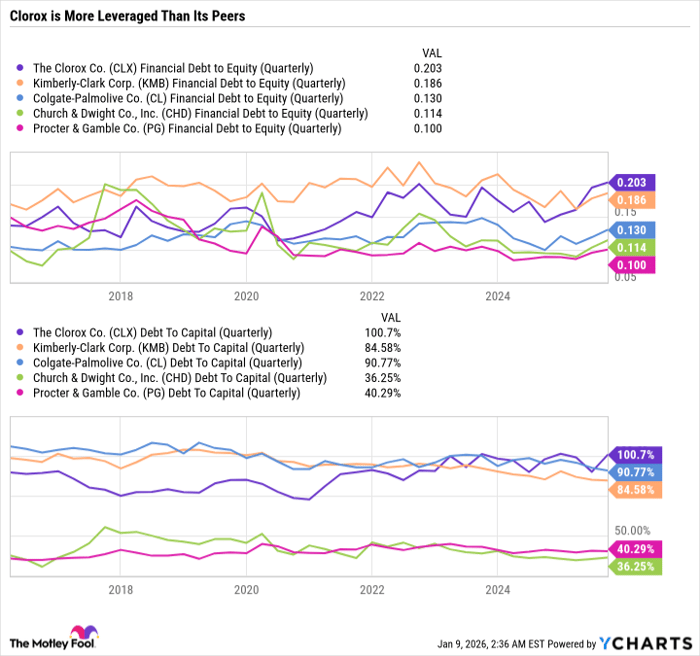
CLX Financial Debt to Equity (Quarterly) data by YCharts
A top high-yield dividend stock to buy in 2026
Clorox's results have been lackluster, and there's little hope for near-term improvement. However, patient investors with at least a three- to five-year time horizon may want to take a closer look at this high-yield stock.
Downturns are the perfect time to undertake complicated, costly, and often messy companywide rollouts -- which is exactly what Clorox did with its ERP transition, the sale of its Vitamins, Minerals, and Supplements businesses, and its divestment from Argentina, Uruguay, and Paraguay in calendar year 2024.
Investors looking for a lower-risk play in the household and personal care industry should take a closer look at Procter & Gamble, which yields 3% and is a higher-quality company. But Clorox has arguably the highest upside potential in the industry for investors who believe it will be well positioned to leverage its diverse product portfolio when consumer spending eventually picks up.
Should you buy stock in Clorox right now?
Before you buy stock in Clorox, consider this:
The Motley Fool Stock Advisor analyst team just identified what they believe are the 10 best stocks for investors to buy now… and Clorox wasn’t one of them. The 10 stocks that made the cut could produce monster returns in the coming years.
Consider when Netflix made this list on December 17, 2004... if you invested $1,000 at the time of our recommendation, you’d have $482,326!* Or when Nvidia made this list on April 15, 2005... if you invested $1,000 at the time of our recommendation, you’d have $1,133,015!*
Now, it’s worth noting Stock Advisor’s total average return is 968% — a market-crushing outperformance compared to 197% for the S&P 500. Don't miss the latest top 10 list, available with Stock Advisor, and join an investing community built by individual investors for individual investors.
See the 10 stocks »
*Stock Advisor returns as of January 11, 2026.
Daniel Foelber has positions in Kimberly Clark and Procter & Gamble and has the following options: short February 2026 $150 calls on Procter & Gamble. The Motley Fool has positions in and recommends Colgate-Palmolive. The Motley Fool has a disclosure policy.
Recommended Articles


