

Just in Time for 2026, Boeing Wins $12.8 Billion in 2 Big Defense Contracts
Key Points
Boeing won four big defense contracts in the final week of 2025.
The two biggest will see Boeing provide service for America's "doomsday planes," and sell up to 50 F-15s to Israel.
- 10 stocks we like better than Boeing ›
Dec. 31, 2025, is now in the history books. Why is this significant?
For defense investors, it's not so much the ending of a calendar year that's important, but the ending of a fiscal quarter. Because every time a quarter ends, there's a mad dash at the Pentagon to shovel out a last few spadefuls of cash, in the form of big-ticket defense contracts. It's a race against the clock (or the calendar) to ensure every last cent of funds already approved by Congress goes to the programs that need funding.
Where to invest $1,000 right now? Our analyst team just revealed what they believe are the 10 best stocks to buy right now, when you join Stock Advisor. See the stocks »
And for giant defense contractors like Boeing (NYSE: BA), it's a chance to cash in.
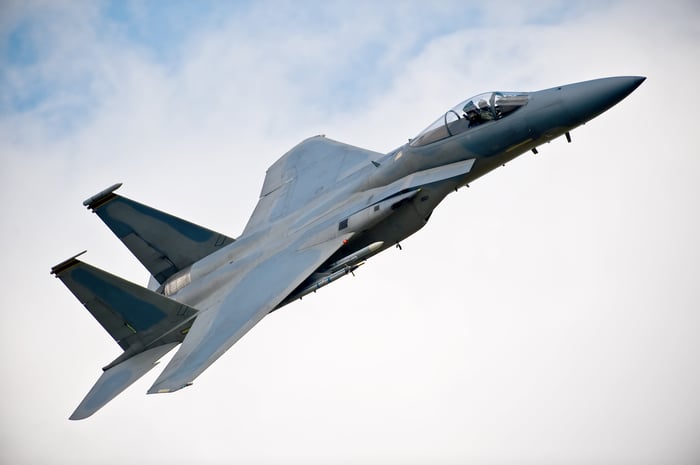
Image source: Getty Images.
$12.8 billion for Boeing -- or with luck, $17.5 billion
And boy, oh boy, did Boeing ever cash in last month. On Dec. 29, Boeing won each of the two biggest Pentagon contracts awarded. For $4.2 billion, Boeing was tasked with providing "E-4B contractor logistic service" to the U.S. Air Force in fiscal 2026 (which ends Sept. 30, 2026).
Then, for $8.6 billion, Boeing won an order to build and deliver at least 25 new F-15IA aircraft to the Israeli Air Force, with an option for 25 more. Seeing as $8.6 billion would imply an MSRP of $343 million per plane (which is quite a high price for a fourth-generation fighter jet), it's likely Boeing will only receive the full $8.6 billion if Israel exercises its option and buys all 50 F-15s. But even if it doesn't, even if Israel only takes the initial 25, that's still a $4.3 billion contract for Boeing, minimum -- and $8.5 billion total from the two contracts.
Not bad for a day's work.
(Just two days later, by the way, Boeing would win another $2.7 billion for "post-production support" on AH-64 Apache helicopters for the U.S. Army. Add in another $2 billion for a Dec. 23 contract for B-52 commercial engine replacement, and Boeing may have cleared as much as $17.5 billion in new revenue in just over a week.)
What does it mean for investors?
All four of these contracts, by the way, fall under the aegis of Boeing's Defense, Space, and Security (BDS) business. Combined, they add up to about 73% of all the revenue that business segment generated in all of 2024.
Why is this significant? Well, consider that while BDS has had its issues, notably with the Starliner spacecraft that it produces, which still isn't cleared for use in human spaceflight, BDS is at least profitable today.
It's not very profitable, earning less than a 2% operating profit margin through the three quarters of 2025 that have already been reported. Still, just being profitable at all is more than Boeing can say about its marquee commercial aircraft division, which continues to lose money at a rate of nearly $8.6 billion per year.
What else does this mean for investors?
Another fact worth highlighting for investors may be less immediately obvious. Re-read my description of those four contracts described above. What do you notice?
One thing you might notice is that only one of the four contracts (the F-15 sale) is actually a contract for Boeing to produce and sell aircraft. The other three are for (1) running logistics for E-4B airborne command centers, (2) support of Apache helicopters, and (3) replacing engines on B-52 bombers.
All three of these activities relate to services the aerospace company provides to its aircraft after they're sold. Money Boeing gets without having to win a hard-fought competition to make a sale to a customer. Money Boeing will get almost by default, by virtue of being the company that built the aircraft in the first place.
If you suspect revenue won in this manner might be just a wee bit more profitable for Boeing than the margins it makes when having to win a bidding war, well, you'd be right. According to data from S&P Global Market Intelligence, Boeing booked $15.7 billion in parts, maintenance, modifications, and logistics services under its global services business. This is the smallest of Boeing's business divisions -- but by far the most profitable, earning an operating margin of 18.6%.
All of which is to say: When researching Boeing, and deciding whether you might want to buy Boeing stock, don't necessarily ignore the big, headline-grabbing contract wins that Boeing announces. But do keep in mind:
Boeing doesn't make its money when it wins a contract. Boeing makes its money in the years after winning the contract. And that makes Boeing Global Services by far the most important business segment at Boeing.
Should you buy stock in Boeing right now?
Before you buy stock in Boeing, consider this:
The Motley Fool Stock Advisor analyst team just identified what they believe are the 10 best stocks for investors to buy now… and Boeing wasn’t one of them. The 10 stocks that made the cut could produce monster returns in the coming years.
Consider when Netflix made this list on December 17, 2004... if you invested $1,000 at the time of our recommendation, you’d have $488,222!* Or when Nvidia made this list on April 15, 2005... if you invested $1,000 at the time of our recommendation, you’d have $1,134,333!*
Now, it’s worth noting Stock Advisor’s total average return is 969% — a market-crushing outperformance compared to 196% for the S&P 500. Don't miss the latest top 10 list, available with Stock Advisor, and join an investing community built by individual investors for individual investors.
See the 10 stocks »
*Stock Advisor returns as of January 10, 2026.
Rich Smith has no position in any of the stocks mentioned. The Motley Fool has positions in and recommends Boeing and S&P Global. The Motley Fool has a disclosure policy.
Recommended Articles


