

Gravity After Prosperity: A Deep Dive into the Triple Core Risks and Strategic Inflection Points for the 2026 US Stock Market
After an epic three-year multi-year rally, the US stock market stands at an extremely delicate psychological and financial anchor. Rising from roughly 3,800 in early 2023, the S&P 500 not only bypassed the shadows of high inflation and tightening cycles but closed 2025 at a record high of 6,845, a cumulative gain of nearly 80%. Such a near-doubling of asset value is rare even in the history of US equities.
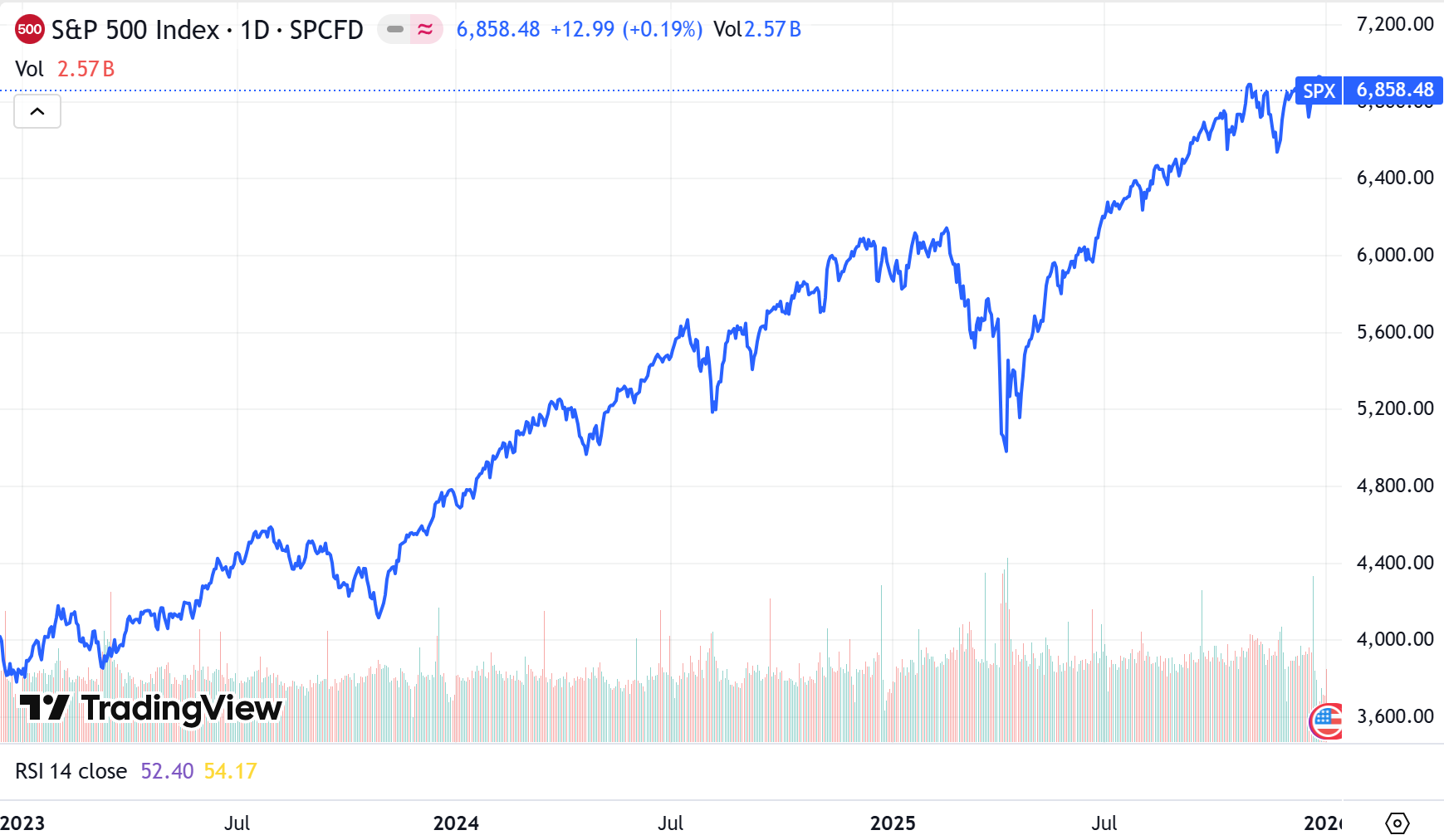
Source: TradingView
However, as major Wall Street investment banks raise their 2026 targets—with Oppenheimer calling for 8,100 and Goldman Sachs and J.P. Morgan generally projecting 10% to 15% upside—the "extreme optimism" of market consensus has itself evolved into a potential systemic risk.
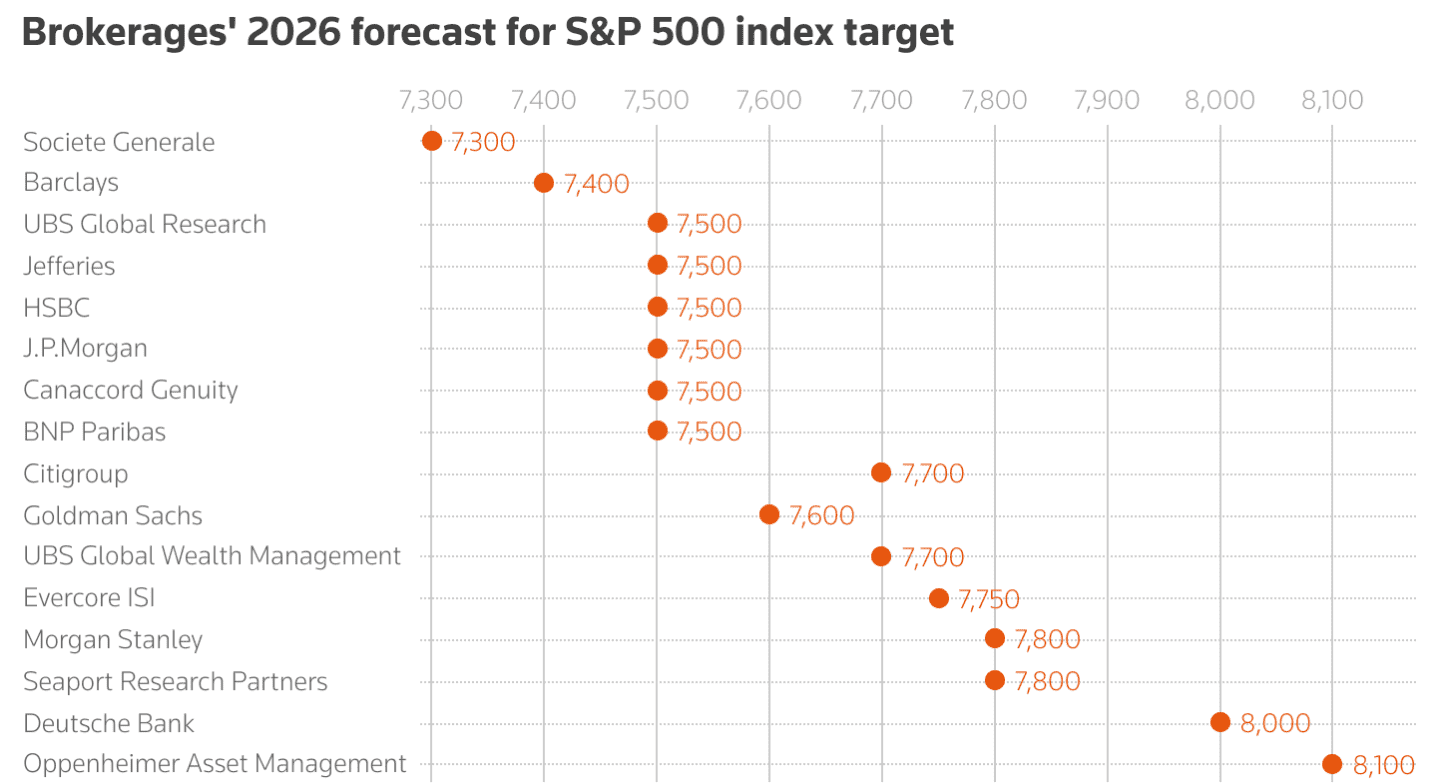
Source: Reuters
The core of this risk lies in the abrupt loss of the "margin for error." The prosperity logic of the past three years has evolved in two stages: 2023 to 2024 was driven by valuation expansion (multiple expansion) based on the AI vision, while 2025 marked the earnings realization phase where AI capital expenditures translated into actual earnings per share (EPS) growth.
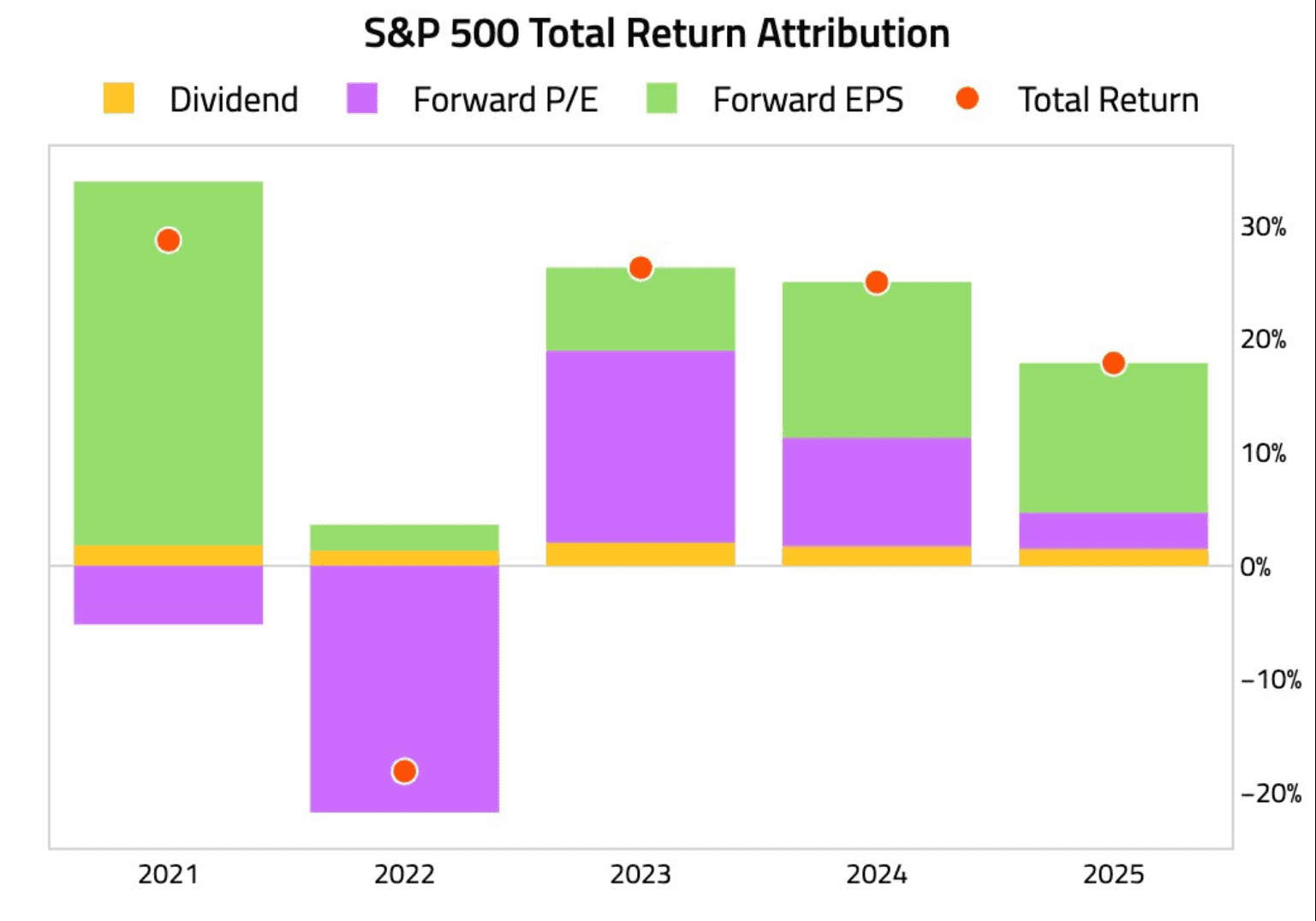
Source: The Daily Shot
Entering 2026, if the market is to reach the 8,000-point target set by investment banks without a pullback in valuation, earnings must maintain a growth rate of 15% to 20%. This is no longer a simple operational challenge but an extreme pressure test for corporate profit margins and productivity limits. This article will analyze the logical restructuring the 2026 US market may face from three dimensions: valuation mean reversion, the AI monetization cycle, and the physical bottlenecks of profit margins.
1. Valuation Gravity: Mean Reversion is an Inviolable Financial Law
In the non-linear volatility of financial markets, mean reversion is one of the few laws characterized by "physical gravity." According to the latest FactSet data, the forward P/E ratio of the S&P 500 has touched approximately 22x, far exceeding the 10-year average of 18.7x and significantly deviating from the 5-year average of 20x. When valuations break away from the "gravitational pull" of earnings support, stock prices transform into a pure psychological premium.
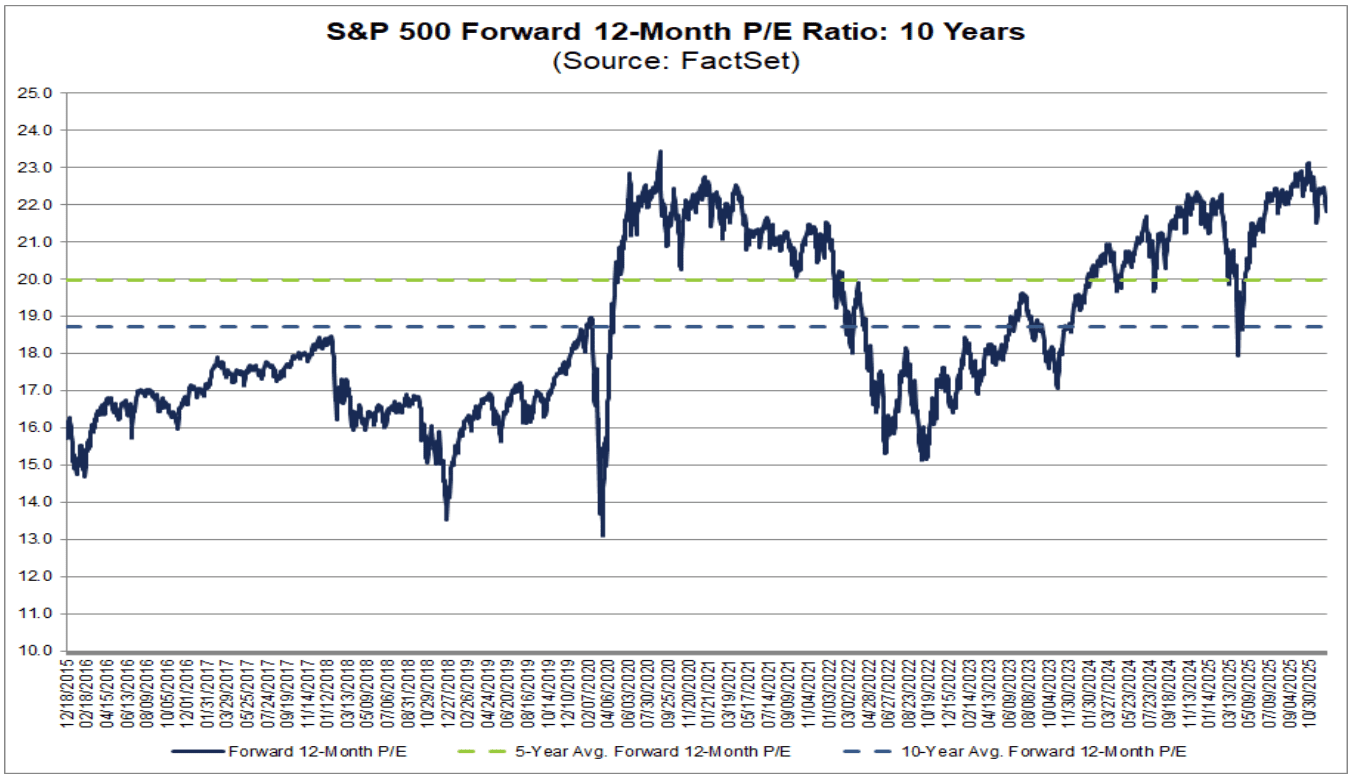
Source: FactSet
Behind these high valuations lies a fragile dependence on "perfect expectations." Historical experience shows that price is always the shadow of value; when the shadow runs too fast or strays too far, it must eventually pause for the body to catch up. The risk in 2026 is that a valuation correction often requires no catastrophic "black swan" event; merely "favorable news failing to exceed expectations" is enough to trigger profit-taking. The market is currently at an extremely sensitive percentile, a state similar to a rubber band stretched to its physical limit, with internal stress seeking a release point. Therefore, at the start of 2026, because current valuations have already front-run future growth, every point of upward movement faces heavy resistance, while a downward mean reversion aligns more closely with the market's endogenous dynamics.
2. AI Monetization’s "Judgment Day": Shifting from Narrative-Driven to Rigorous ROI Quantification
Since generative AI reshaped the tech sector in 2023, discussions regarding market risk perception have never ceased. However, the true risk often lies not in the widely watched "bubble burst," but in the cold transformation of market evaluation logic. Recalling the commercial real estate risk discussions of the past two to three years reveals a counter-intuitive phenomenon: when everyone is guarding against a risk, the risk is often hedged or absorbed in advance. In contrast, the real crisis facing the AI sector in 2026 is the erosion of investor patience and the paradigm shift from "selling the dream" to "calculating the math."
2026 will become the "Audit Year" for AI capital expenditures. Over the past three years, tech pioneers led by the "Magnificent Seven" have invested hundreds of billions of dollars in computing infrastructure (CAPEX), a move the market previously treated with high tolerance. But as we enter 2026, investors will not only focus on the growth rate of CAPEX but will scrutinize the Return on Investment (ROI) with a nearly cynical eye. This "extremely cautious" psychological state means the market is no longer satisfied with demo-level technical displays but requires evidence of AI’s substantive contribution to traditional business profit margins. If massive investments cannot translate into equivalent monetization logic on the balance sheet, or if the monetization of key "killer apps" is delayed, stock prices will face a severe downward shift in valuation multiples, regardless of the revolutionary nature of the technology.
3. The Physical Bottleneck of Profit Margins: The Squeezed Lemon and the Growth Ceiling
If valuation is the market’s psychological game and AI monetization is a future uncertainty, then the peaking of profit margins is a physical constraint on a company’s fundamental "blood-making" ability. Observing the net profit margin trends of the S&P 500 over the past 20 years shows that this indicator has a strong cyclical reversion characteristic. After the cost-cutting and efficiency gains of 2023 to 2025, the overall net profit margin of US equities is now approaching a historical peak.
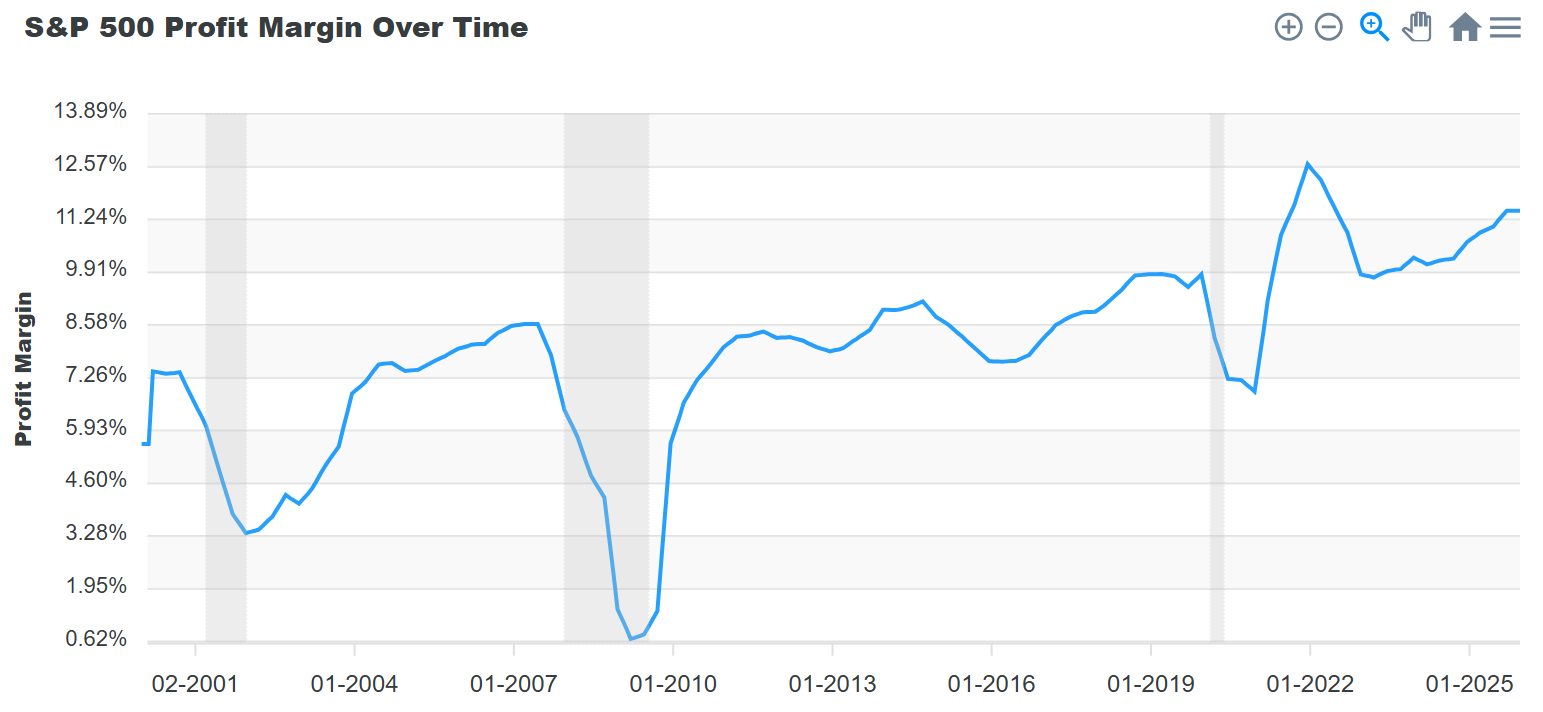
Source: DQYDJ
This expansion of profit margins over the past three years primarily relied on three "water-squeezing" methods: extreme supply chain optimization, the lagging dividend of low-interest debt, and the pricing power brought by an inflationary environment. However, this logic faces collapse in 2026. First, the pressure of rigid wage increases is offsetting some technical dividends. Second, in a "higher-for-longer" interest rate environment, the refinancing pressure of low-cost corporate debt is beginning to manifest substantively. When the profit margin "lemon" has been squeezed to its physical limit, the only way for companies to maintain the EPS growth expected by Wall Street is through a massive explosion in revenue. Yet, in an environment of low-gradient global economic recovery, a revenue breakthrough is far more difficult than cost-cutting. Once the profit margin curve begins to bend downward under the influence of cyclical gravity, the damage to the earnings elasticity of US equities could be significant.
Bull Case Analysis: Productivity Miracle and Probability Elasticity
Of course, while analyzing downside risks, we must reserve space for the possibility of a "productivity miracle." If AI not only achieves breakthroughs in the tech sector but truly penetrates traditional pillar industries such as manufacturing, law, and consulting by 2026, achieving a step-change in total factor productivity, then current profit margin ceilings and valuation caps will be shattered. In such a scenario, the explosiveness of earnings would completely offset the pressure of valuation reversion. However, J.P. Morgan still predicts an approximately 35% macro recession probability for 2026 in its latest outlook. In this context, rational investors should not bet entirely on a miracle but should realize that the market is entering a sensitive zone with a very low margin for error and extremely high volatility.
Conclusion
In summary, the 2026 US stock market is a high-wire balancing act. Under the intersection of gravitational mean reversion, monetization audits, and profit bottlenecks, the market's response to any negative signal will be multiplicative. For investors, the key to navigating a potential "deep squat" is understanding these underlying risks obscured by optimistic consensus and pre-positioning in defensive sectors such as consumer staples or low-sensitivity assets like US Treasuries. At the tail end of prosperity, maintaining reverence for financial laws will be more decisive for long-term investment success than merely chasing gains.
Recommended Articles


