

Is D-Wave Quantum Stock a Buy in 2026?
Key Points
Quantum computing stocks benefited from industry-wide tailwinds in 2025.
Can D-Wave Quantum set itself apart with its focus on quantum annealing?
- 10 stocks we like better than D-Wave Quantum ›
2025 is finally over, and it's an exciting time for technology investors as they ride the wave of new megatrends like generative artificial intelligence (AI) and quantum computing. With shares up by almost 200% over the last 12 months, D-Wave Quantum (NYSE: QBTS) has established itself as an early leader.
But can the boom continue in 2026? Let's dig deeper to see if the company's fundamentals live up to the hype.
Where to invest $1,000 right now? Our analyst team just revealed what they believe are the 10 best stocks to buy right now, when you join Stock Advisor. See the stocks »
Why did D-Wave Quantum's stock surge in 2025?
A rising tide tends to lift all boats in financial markets. This means good news for one company in an industry (or the industry as a whole) can inadvertently boost the stock price of similar companies.
Quantum computing's big break started in late 2024 when tech giant Google announced Willow -- a state-of-the-art quantum computing chip capable of correcting its own errors and solving a previously unsolvable problem. The news sent money pouring into the industry because investors believe it could be a sign that real-world commercialization could be on the horizon.
The industry also got a jolt in mid-October when rumors suggested the Trump administration may be considering equity positions in U.S. quantum stocks. These rumors turned out to be unsubstantiated. But investors should expect a high level of government support because of the geopolitically sensitive nature of quantum technology.
If it works, quantum computing could be used for military purposes like cracking encryption, and the Trump administration is eager to stay ahead of rivals like China. Support could come in the form of grants, device purchases, and executive action to reduce regulatory red tape.
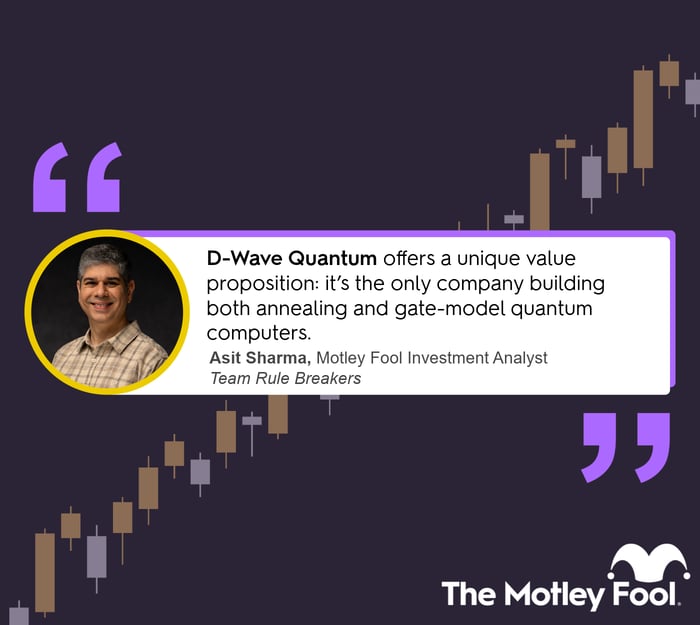
Image source: The Motley Fool.
Where does D-Wave Quantum fit in?
Most of D-Wave Quantum's 2025 rally can be attributed to industrywide factors outside its control. However, it does have some company-specific characteristics worth paying attention to. Unlike large rivals such as Google or International Business Machines, which pursue general-purpose gate-based quantum computing, D-Wave Quantum focuses on a subset of the technology called quantum annealing, which involves solving optimization problems -- or finding the lowest energy solution from a set of possible choices.
Quantum annealing could have potential use cases in tasks ranging from logistics (finding the most fuel-efficient delivery routes) to portfolio optimization and even generative AI model training. D-Wave plans to take a picks-and-shovels approach to the industry, where it sells pre-built quantum annealing devices, such as its flagship Advantage2 systems, for enterprise clients to integrate into their specific workloads.
The company is already seeing impressive operational momentum, with revenue jumping 100% year over year to $3.5 million as the company attracted customers in the public and private sectors. Notable private sector clients include an airline, a pharmaceutical company, and a semiconductor foundry. But it is unclear whether these purchases are for internal research or revenue-generating operations.
Investors should also note that despite the massive growth rate, D-Wave's third-quarter revenue is relatively small for a company with a market cap of $10 billion. Furthermore, cash burn remains alarming with an operating loss of $27.7 million in the third quarter alone. The good news is that with $836.2 million in cash and equivalents on its balance sheet, the company is in no immediate danger of running out of money.
Still, there seems to be no pathway to profitability any time soon.
Will D-Wave's rally continue in 2026?
There are plenty of potential catalysts for quantum industry hype in 2026, as the technology continues to improve and the Trump administration explores its legislative and executive options to ensure U.S. dominance. That said, with a price-to-sales (P/S) ratio of 383, D-Wave stock is costly compared to the S&P 500 average of just 3.4. Investors may want to wait on the sidelines until the hype translates into real shareholder value.
Should you buy stock in D-Wave Quantum right now?
Before you buy stock in D-Wave Quantum, consider this:
The Motley Fool Stock Advisor analyst team just identified what they believe are the 10 best stocks for investors to buy now… and D-Wave Quantum wasn’t one of them. The 10 stocks that made the cut could produce monster returns in the coming years.
Consider when Netflix made this list on December 17, 2004... if you invested $1,000 at the time of our recommendation, you’d have $493,290!* Or when Nvidia made this list on April 15, 2005... if you invested $1,000 at the time of our recommendation, you’d have $1,153,214!*
Now, it’s worth noting Stock Advisor’s total average return is 973% — a market-crushing outperformance compared to 195% for the S&P 500. Don't miss the latest top 10 list, available with Stock Advisor, and join an investing community built by individual investors for individual investors.
See the 10 stocks »
*Stock Advisor returns as of January 6, 2026.
Will Ebiefung has no position in any of the stocks mentioned. The Motley Fool has positions in and recommends Alphabet and International Business Machines. The Motley Fool has a disclosure policy.
Recommended Articles


