




How Good Has GE Aerospace Stock Actually Been?
Key Points
The growth in flight departures has pushed out the sales peak period for services of the company's legacy engines.
The easing of the supply chain crisis is creating long-term growth opportunities for the company.
- 10 stocks we like better than GE Aerospace ›
In its first full year as a stand-alone company, GE Aerospace (NYSE: GE) continued its fantastic run by appreciating almost 85% last year. It's a performance that underlines the company's critical importance to the aerospace industry and its long-term potential to generate streams of recurring income from servicing its commercial aerospace engines. Here's why GE Aerospace has been a standout performer in recent years.
Having great technology pays off
The company has come a long way since the dark days of 2018, when it was part of an industrial conglomerate, General Electric. While the former GE faced significant challenges in the decade leading up to 2018, one thing it always had was great technology. Indeed, the spinoffs, GE Healthcare and GE Vernova, are market leaders in imaging equipment and gas turbines, and GE Aerospace is the dominant player in commercial aerospace with 3 out of 4 commercial flights powered by GE or GE joint venture (CFM International) engines.
Where to invest $1,000 right now? Our analyst team just revealed what they believe are the 10 best stocks to buy right now. Continue »
Why GE Aerospace's stock outperformed
CFM International's LEAP engine is the sole engine on the Boeing 737 MAX and one of two options on the Airbus A320neo family of aircraft, which are the workhorses of the skies.
This dominant position, combined with the legacy CFM56 (which powers the legacy 737s and A320s), ensures a secure long-term stream of income from highly lucrative long-term services agreements signed at the sale of engines. It's essentially a razor-and-blade model, whereby engines are sold at a negative or small profit margin only to generate service revenue, which can span over four decades, as engines tend to be used over a long-term period.

Image source: Getty Images.
Why the business model has served GE Aerospace well
In a nutshell, the recovery in flight departures has led to strong growth in service demand, resulting in better-than-expected service revenue on the legacy CFM56, particularly as LEAP engine delivery growth has been slower than expected due to supply chain issues. It's a somewhat unfortunate situation for airlines that want new, more efficient planes and engines, but the reality is that they will often run older planes and engines (which often require more servicing) if the routes are commercially profitable.
How GE Aerospace is set up for 2026
The good news is that the supply chain issues, notably material part availability, are easing significantly, which is making it easier for GE to ramp up LEAP deliveries and deliver on soaring commercial engine and services (CES) order growth.
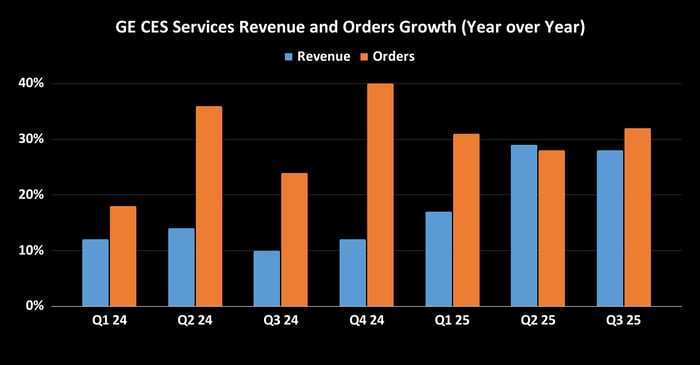
Data source: GE Aerospace presentations. Chart by author.
As such, management believes it's heading for annual revenue growth in the double-digit percentage range from 2025 to 2028, with earnings per share rising from about $6.10 in 2025 to $8.40 in 2028.
Moreover, growth in services revenue on the LEAP engine is starting to take hold, even as CFM56 services revenue remains robust. The ramp-up in LEAP deliveries (likely to be a negative for margins in the near term) will lead to the penciling in of increased estimates for long-term earnings growth.
All told, the stock's outperformance speaks to the importance of maintaining a long-term perspective in investing, particularly when the company being invested in has a dominant market position and a favorable business model.
Should you buy stock in GE Aerospace right now?
Before you buy stock in GE Aerospace, consider this:
The Motley Fool Stock Advisor analyst team just identified what they believe are the 10 best stocks for investors to buy now… and GE Aerospace wasn’t one of them. The 10 stocks that made the cut could produce monster returns in the coming years.
Consider when Netflix made this list on December 17, 2004... if you invested $1,000 at the time of our recommendation, you’d have $490,703!* Or when Nvidia made this list on April 15, 2005... if you invested $1,000 at the time of our recommendation, you’d have $1,157,689!*
Now, it’s worth noting Stock Advisor’s total average return is 966% — a market-crushing outperformance compared to 194% for the S&P 500. Don't miss the latest top 10 list, available with Stock Advisor, and join an investing community built by individual investors for individual investors.
See the 10 stocks »
*Stock Advisor returns as of January 4, 2026.
Lee Samaha has no position in any of the stocks mentioned. The Motley Fool has positions in and recommends Boeing, GE Aerospace, and GE HealthCare Technologies. The Motley Fool recommends Ge Vernova. The Motley Fool has a disclosure policy.
Recommended Articles


